
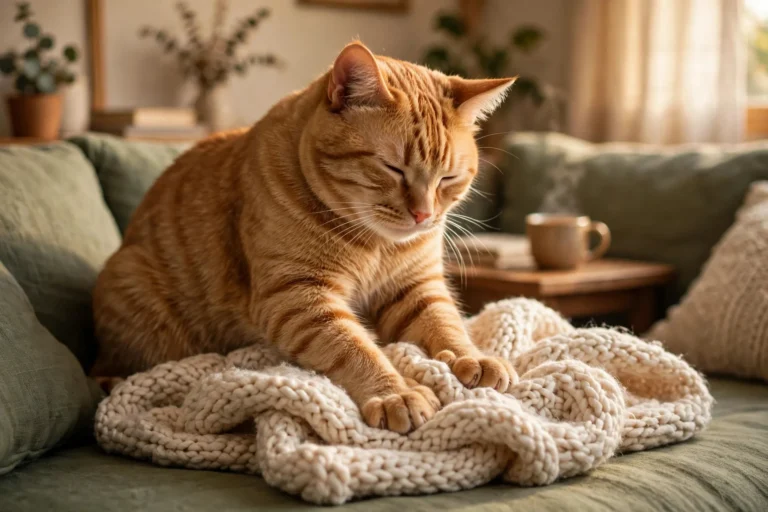
Cats knead and purr together because both habits trace back to kittenhood, and both usually signal comfort. A cat that presses its paws into your lap in a slow rhythm while its throat hums is, most of the time, a relaxed cat. That pairing raises the question behind this guide: why do cats knead and purr at the same time, and what does it mean when the answer changes?
Purring can show up when a cat hurts. Kneading can show up when a cat feels nervous. Meowing, the third sound in the set, works differently again, since adult cats aim it mostly at people, not at other cats. This guide untangles all three, so you can tell a happy ritual from a call for help.
Why do cats knead and purr at the same time?
Start with the simplest version. Kittens knead their mother to get milk flowing, and they purr while they nurse. Your adult cat kept both habits because they worked, and now your lap plays the role of a warm, safe place that sometimes produces food.
The two habits share a job. Kneading presses scent from glands in the paw pads onto a surface, which marks it as familiar. Purring comes from rhythmic signals the brain sends to the muscles around the voice box, and the vocal cords vibrate while the cat breathes in and out. A cat can purr without stopping to take a breath, which is why the sound runs on and on like a small engine that forgot how to switch off.
Put them together and you get a self-soothing ritual. The cat picks a soft spot, presses its paws in an alternating rhythm, and starts the motor.
Vets and behaviourists read this combination as contentment in most cases, especially when the cat looks loose and sleepy, with slow blinks and ears in a neutral position. Context does the rest of the talking. A cat kneading your chest at bedtime is settling in. The same cat kneading a vet exam table is probably trying to calm itself down.
Your lap is, in your cat’s view, a heated blanket that occasionally opens the fridge. That is a compliment, even when the claws come out.
Cats often knead right before sleep, and the ritual can run for a few minutes before they curl up and drift off. If your cat sleeps most of the day and you wonder what counts as normal, our guide on why cats sleep so much lays out the usual hours and the warning signs that mean something changed.
Kneading started before your cat met you
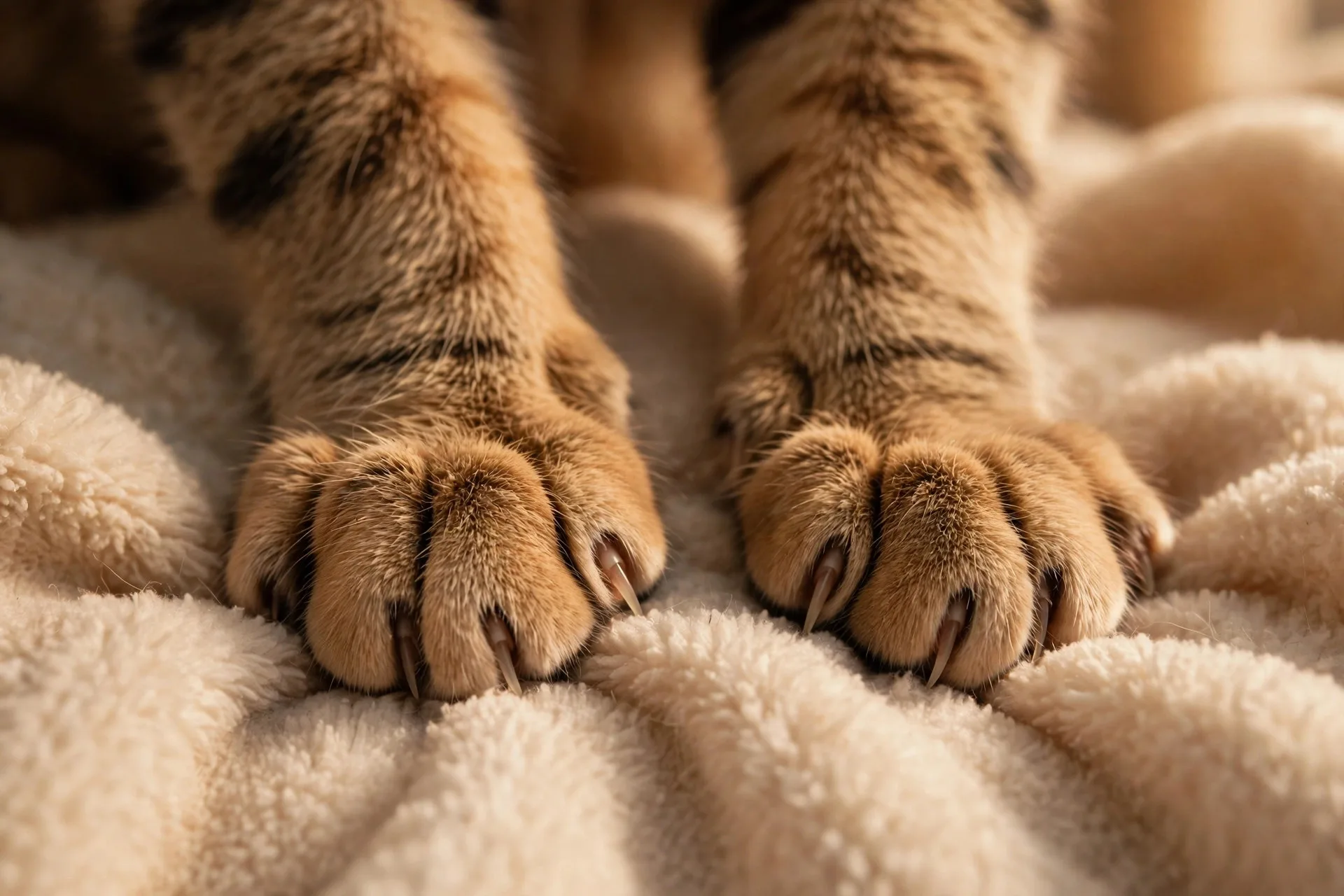
Kneading begins in the first days of life. A newborn kitten pushes its paws against its mother in a steady rhythm, and that pressure helps milk flow. Kittens that nurse well grow into adults that knead, and the habit sticks because it pairs with warmth and food from the very start. It is one of the few behaviours a cat carries unchanged from kittenhood into old age.
Wild ancestors may have kneaded for a different reason. Behaviourists suggest cats once patted down tall grass and leaves to make a sleeping spot, and the motion survived long after the grass disappeared. Nobody can watch a wild ancestor to confirm it, so treat that idea as a likely story rather than a proven fact.
Kneading also marks territory in a quiet way. Scent glands between the toes leave a trace on blankets and laps, plus favourite chairs, and that trace tells other cats that this spot already belongs to someone. Some cats knead only soft things. Others knead anything, including your stomach at 5 a.m.
Some drool while they knead. A few suckle fabric as well, and vets see that more often in Oriental breeds and in cats taken from their mothers very young. None of that points to a problem on its own. It points to a cat running an old program that still feels good.
Purring is not a happiness meter
Here is where the simple story gets complicated. A cat can purr while it feels content, while it feels scared, while it hurts, and while it gives birth. Mother cats purr through labour. Sick cats purr in the vet waiting room.
Cats near the end of life sometimes purr too. So purring tracks arousal and self-soothing as much as it tracks joy, and a purr on its own tells you less than a purr plus the rest of the cat.
The sound itself runs at a frequency researchers usually place between 25 and 150 hertz. That range has produced a lively disagreement. Some writers claim purring promotes healing because similar frequencies show up in vibration therapy for human bones and tissue. Other vets and researchers push back, and they point out that no clinical trial has shown a cat’s purr healing a cat.
The honest position sits between the two camps. The frequency numbers come from real measurements. The healing claim runs ahead of the evidence. Until someone tests it properly, treat purring as comfort, not medicine.
Kittens give purring its most practical job. They arrive blind and deaf, and they find their mother partly by feeling the vibrations of her purr. The mother purrs as a signal, and the kittens purr back once they learn how, at only a few days old. That early link between purring and closeness explains why so many adult cats purr when they sit with a person they trust.
So read the whole cat. A purring cat with a relaxed body and slow blinks is enjoying itself. A purring cat that hides, flattens its ears, refuses food, or guards one part of its body may be asking for help in the only voice it has.
Meowing is mostly for you
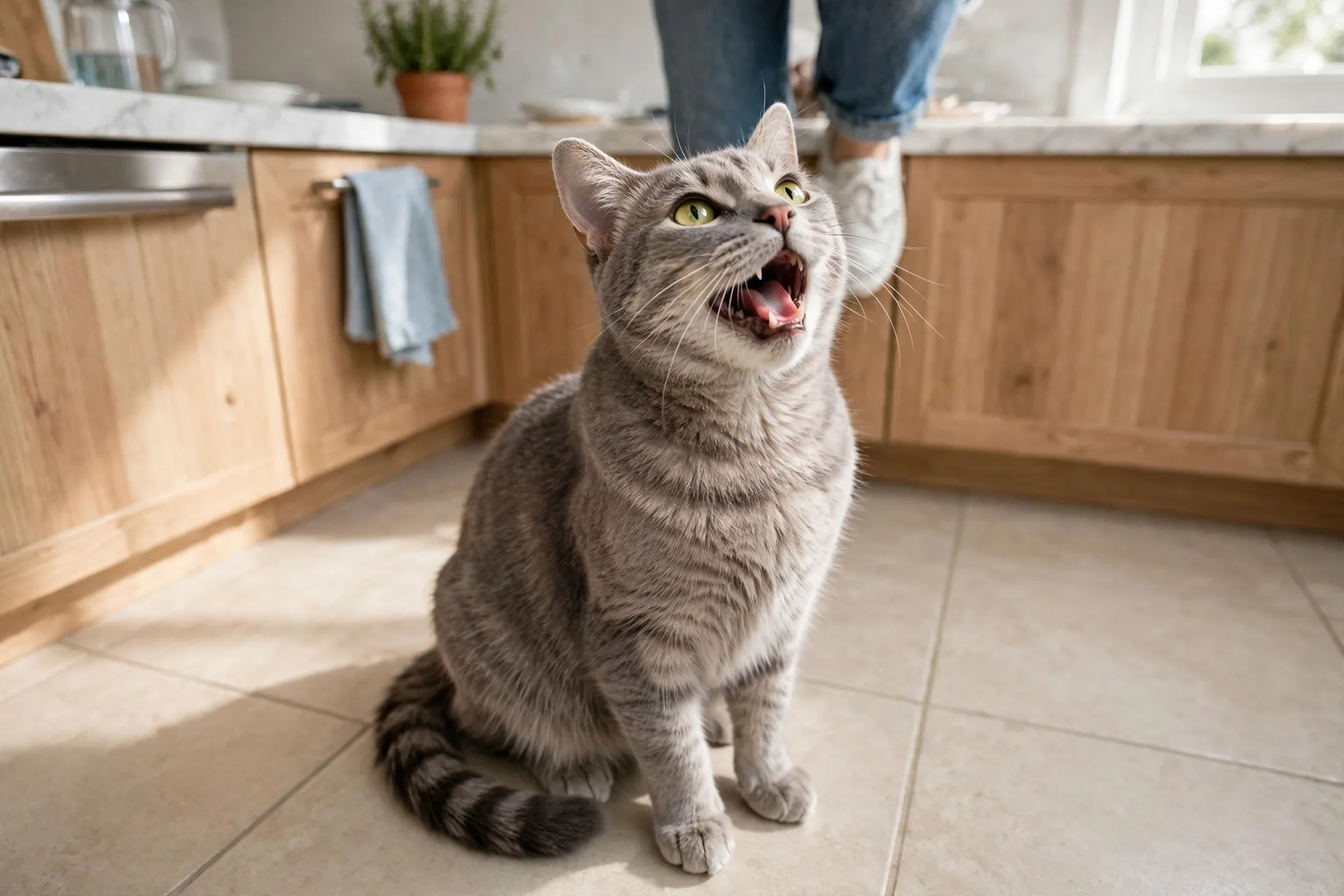
Adult cats rarely meow at each other. They use posture and scent to settle things between themselves, and they hiss and growl when that fails. Meowing belongs mostly to kittens calling their mothers, and to adult cats talking to people. Somewhere along the way, cats learned that humans respond to sound, and they built a small vocabulary out of it.
That vocabulary varies by cat, and owners usually learn it faster than any outsider. A short chirp often works as a greeting. A drawn out yowl often means frustration, a closed door, or a cat in heat. Chattering at a bird through a window looks like excitement mixed with irritation, and nobody has settled what the cat hopes to achieve by it.
Cats also adjust. A meow that earns dinner gets used again. A meow that earns nothing fades away. Your cat has trained you at least as much as you have trained your cat.
Some breeds talk more than others. Ragdoll cats tend toward soft, musical voices and use them often, which surprises first-time owners who expected a quiet lap cat. Kittens meow more than adults too, especially in the first nights in a new home, when everything smells strange and the humans keep leaving the room. Our new kitten checklist covers how to set up those first nights so the crying settles faster.
A cat that never meows is not broken. Quiet cats exist, and some cats communicate almost entirely through body language. A silent cat that eats well and seeks you out is a healthy cat with a different style.
When the sounds change, pay attention
Healthy habits turn into warning signs when they change. The change matters more than the habit itself, so watch for breaks in the pattern rather than single events.
Call your vet if purring shows up with hiding, appetite loss, limping, or flinching when you touch one spot. Those pairings point to pain or illness more often than a purr alone ever could. Call too if kneading stops all at once in a cat that always kneaded, or if kneading turns frantic and constant in a cat that seems restless and unable to settle. Sudden silence from a chatty cat deserves the same attention as sudden noise from a quiet one.
Night yowling in a senior cat deserves a special note. Older cats sometimes cry at night because of confusion, high blood pressure, thyroid trouble, or pain. Vets can test for several of those causes in one visit.
A senior cat that starts wailing at 3 a.m. is not trying to ruin your sleep. Something in its body or its mind has shifted, and it needs a check. You can read about typical lifespans and the changes age brings in our guide to how long cats live.
Keep a simple record before the visit. Note when the change started, what else changed at the same time, and whether eating and litter habits changed too. Vets work faster with a short timeline than with a vague feeling, and your notes give them one.
If the kneading hurts, give your cat a better target
Claws make kneading less fun for the person underneath. A thick folded blanket on your lap takes the edge off, and most cats accept the blanket as part of the ritual within a few days. Trim the front claws carefully, or ask your vet or a groomer to show you how, since a bad cut hurts and bleeds.
Never punish a cat for kneading. The cat means no harm. It is doing the thing that has comforted it since birth, and punishment only teaches it to fear the lap.
Redirect instead of scolding. Put the blanket where the paws land, keep your voice calm, and let the ritual run its course.
FAQ
Why does my cat knead me and purr at the same time?
Your cat links both habits to kittenhood, when kneading brought milk and purring meant closeness with its mother. Together they form a comfort ritual, and a relaxed body with slow blinks confirms the cat feels safe.
Do cats purr when they are in pain?
Yes, cats purr when they hurt, when they feel frightened, and during labour, as well as when they feel content. Vets read purring as self-soothing, so check the rest of the body for hiding, appetite loss, or flinching before you decide the cat feels fine.
Why does my cat meow at me so much?
Cats aim most meowing at people because humans respond to sound. Your cat learned which meows earn food, attention, or an open door, and it repeats the ones that work. A sudden increase still deserves a vet check, especially in a senior cat.
Should I stop my cat from kneading?
No, kneading is normal and comforting, so redirect it rather than stopping it. Put a thick blanket on your lap, keep the claws trimmed, and let the cat finish its ritual.
Sources
- Cornell Feline Health Center explains how cats purr and what the sound can mean: 1243 Cat Purr
- VCA Animal Hospitals, Why do cats knead?: True Or False Do Cats Knead
- International Cat Care, Why do cats..?: Why Do Cats Knead
- PetMD, Why Do Cats Knead?: Why Do Cats Knead