
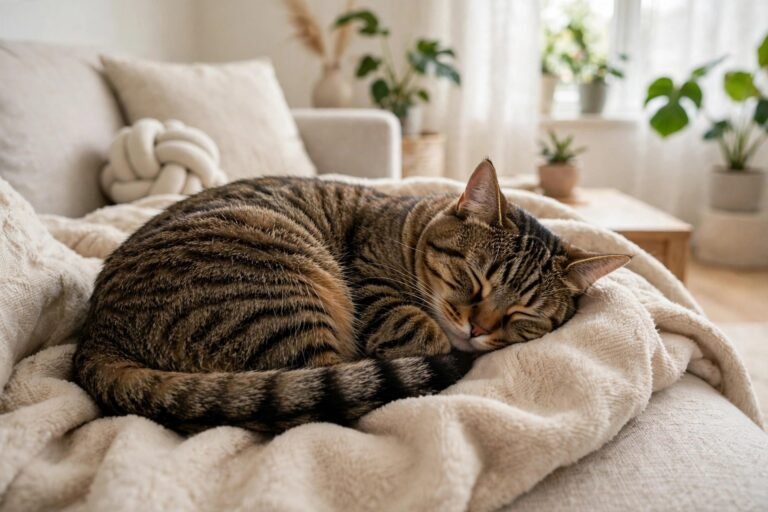
A healthy adult cat sleeps 12 to 16 hours a day. That is half the day gone, and some cats push past it. Kittens and senior cats sleep up to 20 hours.
So why do cats sleep so much, and when does a long nap stop being normal? The short version is that your cat is built for short bursts of hard work and long stretches of recovery, and most of that sleep is light dozing rather than deep sleep.
Your cat runs a different schedule from yours, and it has run that schedule since long before cats moved indoors.
How many hours do cats sleep
The core range for a healthy adult cat is 12 to 16 hours a day. Purina puts the average at 13 to 16 hours, and PetMD uses 12 to 16 hours as its normal range.
Other sources stretch the top end. Litter-Robot gives an average of 15 hours with some cats reaching 20, and Rover gives 15 to 20 hours as its headline range. Treat 12 to 16 as the core range for an adult, and 20 as the far end for a cat that is very young, very old, or having a quiet day.
Age moves the number more than anything else. Kittens sleep the most. Purina says roughly 90 percent of kittenhood is spent snoozing, because the brain and central nervous system are still developing, and sleep strengthens muscles and bones and keeps the immune system working.
A kitten that plays hard for twenty minutes and then crashes for two hours is doing exactly what a kitten should do. Adults settle into the steadiest pattern, around 12 to 16 hours spread across many naps.
Adolescent cats are the exception. Litter-Robot notes they have the most erratic sleep of all, with intense play mixed with irregular sleep, which fits any owner who has lived with a teenage cat.
Senior cats sleep more again, usually up to 20 hours a day. Purina says older cats tire more quickly, the same way older people do. A senior cat should still wake up alert and eat between naps. If the extra sleep arrived suddenly, Purina says to seek advice from a vet.
Breed plays a smaller part. A calm breed sleeps more than a restless one. Our ragdoll cat breed guide describes a cat that follows its owner around the house and then flops down for a long rest, and that pattern fits the breed.
Weather and boredom shift the total too. Rover notes that cats sleep more in cold weather to stay warm, and more in hot weather to avoid the heat. An indoor cat with nothing to do will sleep through the empty hours.
That is a hint, rather than a health problem on its own. A cat that sleeps because the house offers nothing else needs play, a window perch, and a puzzle feeder before it needs a vet.
Why do cats sleep so much: the hunting answer
Cats are predators built for short, expensive bursts of effort. Purina explains that hunting demands a huge amount of energy. Stalking and pouncing burn fuel fast, and wild cats hunt and then sleep for extended periods.
Your cat does the same thing with a toy mouse. The chase lasts minutes. The recovery lasts hours.
Sleep is how a cat pays back a body built for sprinting. A cat that spent ten minutes tearing around the living room at full speed has earned a long nap in the same way a sprinter earns a rest after a race.
Sleep also keeps the body cool. Rover points to the house cat’s desert ancestors and notes that scientists say sleeping helps cool a cat’s body and brain temperature. Midday is the hottest part of the day, and a cat that sleeps through it is doing what its ancestors did.
There is a second reason, and it is less flattering. A cat is also prey. Staying in light sleep lets it rest while keeping one ear on the room.
That is why so much cat sleep looks half awake. It is.
Your cat is crepuscular, not nocturnal
This is the fact most new owners get wrong. Cats are crepuscular, which means they are most active at dawn and dusk. PetMD states it plainly: cats are crepuscular, and they are naturally most active at dawn and dusk.
The timing comes from prey. Birds and mice are most active at dawn and dusk, so cats evolved to hunt then. Twilight also protects a cat from larger animals that hunt in full daylight or full dark. Purina adds that a cat’s eyes are adapted for low light, so it can see movement clearly when the light is fading.
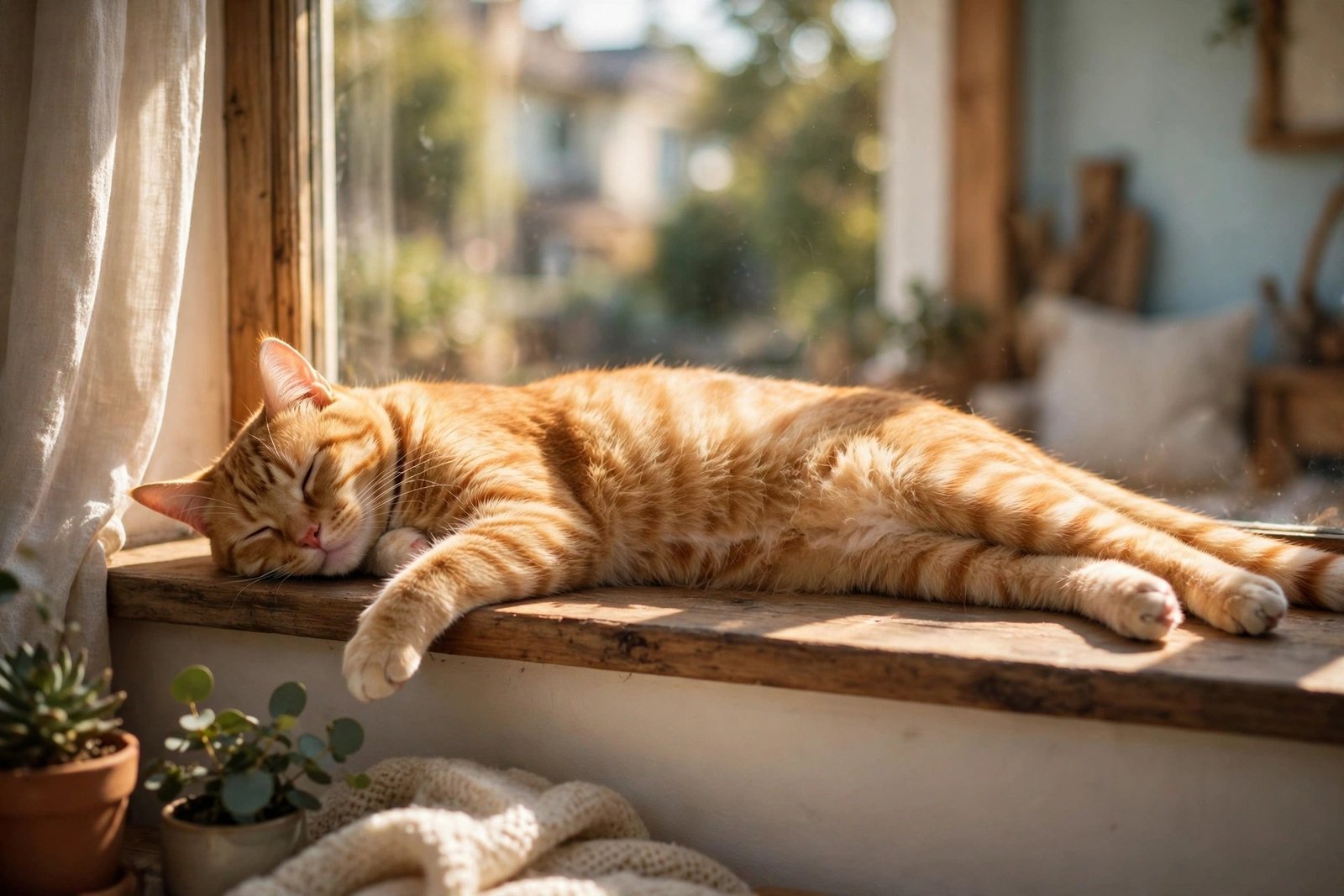
That schedule explains the 5 a.m. wake up call. Your cat is at peak hunting time, and breakfast is part of the hunt. Many cats do adapt to sleeping through the night like their owners, Purina says, but the dawn demand for breakfast stays.
If your cat keeps you up at night, look at the day first. PetMD notes that cats sleep about 18 hours a day spread over naps that average 78 minutes each, which leaves plenty of waking hours. A cat that slept all day will be ready to play at midnight.
A play session in the evening, followed by a small snack, uses up that energy before bed. Our guide on what can cats eat covers which treats are safe for that bedtime snack.
Resetting the 5 a.m. wake-up call
The 5 a.m. wake-up call is the most common sleep complaint in the guide, and the article names it without giving a reset plan. Here is the plan, in order, and it takes about two weeks of consistency to work.
Step one is the evening. Play with your cat in the evening, hard enough that it is genuinely tired, not just mildly interested. A feather wand or a toy that moves like prey works better than a toy that sits still. End the play session with a small meal or snack, so the cat’s body gets the hunt, catch, eat, groom, sleep sequence it is built for.
Step two is the night itself. Feed the last meal late, close the bedroom door if the cat wakes you by walking on you, and make the house dark and quiet. A blackout curtain helps if street light comes through the window, and a timed feeder set for just before dawn can give the cat breakfast without teaching it that waking you is how breakfast arrives.
Step three is the hardest part, and it is yours. When the cat wakes you at 5 a.m., do nothing. Do not feed it, do not play, do not talk to it. Any response, even a grumble, teaches the cat that 5 a.m. works. The first few mornings will be louder, because the cat will try harder before it gives up. That is normal. If you hold the line for a week, most cats shift their wake-up later, and the ones that do not are telling you something worth a vet visit. Check the snack is safe first in our guide to what cats can eat.
Light dozing and the twitch
Cat sleep patterns are not one long stretch. Cats are polyphasic sleepers, which means they take many short naps through the day and night instead of one long sleep. Rover says their naps last about 15 to 20 minutes per cycle, with deep REM sleep lasting around five minutes.
Purina gives a similar split. Light sleep lasts fifteen minutes to half an hour, while deeper sleep lasts about five minutes at a time. During light sleep, the ears stay erect and respond to sounds, the tail may move, and one eye can sit half open. The cat looks asleep and is ready to move in a second.
Deep sleep looks different. The posture relaxes, including the ears, and you may see twitching or paws paddling the air. That is the dreaming part, and it is short. A cat cycles back to light sleep quickly, which is one reason the total hours add up so fast.
A cat that sleeps 15 hours has spent most of it dozing, rather than in deep sleep. Let the nap finish. Litter-Robot advises against waking a cat from sleep, since sleep restores the body and the immune system, and kittens in particular need it to build muscle and bone.
Sleep positions and what they mean
A cat’s sleeping position is a small report on how safe and warm it feels, and it changes through the day. The loaf, paws tucked under the body and tail wrapped round, is the resting position. The cat is warm, alert enough to move fast, and not yet in deep sleep. A cat that loafs in the middle of the room trusts the room.
Curled up tight, nose to tail, is the warmth position. The cat is saving heat, which is why it appears on cold days and in drafty rooms. A cat that always sleeps curled tight may be telling you the room is cold, and a warmer bed in a warmer spot is a cheap fix.
Belly up, paws in the air, is the trust position. A cat only shows its belly when it feels safe, because the belly is the most vulnerable part. It does not mean the cat wants a belly rub. It means the cat feels safe enough to sleep unguarded, and the right response is to leave it alone.
Stretched out long, on its side, is the deep sleep position. The cat is cool, comfortable, and in the deepest part of its sleep cycle, which is when the twitching and dreaming the guide describes usually happens. A cat that never stretches out may be cold, stiff, or in pain, and that is worth noting at the next vet visit.
Is my cat sleeping too much
More sleep alone is a poor test. The question to ask is whether the sleep changed. A cat that has always slept 16 hours and still greets you and plays is fine. A cat that slept 12 hours last month and now sleeps 19, and skips meals, needs attention.
PetMD draws the line clearly. Lethargy is an abnormal drop in activity and alertness, and it differs from tiredness. Tiredness passes after rest. Lethargy stays until the underlying problem is addressed.
A lethargic cat sleeps more, grooms less, withdraws from normal activities, and may avoid jumping onto a favorite spot.
Watch for the cluster, rather than one sign. Litter-Robot lists the companions to extra sleep: eating less, drinking more, trouble urinating or with bowel movements, or sudden aggression. Rover adds hiding, loss of appetite, and sleeping in strange places.
One of these on its own can mean a bad day. Two or three together mean a vet visit.
Some causes are ordinary. A cat may sleep more for a day or two after a vaccination, PetMD notes. Cold weather, a quiet house, and a recent move can all add naps. Pain does the same.
Rover notes that cats with arthritis move less and sleep more because moving hurts, and overweight cats sleep more because carrying the extra weight tires them.
Call the vet promptly if the change is sudden, if the cat sleeps more than 20 hours a day, or if extra sleep comes with not eating, not drinking, vomiting, diarrhea, difficulty breathing, or hiding. PetMD says to contact a vet immediately if lethargy is sudden or extreme, or comes with difficulty breathing or severe vomiting or diarrhea.
For senior cats, the bar is lower. Rover notes that trouble sleeping or calming down at night in an older cat can signal feline cognitive dysfunction, and Purina says a sudden change in a senior cat’s sleep deserves vet advice. An older cat that sleeps more gradually is normal. An older cat that changes overnight is a different matter.
Helping an older cat sleep comfortably
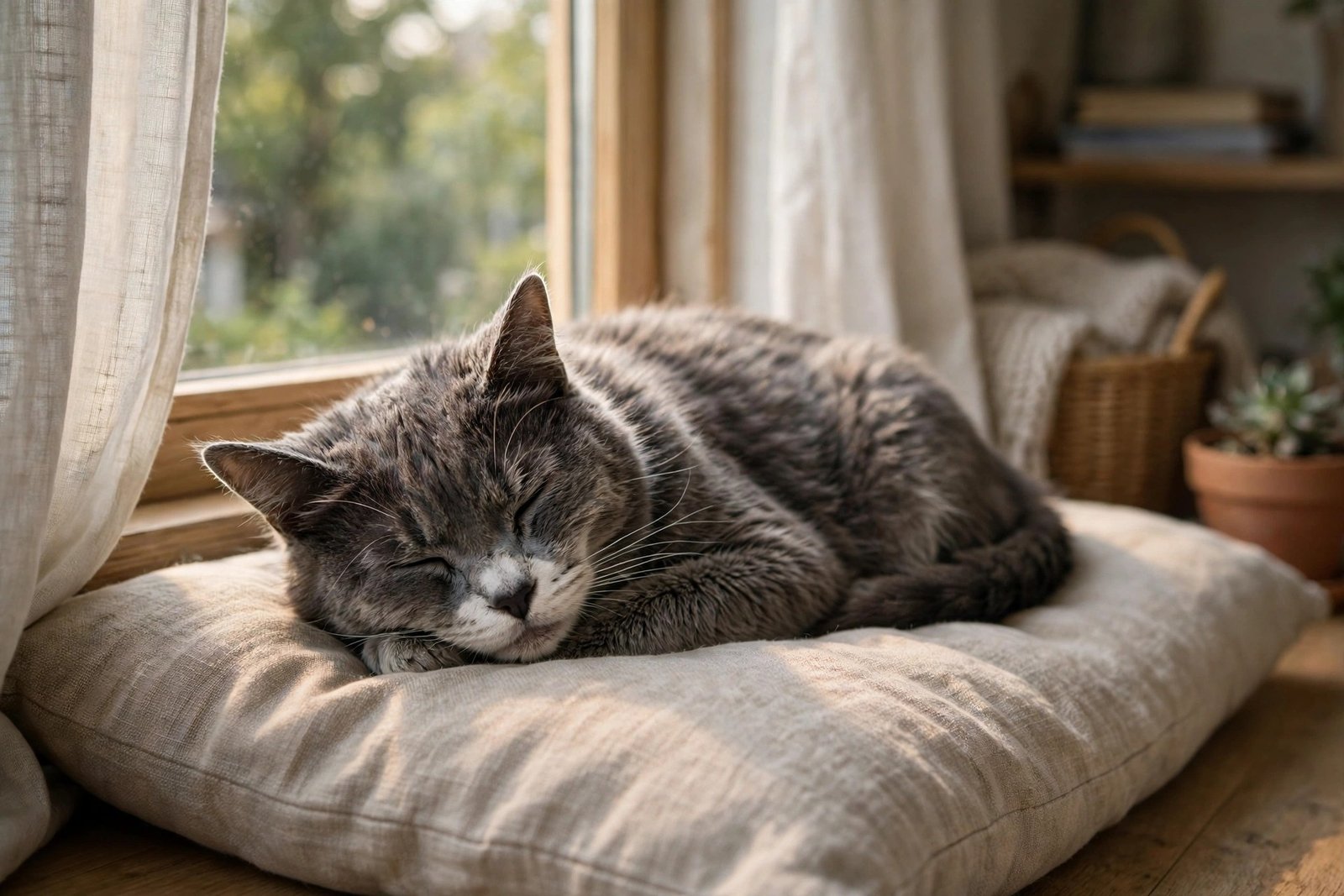
Senior cats sleep more, and they sleep less well. The article notes the problems. Here is the setup that helps.
Warmth comes first. An older cat feels the cold more, so put a warm bed in a warm spot, away from drafts, and add a second bed near where the family sits. A heated pad made for pets, used on its lowest setting and always with a cover, helps a stiff cat settle. Never use a human heating pad, which can get too hot and has no auto shutoff for a sleeping animal.
Access comes second. A cat that used to jump onto the bed and now hesitates needs a ramp or a step, not encouragement to jump. Put a step beside the bed and beside the favorite windowsill. Keep the litter box on the same floor as the bed, and keep the route to it clear and lit at night. A night light on the hallway helps a cat whose eyesight is fading, and a box with low sides helps a cat whose joints are stiff.
Comfort is the third piece. A bed with raised sides gives a senior cat something to lean against, and a soft blanket that smells like home beats a new bed that smells like a shop. If your cat is sleeping much more and seems uncomfortable rather than rested, read our guide to how long cats live for the senior warning signs, and book a vet visit. PetMD on getting your cat to sleep at night covers the night routine in more detail.
Questions owners ask about cat sleep
How many hours do cats sleep at night?
Cats nap through the day and night, with their busiest hours at dawn and dusk. An adult cat still totals 12 to 16 hours across the full 24 hours.
Do cats dream?
Probably yes. Twitching paws during deep sleep match dreaming in other mammals. Deep sleep only lasts about five minutes at a time, so the dreaming is brief.
Why does my cat sleep on me?
Warmth and safety, plus your scent. You are the warmest, safest surface in the house, and your smell is familiar. A cat that sleeps on you trusts you, and it is also borrowing your body heat.
Should I let my cat sleep in my bed?
That is a personal choice, rather than a health rule. If the cat sleeps through the night and you sleep well, it is fine. If the cat wakes you at dawn every day, a closed bedroom door and an evening play session will help more than any scolding.
Keep a note of your cat’s normal sleep for one week. Write down roughly how many hours it sleeps, when it is most active, and whether it eats and plays as usual. That note is the thing a vet will ask for first, and it turns a vague worry into a clear answer.
2 thoughts on “Why Do Cats Sleep So Much? Normal Hours and Warning Signs”