
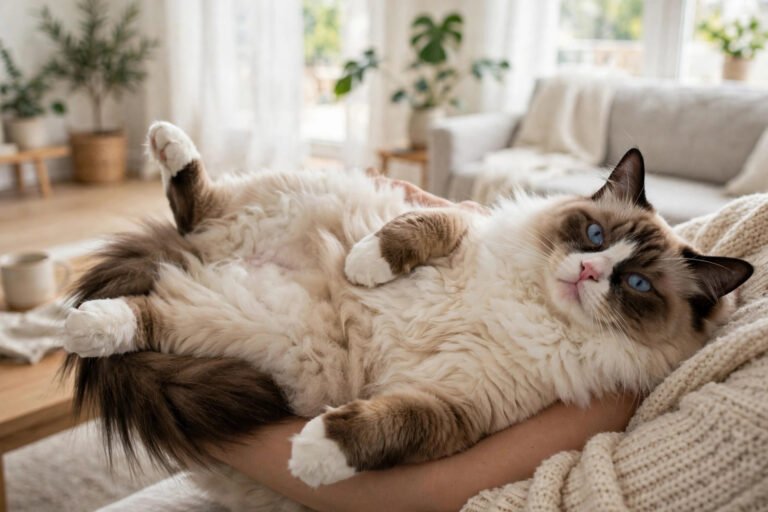
You want a cat that greets you at the door, follows you from room to room, and flops into your arms like a stuffed toy. That is the Ragdoll. This ragdoll cat breed guide covers what living with one actually takes: the size, the coat, the health checks, and the attention bill that comes with a cat this social.
The name comes from the flop. PetMD says the breed is named for the way Ragdolls relax to the point of floppiness when petted, cuddled, or held. That loose body is the first thing most owners notice.
A Ragdoll suits a first-time owner who is home a lot and wants a companion. It does not suit someone who works long hours and wants a cat that entertains itself.
The flop is real, and so is the following you around
Ragdoll cat personality starts with people. Vetstreet calls them puppycats because they follow their people from room to room, and says not even the bathroom offers privacy from one of these gentle lovebugs. They greet you at the door, sleep with you at night, and settle where they get the most human contact, on the floor at your feet or in your lap.
Most cats pick a high perch and watch the room. A Ragdoll picks your lap. PetMD quotes Amy Stadter, chair of the TICA Ragdoll Breed Committee, who has kept Ragdolls since 1997: they are uniquely friendly, social, and affectionate, and one of the most laid-back, most adaptable breeds.
They are not loud. Vetstreet describes their voice as soft and musical, and PetMD says they are rarely overly vocal unless they are hungry or want extra affection, when they make little noises to get your attention. If you want a quiet house, that matters as much as the temperament.
Energy sits in the middle. Ragdolls keep a kittenlike playfulness into adulthood, according to Vetstreet, and they enjoy fetch and can learn to walk on a leash. PetMD adds a detail owners recognize at once: Ragdolls have their crazy 15 minutes once or twice a day, then go back to lounging. A wand toy, a small toy to fetch, and a scratching post cover most of their play needs.
They also learn. PetMD says Ragdolls are quite trainable for cats, and most can be motivated by the right treats or toys. Stadter has clicker-trained her own Ragdolls, including one that learned agility. That forgiving temperament is part of why they appear in our guide to best cat breeds for first-time owners, where temperament matters more than looks.
The catch is the attention. PetMD quotes Stadter again: a lonely Ragdoll is an unhappy Ragdoll, and may develop bad or annoying habits out of frustration.
This breed does best in a home with other Ragdolls or pets, especially when people are out during the day. If your house is empty from morning to night, a Ragdoll will feel it. A second cat, a cat sitter, or a different breed may be the kinder choice.
Ragdoll cat breed guide to size, coat, and slow growing up
Ragdolls are one of the largest domestic cat breeds. Vetstreet says males range up to 20 pounds, with females starting at 10 pounds and going up to 15. A full-grown Ragdoll takes up real space on the sofa, so support the cat with both hands when you pick it up.
They grow slowly. Vetstreet says they reach full size at four years old, while WebMD puts it at about three. Treat three to four years as the range.
A Ragdoll kitten looks ordinary for a long time, then fills out into the big cat you expected. That slow maturity also applies to the coat, which may not reach its full color until the cat is about four.
The coat is semi-long, silky, and pointed, which means darker color on the face, legs, tail, and ears. Vetstreet lists four patterns and six colors for the breed. Every Ragdoll has large, oval, blue eyes, and that eye color is part of the breed standard.
Lifespan is where the sources split. Vetstreet says Ragdolls can live to be 12 to 15 years or more. PetMD gives a typical feline lifespan of up to 17 years.
WebMD is the outlier: it puts the average near 12 years, with only 63 percent living longer than 10. No sample size sits behind that WebMD figure in the page, so read it as a caution rather than a verdict. A Ragdoll kept indoors, kept lean, and seen by a vet every year has a fair shot at the top of the range.
The breed is young. Vetstreet says Ragdolls were created in California in 1963, when breeder Ann Baker set out to build a beautiful cat with a loving, gentle personality. The Cat Fanciers Association began registering Ragdolls in 1993, and they reached championship status in 2000. Today they are the fifth most popular breed registered by CFA, which explains the waiting lists and the price.
Ragdoll cat care in a normal week
Ragdoll cat care is lighter than the coat suggests. The fur is silky with little undercoat, so it resists tangling better than a Persian or Maine Coon coat. PetMD says some Ragdolls only need combing once or twice a week, while others with a heavier undercoat need more.
Stadter recommends two good metal combs, a larger one and a smaller, finer one, and says combing once or twice a week, possibly every couple of days during spring shedding, should keep mats away. A comb works better than a brush here, because it reaches the skin where mats start.
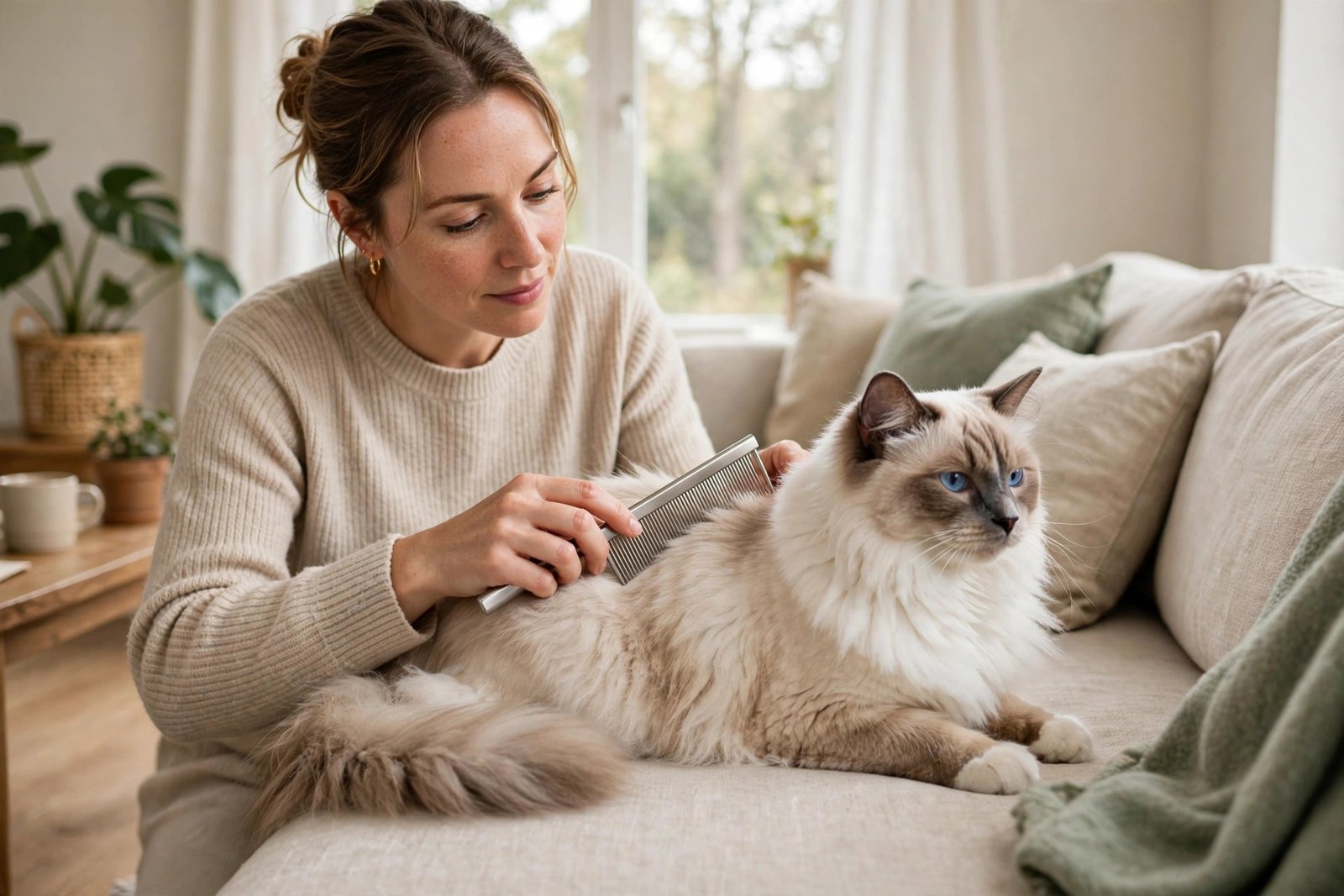
Start grooming in kittenhood. PetMD says Ragdolls that experience nail trimming, bathing, and ear cleaning from a young age generally tolerate it well. The reverse is also true. A cat whose only grooming experience is having painful mats combed out learns to fear the comb. Our new kitten checklist covers the first week supplies, including a comb and nail clippers.
Nails need trimming every 10 days to two weeks, according to Vetstreet. Teeth need brushing at home with a vet-approved pet toothpaste, since cats are prone to periodontal disease. Watch the eyes for redness or discharge, and the ears for head shaking, scratching, or discharge, which are signs of infection.
Feeding is where Ragdoll owners most often go wrong. The cats are hearty eaters and prone to weight gain, and extra weight on a frame that big strains the joints. PetMD says to measure a life stage appropriate food at each meal, and that treats count toward the daily calories.
Choose a food that meets AAFCO standards, and consider a mix of dry and wet food. Wet food helps hydration, since canned food holds more water than kibble. The trade-off is that wet food does not scrape plaque the way dry food does, and it tends to be higher in protein and fat, which can leave a cat hungry sooner and gaining weight.
Kittens eat differently from adults. Vetstreet says Ragdoll kittens can have rapid growth spurts and need plenty of food available all the time. If a kitten cleans its plate, offer a little more until it stops eating. Once the cat reaches full size at four years, ration the food so it does not get fat.
The health problems to ask about before you buy
Ragdolls are generally healthy, but three problems show up often enough to ask about. The first is hypertrophic cardiomyopathy, or HCM. Vetstreet calls it the most common form of heart disease in cats, and says it causes thickening of the heart muscle.
Researchers found the genetic mutation behind HCM in Ragdolls and built a DNA test, so breeders can screen cats before breeding them. PetMD says that test has helped breeders eliminate the most common cause of HCM in the breed, and the condition has become uncommon, though it is still possible.
Ask for the test results. A breeder who claims a line is 100 percent free of HCM is either lying or not knowledgeable, according to Vetstreet, and no one can guarantee a cat will never develop it. Signs worth a vet visit include lethargy, eating less, difficulty breathing, and trouble exercising.
The second problem is bladder stones. PetMD says they are painful and can become life-threatening if they block the urethra completely. Watch for peeing more often in small amounts, straining, crying while peeing, or peeing outside the litter box.
Male cats carry the higher risk of a full blockage. A prescription diet can dissolve some stones, and more water, including through canned food, helps prevent them.
The third is weight. PetMD says obesity is no laughing matter for a breed this big, because extra pounds wear on the joints and lead to arthritis and mobility problems as the cat ages. Measure the food, watch the body shape under the fluffy coat, and talk to your vet about pain management if an older Ragdoll starts moving stiffly.
PetMD also notes that Ragdolls can be more sensitive to food and seasonal allergens than some breeds. Watch the coat, skin, and bathroom habits, and tell your vet if the cat seems itchy or the coat changes.
Are Ragdoll cats good for beginners?
For most first-time owners, yes, with two conditions. The first is time. A Ragdoll needs company, play, and grooming, and it will not thrive alone in an empty apartment.
The second is indoors. PetMD says Ragdolls must live inside, unless they have a safe, fully enclosed catio or yard, because they are social and friendly and not street-smart enough to be wary of danger. Vetstreet agrees: keep the cat indoors to protect it from cars, diseases spread by other cats, and attacks from other animals.
Children and other pets are a strength of the breed. PetMD says Ragdolls are a great choice for families with children or other pets, as long as introductions are slow and supervised and children are taught to play gently. Vetstreet says they are sturdy and tolerant enough to be dressed up and pushed around in a baby buggy, with the warning that a child should not take advantage of that good nature. They get along with dogs too, and can learn to walk on a leash, which makes them one of the easier breeds to fit into a busy household.
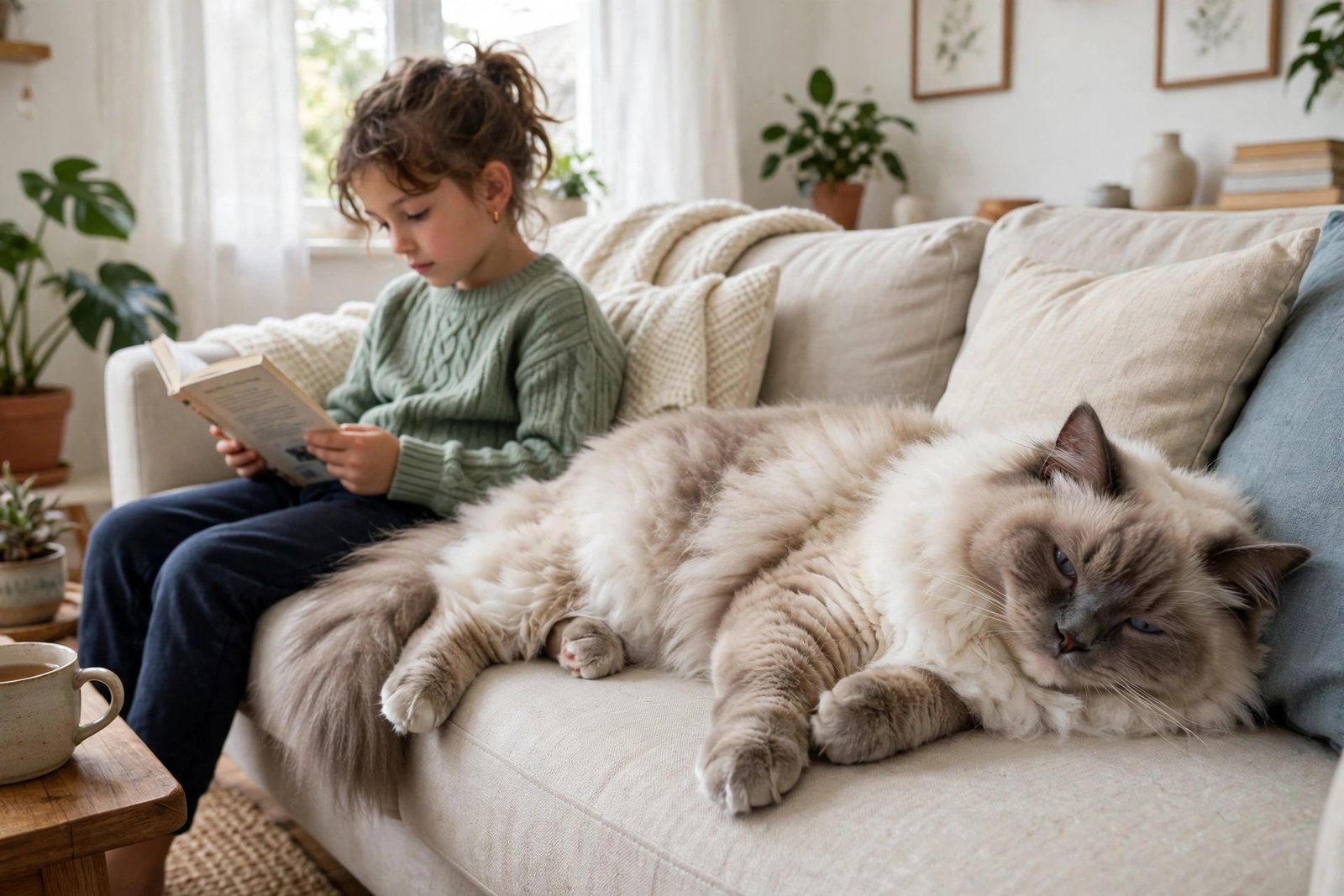
Apartments suit them. They are quiet, they do not climb curtains or tear around the house, and their exercise needs are modest. A tall scratching post, a window perch, and a daily play session cover it. They sleep a lot, like most cats, and our guide on why do cats sleep so much covers the long naps that surprise new owners.
Buying one takes patience. PetMD says to expect $1,800 to $2,500 for a Ragdoll from a reputable breeder, and to do your homework before choosing one. Vetstreet adds that most breeders have waiting lists, and a kitten in a specific color or pattern can take six months or more.
Many breeders will not release kittens until they are 12 to 16 weeks old. Ask for the HCM DNA test results for both parents, a written health guarantee, and proof the kittens were raised in the home rather than isolated.
Consider an adult Ragdoll too. Vetstreet says an adult from a breeder, a retired show or breeding cat, or a rescue gives you a clearer picture of personality and health, and adult Ragdolls do turn up in shelters and rescue groups even when kittens almost never do.
Questions new owners ask about Ragdolls
Are Ragdoll cats hypoallergenic?
Ragdolls are not hypoallergenic. PetMD says they are not heavy shedders, but they have longer fur, need regular grooming, and shed seasonally.
How big do Ragdoll cats get?
Males reach up to 20 pounds and females 10 to 15 pounds, according to Vetstreet, and they keep growing until three to four years old.
Do Ragdoll cats shed a lot?
Moderately. The coat sheds, but not excessively, and shedding picks up in spring and fall. Comb every couple of days during those weeks.
How long do Ragdoll cats live?
Sources give 12 to 17 years, with Vetstreet at 12 to 15 or more and PetMD up to 17. WebMD puts the average closer to 12, so indoor life, weight control, and yearly vet visits matter.
If a Ragdoll fits your life, the next step is practical. Ask the breeder for the HCM DNA test results for both parents, meet the kitten in the home where it was raised, and buy two metal combs before pickup day.
5 thoughts on “Ragdoll Cat Breed Guide: A Big, Calm Cat That Follows You Everywhere”