
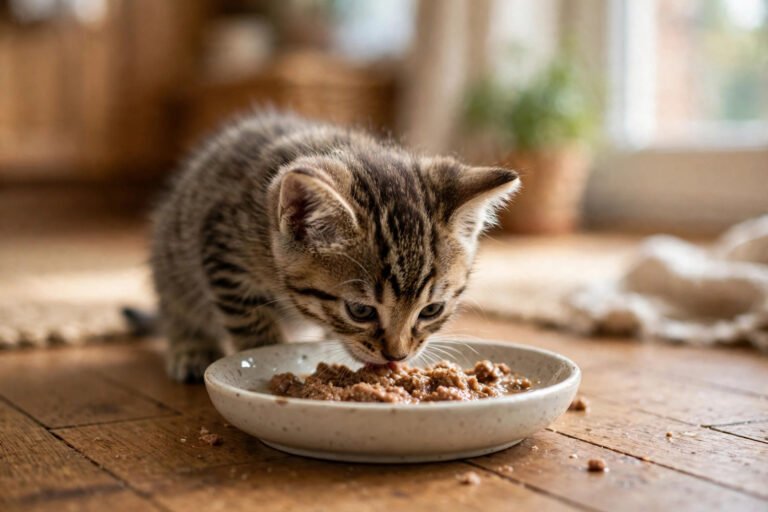
Two feeding charts can disagree by half and still both be right. Chewy, citing a veterinarian, says an individual kitten’s needs can vary up to 50 percent in either direction from the average. That is the first thing to understand about how much to feed a kitten. The chart gives you a starting point, not a verdict.
Here is the starting point. An 8 week old kitten weighs about 2 pounds and needs around 162 calories a day, according to Chewy. A 6 month old kitten weighs about 6 pounds and needs around 369 calories a day. Feed a food labeled for kittens, split the daily amount into several small meals, and adjust by watching the kitten’s body, not by watching the bowl empty.
Kitten food portions by age and weight
Kittens grow fastest in the first six months. Chewy says the most rapid period of growth happens in those months, and after that the need for extra calories starts to slow. That is why the portions climb steeply early on and then level off.
The table below uses Chewy’s chart, which lists average calories for healthy kittens. The wet amounts assume a standard 3 ounce can, and the dry amounts assume a typical kibble. Your bag will differ, so read its label and do the same math with its numbers.
| Age | Weight | Calories a day | Wet food a day | Dry food a day |
|---|---|---|---|---|
| 2 months | 2 pounds | 162 | 1 and a half cans | 1/4 cup |
| 4 months | 4 pounds | 272 | 2 and a half cans | 1/2 cup |
| 6 months | 6 pounds | 369 | 3 and a half cans | 2/3 cup |
| 8 months | 8 pounds | 457 | 4 and a quarter cans | 3/4 to 1 cup |
| 10 months | 10 pounds | 541 | 5 cans | 1 cup |
Purina’s chart tells a similar story with wider ranges. For kittens aged 4 to 12 weeks it lists 1/4 to 1/2 cup of dry food, or 1/2 to 1 and a half cans of wet food, split into 3 to 4 meals a day. By 8 months to a year the dry range is 1/4 to 3/4 cup and the wet range is 2 to 7 cans, which shows how much breed and size matter by then.
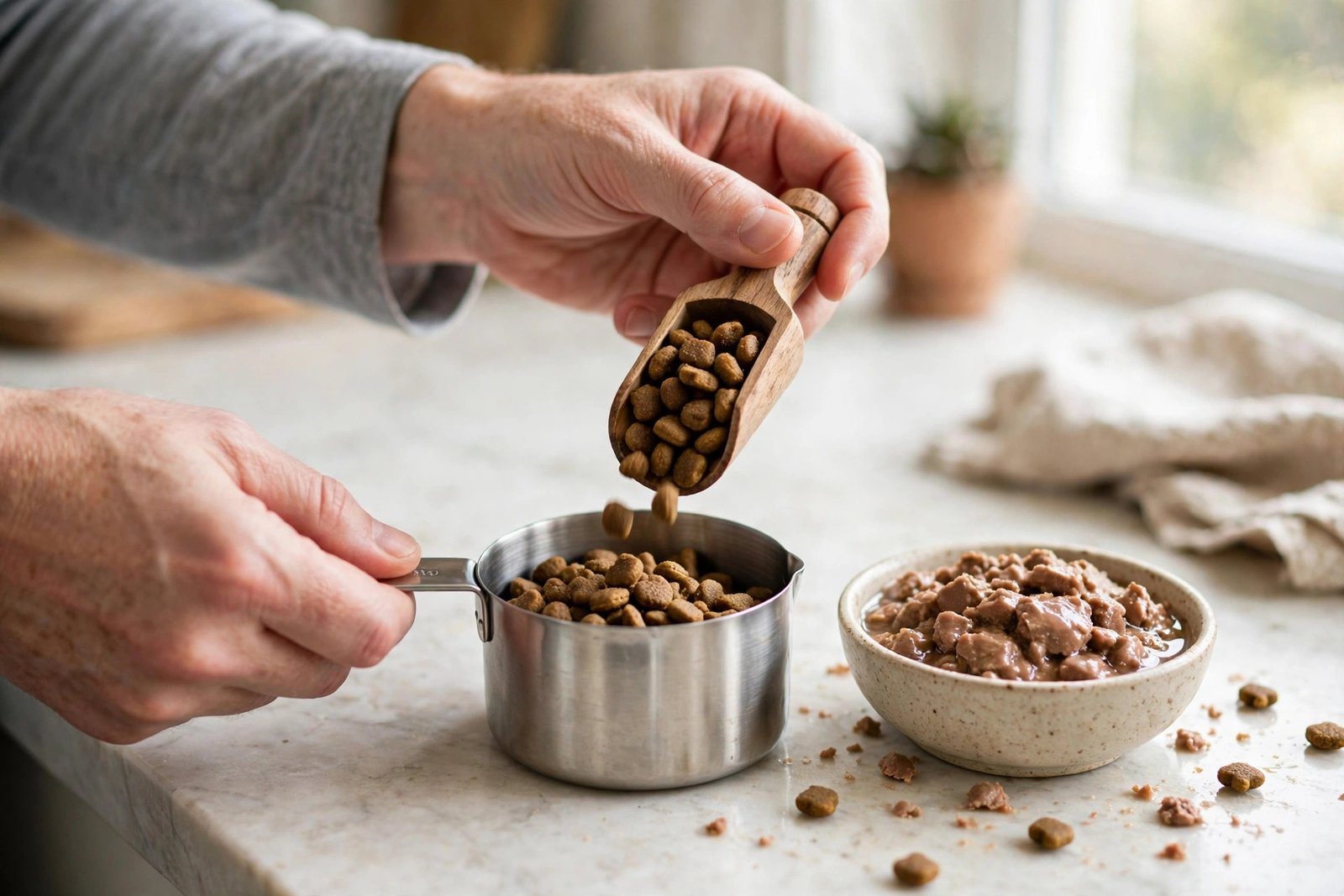
Do the math yourself once, with your own food. Chewy explains the method in two steps. Divide the kitten’s daily calories by the calories per can or per cup printed on the label, and that gives the daily amount. Then divide that amount by the number of meals you plan to serve, and that gives each meal.
A kitten feeding schedule that fits a workday
Small stomachs need frequent meals. A kitten cannot eat a whole day of food in one sitting, and a single big meal leaves it hungry for hours and then stuffed.
Chewy says most kittens should have food left out through the day and night until they are 4 to 6 months old, and to offer 4 to 6 month old kittens food at least three times a day. By 10 months, offer at least two meals a day.
Purina says to divide dry food into 3 to 4 servings until the kitten is 4 months old, then 2 to 3 meals a day for wet food through the middle months, and 2 meals a day from about 8 months on.
Put together, a workable kitten feeding schedule looks like this. Under 4 months, 3 to 4 small meals a day. From 4 to 6 months, 3 meals a day. From 6 to 12 months, 2 meals a day, with a small third meal if your day allows it. Wet food should not sit out all day. Purina says to discard wet leftovers and to refrigerate an open can for up to 24 hours, then bring it to room temperature before serving.
A timed feeder earns its place here. Chewy suggests one for owners who cannot serve several small meals, since it can be preloaded with measured meals across the day.
Feed in a quiet spot, away from the litter box. Cornell notes that heavy traffic, noise, other animals, dirty bowls, or a nearby litter box can put a cat off eating. A kitten that walks away from a full bowl may be telling you about the location, not the food. Our new kitten checklist covers the first week supplies, including bowls and a feeding spot, so the routine starts right.
Wet food, dry food, or both
Neither wins outright, and the kitten does not care about the debate. The difference is water and calories per bite.
Cornell says dry food holds 6 to 10 percent water, while canned food holds at least 75 percent moisture. Chewy adds that cats are poor water drinkers, so wet food helps keep a kitten hydrated. Dry food is cheaper, keeps longer, and can sit out for grazing. It also works in food puzzles, which give a kitten something to do.
Mixing the two is the usual answer. Give wet food as the main meals and leave a measured amount of dry food for grazing, or split the day between them. The rule is to count both toward the same daily total. Purina says if the kitten eats wet and dry food, the combined amount must not exceed the recommended daily serving. A full can plus a full cup of kibble is two full days of food in one bowl, not one.
Offer variety early. Chewy says kittens develop strong preferences for taste and texture early in life, and offering dry food, wet food, and different flavors keeps options open later.
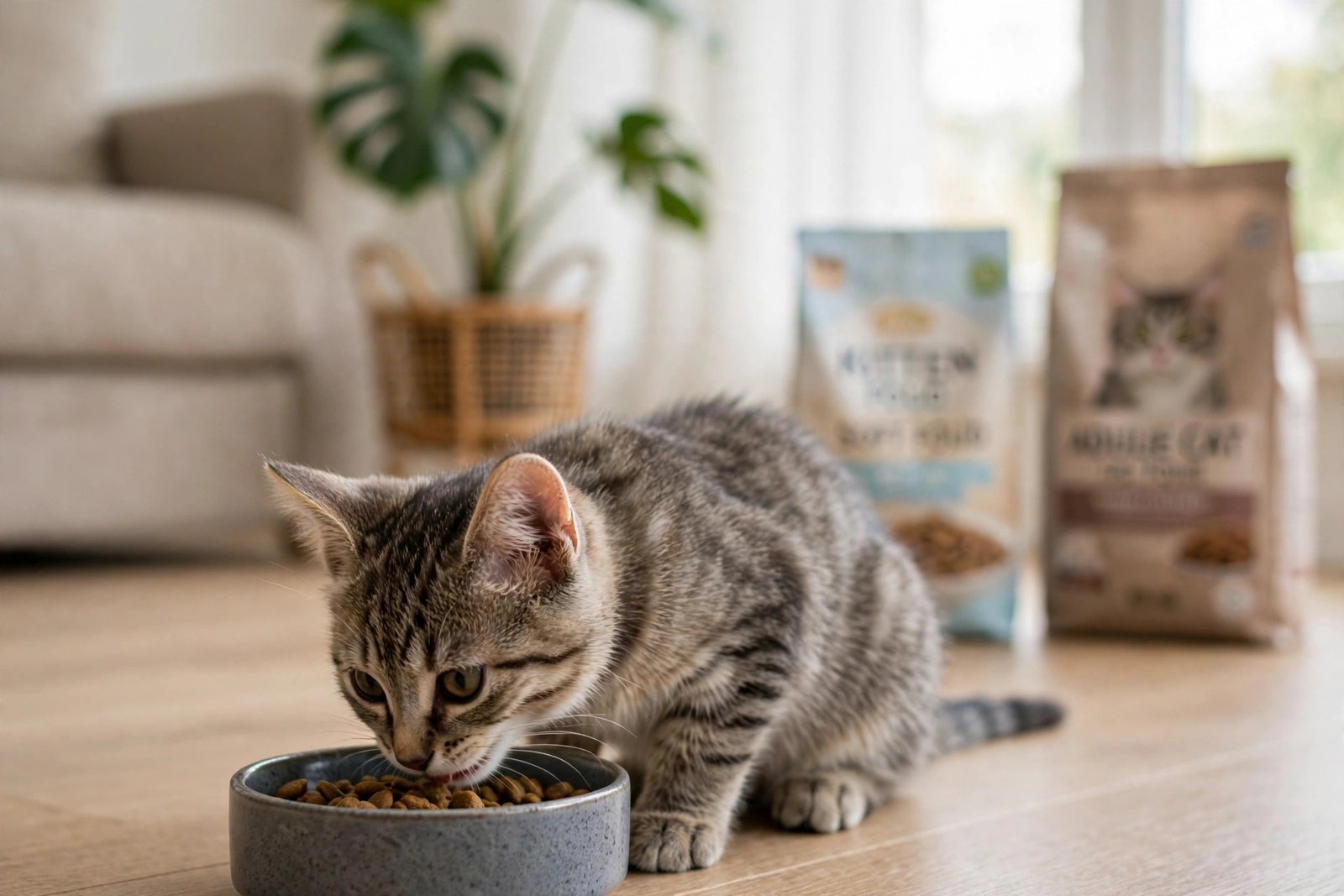
Whatever you choose, the label has to say kitten food, or food for all life stages. Cornell says the nutritional claim on the label should state the life stage the food is complete and balanced for, and that an AAFCO statement marks a food as nutritionally complete and balanced. Kitten food carries more calories, protein, and fat than adult food, plus DHA for brain and eye development, according to Purina.
Free feeding stops working at about 6 months
Free feeding means leaving dry food out all day so the kitten grazes. It works well for a very young kitten and it stops working well as the kitten grows.
Chewy says a kitten’s risk of unhealthy weight gain when fed free choice rises once the kitten is 4 to 6 months old, especially after spaying or neutering. Unless the kitten is underweight, switching to a meal based schedule is usually wise at about that time. A 3 month old kitten burns almost everything it eats on growth. A 7 month old kitten burns less on growth and more on play, and the bowl is still full all day.
Spaying and neutering change the math too. The operation lowers energy needs while appetite often stays the same, so the same full bowl that kept a young kitten lean starts adding weight. Scoop the daily amount into a container in the morning, serve meals from it, and when it is empty the feeding day is done.
Cornell calls obesity the most common nutrition related problem in cats, and says it makes cats susceptible to arthritis and diabetes. That starts here, in the months when a kitten stops growing fast and nobody trims the portions.
Treats count toward the daily total as well. Cornell gives a rule of thumb that treats should not exceed 10 to 15 percent of a cat’s daily calories. For a kitten eating 300 calories a day, that is 30 to 45 calories of treats at most, which is a few small pieces. Our guide on what can cats eat covers which human foods are safe as treats and which belong on the never list.
When to switch kitten to adult food
Most kittens switch at about their first birthday. Purina says most cats are considered kittens until around 12 months of age, and Chewy puts the switch at around 10 months. Treat 10 to 12 months as the range for an average sized cat, and ask the vet to confirm for yours.
Large breeds run late. Purina says Maine Coons can take 18 months to 2 years to reach maturity, and Chewy agrees that large breeds should stay on kitten food longer. A Ragdoll grows slowly too, which is one more reason to go by the cat in front of you rather than the calendar alone.
Switch gradually over 7 to 10 days. Purina gives the steps: serve 3/4 kitten food and 1/4 adult food for days 1 and 2, half and half for days 3 and 4, 1/4 kitten food and 3/4 adult food for days 5 to 7, then adult food only from day 8 to 10. A sudden swap can upset the stomach and turn the kitten off the new food entirely. If the kitten refuses the mix, slow down and hold each step an extra day or two before moving on.
Do not switch early to save money. Adult food is cheaper per bag, and kitten food is richer for a reason. A kitten switched at 6 months loses months of the extra protein, fat, and DHA that growth needs.
How to tell if the amount is wrong
The scale and the ribs tell you more than the chart. Weigh weekly, feel the ribs weekly, and look at the waist from above.
Chewy says newborns should gain about half to three quarters of an ounce a day, and the same habit serves an older kitten well. If the ribs are easy to feel under a thin layer of fat and the waist narrows behind the ribs, the amount is close.
A kitten eating too little stays bony, plays less, and gains weight slowly or not at all. A kitten eating too much rounds out, loses its waist, and starts to waddle rather than trot. Both need a change in amount, not a change in brand. Adjust by about 10 percent, wait a week, and weigh again.
Appetite changes deserve attention too. A kitten that suddenly eats much less, or much more, may be ill, stressed, or coming into a growth spurt. A kitten that stops eating, hides, vomits, or has diarrhea needs a vet the same day. Cornell says a cat that refuses to eat can develop serious medical problems, and a vet should examine any cat that refuses to eat and is losing weight.
Water matters as much as food. Cornell says cats should have access to clean, fresh water at all times. A kitten eating mostly dry food needs a full water bowl in a separate spot from the food bowl, refreshed daily.
Questions owners ask about feeding kittens
Can I feed my kitten adult cat food?
Not as the main diet. Adult food lacks the calorie and nutrient profile a growing kitten needs, and Purina says kittens should not eat adult cat food before they have fully matured.
How many times a day should a kitten eat?
Three to 4 meals a day under 4 months, 3 meals a day from 4 to 6 months, and 2 meals a day from 6 months to a year. A timed feeder covers the midday meal when you are out.
Should kittens drink milk?
No. Once a kitten is weaned, it does not need milk in any form, according to Purina. Cornell adds that milk is not generally recommended as a treat, since many cats are lactose intolerant.
Can I leave dry food out all day for my kitten?
Yes while the kitten is under 4 to 6 months old, and measure it once the kitten passes that age. Free feeding works for a fast growing kitten and turns into weight gain once growth slows, especially after spaying or neutering.
Weigh your kitten today, read the calories per can or per cup on your bag, and work out the daily amount with the two step math above. Serve it in 3 meals if the kitten is under 6 months, and 2 meals if it is older. Then weigh again in a week and adjust.
2 thoughts on “How Much to Feed a Kitten: Portions by Age”