
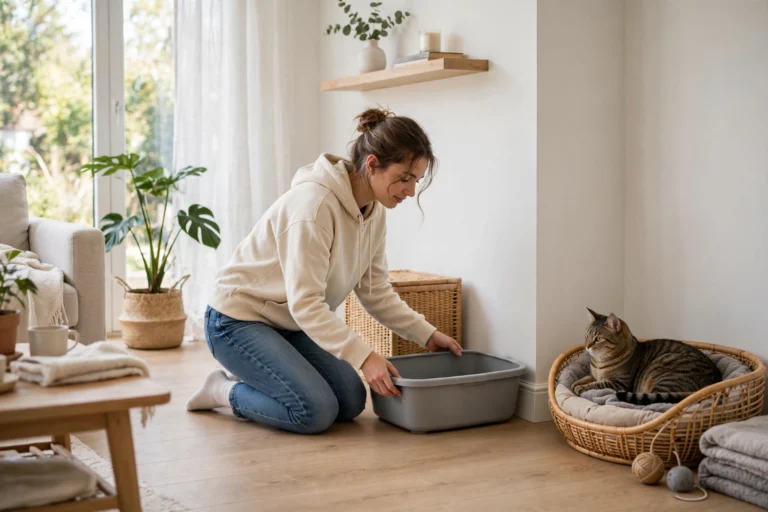
Quick Answer: What Are the Most Important Cat Care Tips for a Beginner?
Give your cat one litter box per cat plus one extra, fresh water daily, and a food with an AAFCO complete and balanced statement for your cat’s life stage. Scoop the box daily and brush weekly, then book a vet check in the first week. Most new cat problems come from a dirty box or stale water.
It is 2 a.m. on your cat’s first night home, and something small is thumping around the kitchen. You find her behind the fridge, wide-eyed, with a full food bowl sitting untouched in the next room. Nothing is wrong, exactly. She is just new, and new cats need time to learn where things are. This guide gives you 15 practical cat care tips for beginners, in the order you will actually need them, so the first month runs on routine instead of guesswork.
Your First Week With a Cat: A Simple Plan
A new cat does not need your whole house on day one. She needs one safe room, the same food she already knows, and a vet appointment on the calendar. The table below turns the first week into four small jobs.
| When | Do this | Why it matters |
|---|---|---|
| Day 1 | Set up one quiet room with a litter box, food and water, and a bed to hide in | A new cat explores slowly and settles faster in one safe space. |
| Days 2 to 3 | Keep feeding the food the shelter or breeder used, and keep food and water far from the litter box | A sudden food change upsets the stomach, and cats avoid eating near their toilet. |
| Days 4 to 7 | Book the first vet check and ask about vaccines and the spay or neuter date | A vet check soon after adoption catches problems early. |
| End of week 1 | Start a daily routine. Scoop the box and refresh the water each morning, then add a short brush and a play session. | Cats relax when the same things happen at the same times each day. |
How Do You Set Up a Home for a Cat on Day One?
- Tip 1: Start her in one quiet room. A spare bedroom or a quiet bathroom works better than the whole house. Put her litter box, food, water and bed in that one room, plus a cardboard box to hide in. Open the door to the rest of the house after a few days, once she eats well and uses the box without hiding all day.
- Tip 2: Buy the basics before she arrives. The ASPCA supply list covers it: premium brand cat food, a food dish, a water bowl, a brush, a comb, a safety collar with an ID tag, a scratching post, a litter box with litter, a carrier, and a bed or box with a warm blanket. If you are bringing home a kitten, the new kitten checklist on PawPediaHub walks through the same setup item by item.
- Tip 3: Put food and water far from the litter box. Cats are fastidious, and Cornell’s feline care guidance is blunt on this point: keep dishes far away from the litter box to avoid contamination. A quiet corner of the kitchen works. A heavy traffic hallway does not, because noise and other animals, or a nearby litter box, can put a cat off eating entirely.
What Should You Feed a New Cat?
- Tip 4: Pick a food that fits her life stage. Nutrient needs change with age, so the label tells you which stage a food covers. Look for the AAFCO statement on the bag or can. Cornell’s feeding guidance explains that foods carrying an AAFCO approved nutritional guarantee count as nutritionally complete and balanced, and that the ingredients list runs in order of decreasing weight, so meat or seafood near the top is a good sign.
- Tip 5: Change foods slowly, never all at once. Find out what your cat has been eating and keep serving some of it while you mix in the new food over several days. A hard switch is the fastest way to an upset stomach and a cat that refuses the bowl. If she stops eating and starts losing weight, that is a vet visit, not a waiting game.
- Tip 6: Treat water as part of the food, not an afterthought. Give fresh, clean water at all times and wash and refill the bowls daily, because cats reject stale water. Canned food helps here too, since it holds at least 75 percent moisture while dry food holds only 6 to 10 percent water. Keep treats small as well. The ASPCA puts treats at 5 to 10 percent of the diet, so a few treats a day is plenty.

How Do You Keep the Litter Box Working?
- Tip 7: Follow the cats plus one rule. Cornell’s rule is simple: provide as many boxes as you have cats, plus one. One cat needs two boxes. Two cats need three. This one rule prevents more litter box problems than any fancy litter ever will.
- Tip 8: Scoop every day and wash the box every week. The ASPCA routine is exact: scoop solid waste out at least once a day, then dump everything, wash with a mild detergent, and refill at least once a week. Skip the ammonia cleaners and lemon scented products, because strong smells drive cats away from the box. If your cat will not use a litter box at all, ask your vet, since refusal sometimes comes from a medical problem.
- Tip 9: Put the box somewhere quiet and leave it there. A laundry room corner or a quiet bathroom beats a spot next to the washing machine. In a home with more than one floor, put one box on each floor. Avoid moving the box unless you must, and if you must, move it only a few inches per day. For the full step by step, the PawPediaHub guide on how to litter train a kitten covers placement and litter choice, plus the common mistakes in detail.
How Much Grooming Does a Cat Really Need?
- Tip 10: Brush weekly and trim nails every 2 to 3 weeks. Most cats stay clean on their own and rarely need a bath. Regular brushing keeps the coat clean, cuts down shedding, and means your cat swallows less loose fur, which means fewer hairballs. Trimming the nails every 2 to 3 weeks keeps them blunt and protects your furniture and your arms. Ask your vet to show you the nail clipping technique once, and the job gets easier every time after that.

- Tip 11: Pick up your cat the right way. Place one hand behind the front legs and the other under the hindquarters, then lift gently. Never pick a cat up by the scruff of the neck or by the front legs. Kittens that get handled gently grow into adults that tolerate brushing and nail trims, plus vet exams without a fight.
How Do You Play With a Cat Without Getting Scratched?
- Tip 12: Give her a scratching post that matches how she scratches. Scratching is normal marking behavior, not bad behavior, and a cat that has no good target will pick your sofa. Watch whether she scratches up high or flat on the floor, then buy to match. The ASPCA recommends a post at least 3 feet high, stable enough not to wobble, and covered in a rough material such as sisal, burlap, or tree bark. Rub a little catnip on it and reward her with a treat when she uses it.

- Tip 13: Play in short sessions and learn her signals. Ten minutes with a wand toy beats an hour of a bored cat batting at your hands. Stop the game when her ears flatten or her tail starts lashing, because that is a cat asking for space. Learning how to read your cat’s body language pays off fast, since most “sudden” bites come with a warning that a new owner simply missed.
When Does a New Cat Need a Vet?
- Tip 14: Book the first vet check in the first week. Cornell advises that any new cat should be checked by a veterinarian as soon as possible after coming home. Ask about prior vaccinations and parasite control, and keep a new cat apart from your other cats until the vet has examined her, especially if her health history is unknown. Cats with an unknown history usually get tested for feline leukemia virus and feline immunodeficiency virus.
- Tip 15: Keep her indoors and tagged, with vaccines on schedule. The ASPCA is direct here: keep your cat indoors, because outdoor cats do not live as long as indoor cats. A safety collar with an elastic panel and an ID tag, or an implanted microchip, brings a lost cat home. On vaccines, Cornell gives the standard timing: the first FVRCP shot at 6 to 8 weeks old, boosters every 3 to 4 weeks until the kitten is 16 to 20 weeks old, then a booster 1 year later and every 3 years after that. Rabies follows at 8 to 12 weeks, then 1 year later, with boosters every 1 to 3 years. After the first year, your cat should see the vet at least once a year. For the bigger picture on the daily routine, the full cat health guide on PawPediaHub covers it in one place.
Infographic Data Summary — Headline: Cat Care Tips for Beginners: 15 Tips for the First Month
- Litter boxes: one per cat, plus one extra.
- Scoop the box daily and wash it weekly.
- Fresh water every day, and wash the bowls daily.
- Treats stay at 5 to 10 percent of the diet.
- First vet check in week one, then at least once a year.
PawPediaHub.com
When to See a Vet
Most first month problems are routine, but these five signs mean home care stops and a vet visit starts.
- Not eating, vomiting, diarrhea, or lethargy for more than 2 days. The ASPCA names 2 days as the line where these symptoms need a vet.
- Straining to urinate, bloody urine, or crying in the litter box. Call your vet the same day, because urinary problems can turn serious fast.
- Difficulty breathing or rapid breathing. This needs a vet now, not tomorrow.
- A swelling that appears fast or keeps growing. Cornell lists rapid or growing swelling among the signs that need prompt care.
- A swallowed toxin, string, or medication meant for people. Never give a cat medication that a vet did not prescribe. Call your vet or the ASPCA Animal Poison Control Center at (888) 426-4435 right away.
Frequently Asked Questions
How often should I feed my cat? Feed a food that matches your cat’s life stage and carries an AAFCO complete and balanced statement, in measured meals rather than an always full bowl. Give fresh water every day and wash the bowls daily. Keep treats at 5 to 10 percent of the diet. Ask your vet to set the daily amount.
How many litter boxes does one cat need? One cat needs two litter boxes, following the cats plus one rule from Cornell. Put them in quiet spots, on different floors if your home has more than one level. Scoop at least once a day and wash and refill the boxes at least once a week. A clean box fixes most litter problems.
Do indoor cats need vet visits? Indoor cats still need a first vet check in their first week home, then at least one exam every year. Those visits cover vaccines and weight checks, plus dental checks and parasite screening. Indoor cats also need identification, since a microchip or an ID tag is what brings a lost cat home.
How do I get my cat to use the scratching post? Put the post where your cat already scratches or near a favorite sleeping spot, and make sure it is tall and stable, with a rough covering such as sisal. Reward her with a treat each time she uses it, and try rubbing catnip on the post. Never punish scratching, since it is normal marking behavior.
What should I do on my cat’s first night home? Set up one quiet room with a litter box, food, water, a bed, and a hiding spot, then let her explore at her own pace. Keep the same food she already knows. Do not force cuddles or carry her around the house. Most cats settle in a few days once they learn where everything is.
How often should I feed my cat?
Feed a food that matches your cat’s life stage and carries an AAFCO complete and balanced statement, in measured meals rather than an always full bowl. Give fresh water every day and wash the bowls daily. Keep treats at 5 to 10 percent of the diet. Ask your vet to set the daily amount.
How many litter boxes does one cat need?
One cat needs two litter boxes, following the cats plus one rule from Cornell. Put them in quiet spots, on different floors if your home has more than one level. Scoop at least once a day and wash and refill the boxes at least once a week. A clean box fixes most litter problems.
Do indoor cats need vet visits?
Indoor cats still need a first vet check in their first week home, then at least one exam every year. Those visits cover vaccines and weight checks, plus dental checks and parasite screening. Indoor cats also need identification, since a microchip or an ID tag is what brings a lost cat home.
How do I get my cat to use the scratching post?
Put the post where your cat already scratches or near a favorite sleeping spot, and make sure it is tall and stable, with a rough covering such as sisal. Reward her with a treat each time she uses it, and try rubbing catnip on the post. Never punish scratching, since it is normal marking behavior.
What should I do on my cat’s first night home?
Set up one quiet room with a litter box, food, water, a bed, and a hiding spot, then let her explore at her own pace. Keep the same food she already knows. Do not force cuddles or carry her around the house. Most cats settle in a few days once they learn where everything is.
That is the whole list. Pick one tip and do it today, whether that is the extra litter box or the vet call, and let the routine build from there. These first time cat owner tips work best as habits, not as a one day project, and your cat will show you they are working by eating and sleeping like she owns the place. If you want the deeper version of the health half of this list, read the full cat health guide next.
Sources
Cornell University College of Veterinary Medicine, Choosing and Caring for Your New Cat: https://www.vet.cornell.edu/node/3986
Cornell University College of Veterinary Medicine, Feeding Your Cat: https://www.vet.cornell.edu/node/4069
ASPCA, General Cat Care: https://www.aspca.org/pet-care/cat-care/general-cat-care
ASPCA, Cat Care: https://www.aspca.org/pet-care/cat-care