
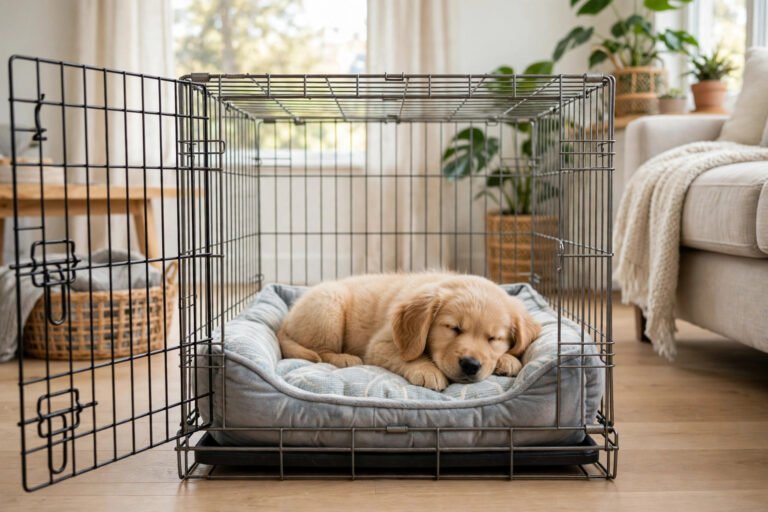
A puppy under six months old should not stay in a crate for more than three or four hours at a time. The Humane Society of the United States gives that number, and it sets the whole method. Learning how to crate train a puppy means short sessions, good things inside the crate, and a bladder that sets the limit, not your schedule.
The crate works as a den. A puppy that likes its crate walks in on its own, settles, and sleeps. A puppy that fears its crate will chew the bars, drool, and cry until it is hoarse. The difference comes from the first week, and from how slowly you build up the time.
If you have not bought the gear yet, our new puppy checklist covers the crate, the bed, and the rest of the first week supplies. The crate work below assumes the puppy already has a place to sleep and a potty spot outside.
Start with the right puppy crate size
Puppy crate size is the first decision, and it is a small one. The crate should be just large enough for the puppy to stand up, turn around, and lie down comfortably. That is the American Kennel Club rule, and the Humane Society gives the same one.
A crate that is too large breaks the whole idea. A puppy in a big crate can eliminate in one end and sleep in the other, and then the crate stops helping with house training. A crate that is too small is worse. The puppy cannot stretch out, and it will hate the box within a day.
Buy for the adult size and use a divider. The AKC suggests a crate sized for the expected full grown dog, with a divider panel that makes the space smaller for now. Move the divider as the puppy grows.
Wire crates suit puppies that like to see out. A covered crate suits puppies that settle better in the dark. Either type works if the air moves through it.
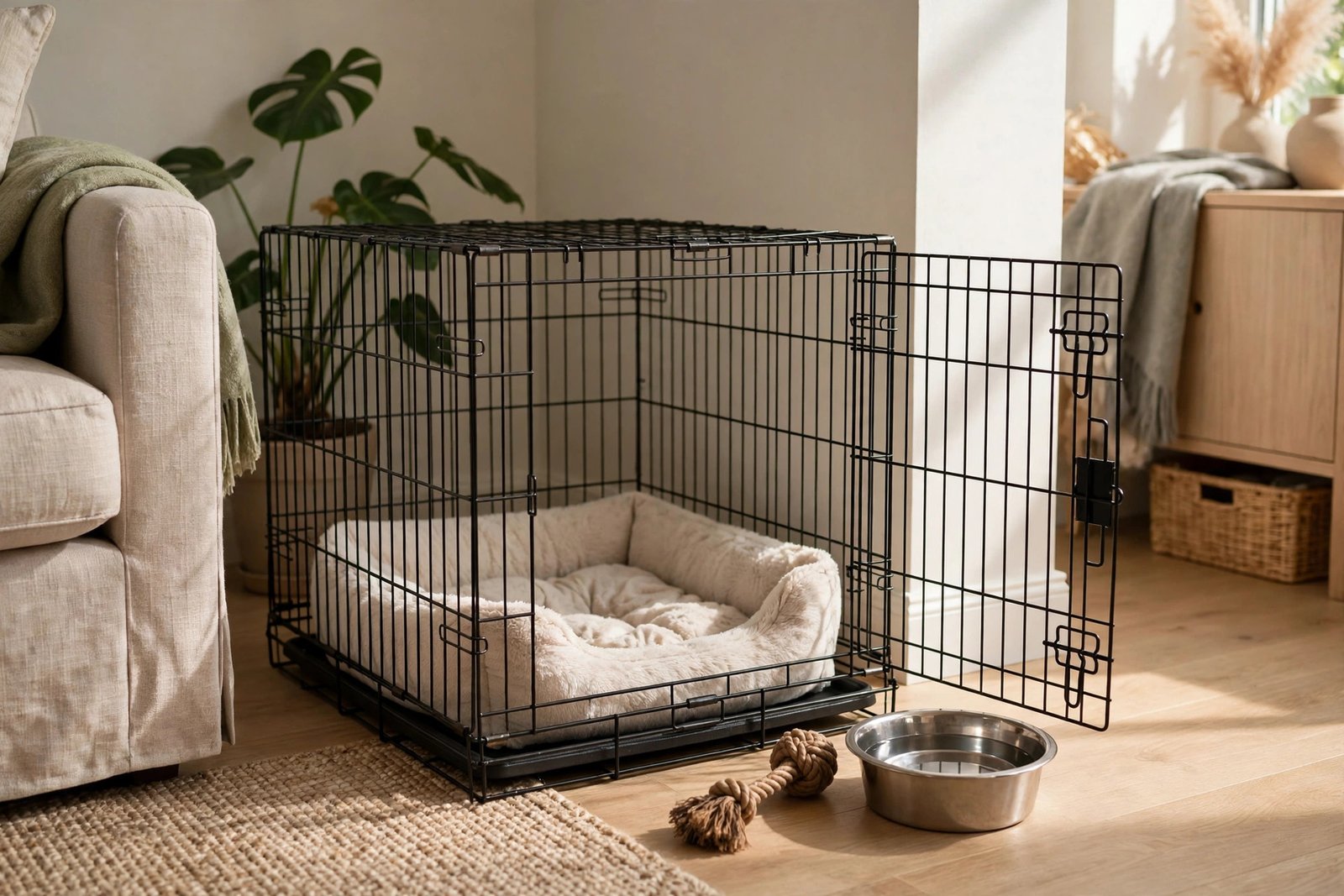
Put the crate where the family spends time. The Humane Society says to place it in a room the family uses, such as the family room, and the AKC adds that the spot should be fairly quiet. A crate in a hallway nobody uses feels like exile. A crate in the middle of a party feels like a fishbowl.
Take the collar off inside the crate. The AKC gives this as a safety rule, because a collar can catch on the crate and twist. Hold off on soft bedding at first too. Many puppies go potty on soft, porous surfaces, the AKC says, so wait until the puppy stops having accidents before you add a bed.
How to crate train a puppy, step by step
Crate training can take days or weeks, the Humane Society says, depending on the puppy’s age, temperament, and past experiences. Two rules carry the whole process. The crate should always be linked to something pleasant, and training should move in small steps. Do not go too fast.
First, introduce the crate with the door open. Take the door off or prop it so it cannot swing shut and hit the puppy. Drop a few small treats near the crate, then just inside the door, then all the way inside. If the puppy refuses to go all the way in, that is fine. Do not force it. Sit next to the crate with a handful of treats. The AKC trainer Rachel Lane advises tossing a treat inside any time the puppy approaches the crate, then giving another treat every 5 to 10 seconds for as long as the puppy stays inside.
Next, feed meals in the crate. Start with the bowl near the crate, then move it a little further inside at each meal. Once the puppy stands comfortably inside to eat, close the door while it eats and open it the moment it finishes. Leave the door closed a few minutes longer at each meal, until the puppy stays in for about 10 minutes after eating. If it whines to be let out, you moved too fast. Go back to a shorter time at the next meal.
Then practice longer stays while you are home. Call the puppy to the crate, give a treat, use a cue word such as crate, and close the door. Sit nearby for 5 to 10 minutes, then step into another room for a few minutes and return. Stretch both times a little each day. Once the puppy stays quiet for about 30 minutes with you mostly out of sight, try short absences and nights in the crate. Keep departures and arrivals boring, and give the puppy a food stuffed chew toy inside, frozen first so it lasts longer.
A crate training schedule the bladder can keep
The schedule follows the bladder, and the bladder is small. The Humane Society caps daytime crate time at three or four hours for puppies under six months. VCA Animal Hospitals gives a range by age, right after a potty break: up to about 3 hours at 2 months, up to about 4 hours at 3 months, and up to about 5 hours at 4 months.
Treat those as ceilings.
VCA also says most puppies get used to their crate within 1 to 2 months. That does not mean the puppy sleeps through the night by then. It means the crate stops being strange. PetMD puts a number on the youngest puppies. An 8 to 12 week old puppy can only hold its bladder for two to three hours, so plan the first crate sessions around that limit.
A workable day looks like this. Potty break first, then breakfast in the crate, then a short nap inside with the door closed. Out again for play and a potty trip, then a longer crate nap while you work. Every crate session starts after the puppy has eaten, played, and gone outside. A puppy that goes in tired and empty settles.
Never leave a puppy in the crate all day. The AKC is blunt about this, and the Humane Society agrees. A dog crated all day and night gets too little exercise and too little human contact, and can become depressed or anxious. If you are out longer than the puppy can hold it, hire a sitter or a dog walker, use daycare, or set up a puppy proofed pen with room to sleep and potty.
Crate training puppy at night, and what the crying means
Nights are where most owners give up, and nights are also where the crate earns its keep. Put the crate in your bedroom or a nearby hallway at first. The Humane Society recommends this because puppies often need to go outside during the night, and you want to hear the whining.
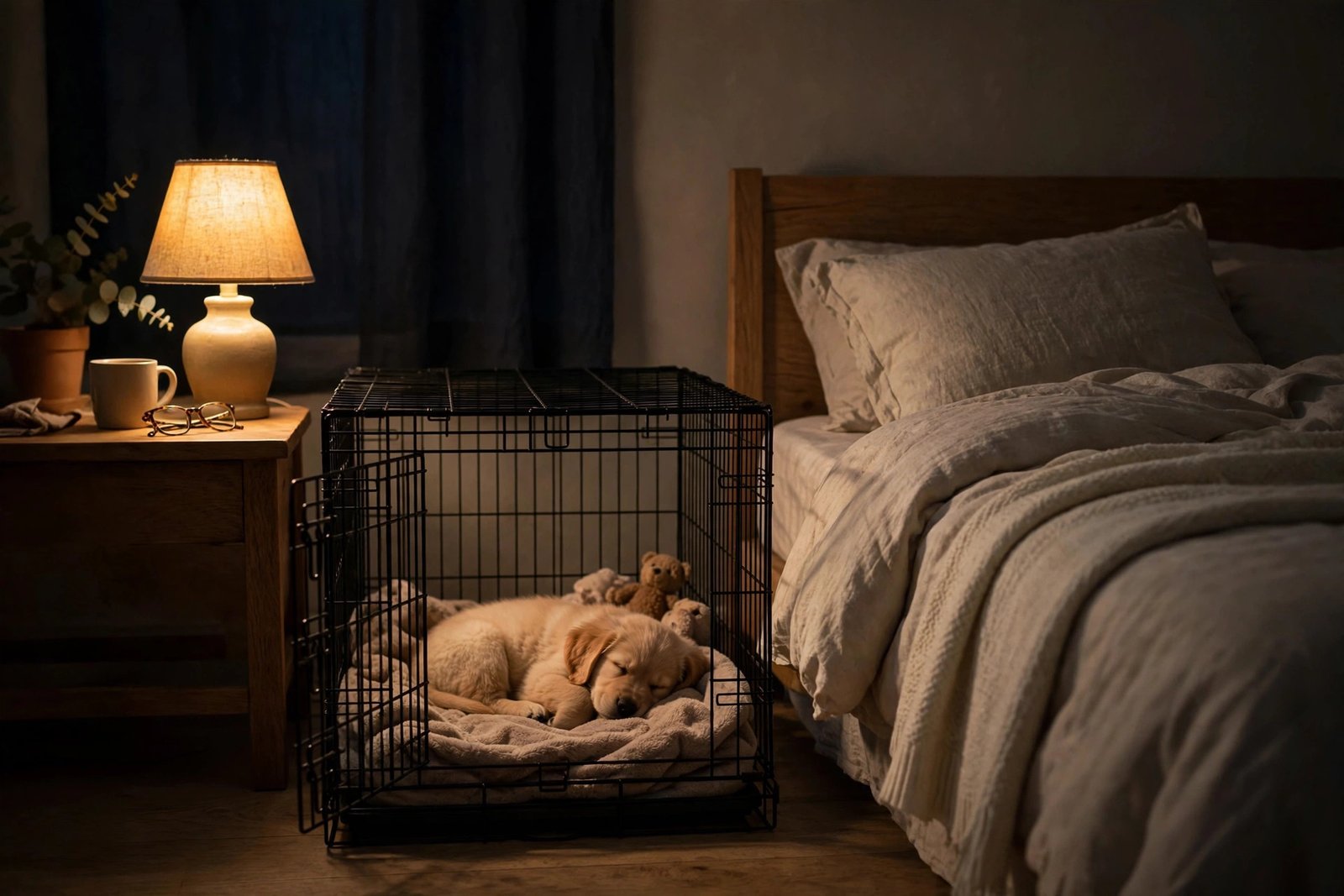
The puppy also sleeps better near you. It just left its mother and littermates, and a silent room down the hall feels like abandonment.
Follow the same routine every night. Last meal a few hours before bed, a calm chew, a potty trip, then into the crate with the cue word and a small treat. Keep the lights low and the house quiet. Once the puppy sleeps well with the crate near you, you can move it gradually to the spot you prefer.
VCA says a 2 month old puppy should go out at least every 2 hours, even overnight, and a 3 month old about every 3 hours. The AKC says most puppies can sleep through the night without a potty break by about 4 months of age, though some need longer. Plan on night trips for the first weeks, and let the puppy’s bladder decide when they stop.
Crying at night needs judgment. The Humane Society says whining in the first minutes usually means stress, and the fix is slower daytime training. Whining after the puppy has settled usually means boredom, hunger, or a need to go outside.
If the whining keeps going after a few minutes, use the phrase the puppy links to going outside. If it gets excited, take it out for a boring potty trip, then straight back in. If it does not need to go, wait until it stops whining before you open the door, and never punish it for whining.
Panic looks different from whining. Pacing, shaking, scratching or biting at the door, long bouts of howling, and drooling are signs the puppy is stressed or afraid, the AKC says. Stop the session. Go back to shorter daytime steps, and use a pen instead of the crate at night until the puppy is calm again.
When the crate is the wrong tool
Never use the crate as punishment. The AKC and the Humane Society both say this plainly. A puppy that gets sent to the crate after chewing a shoe learns that the crate is where bad things happen. Use the crate with a toy when guests arrive, before the trouble starts, and the puppy keeps its good feelings about the box.
A crate also does not fix separation anxiety. The AKC warns that dogs with separation anxiety often panic in a crate and can injure themselves trying to get out. The Humane Society says the same, and adds that the problem needs counterconditioning and desensitization, usually with a professional animal behavior specialist.
The crate also helps with how to potty train a puppy, because a puppy that likes its crate will hold it rather than soil its sleeping spot. That only works if the crate is the right size and the puppy is never left in longer than it can hold. Get those two things wrong and the crate teaches the opposite lesson.
Questions owners ask about crate training
How long does it take to crate train a puppy?
Days or weeks, the Humane Society says, depending on age, temperament, and past experiences. VCA puts the usual range at 1 to 2 months before the puppy is comfortable, with sleeping through the night taking longer.
Can I crate my puppy while I am at work?
Only if someone lets it out. A puppy under six months should not stay in a crate for more than three or four hours at a time, so a full workday needs a sitter, a walker, daycare, or a puppy proofed pen.
My puppy cries in the crate. Should I let it out?
Check the cause first. A puppy that just went in may be stressed, and the answer is shorter sessions. A puppy that settled and then cries may need to go outside. Never punish crying, and wait for a quiet moment before you open the door.
What size crate does my puppy need?
Big enough to stand up, turn around, and lie down, and no bigger. Buy for the adult size and use a divider, so the crate grows with the puppy instead of giving it room to soil one end.
Start tonight with the crate door open and a treat inside. Let the puppy walk in on its own, eat a meal there tomorrow, and close the door for a few minutes only when it is already calm. That is the whole method, repeated until the crate feels like its own room.
4 thoughts on “How to Crate Train a Puppy in Small Steps”