
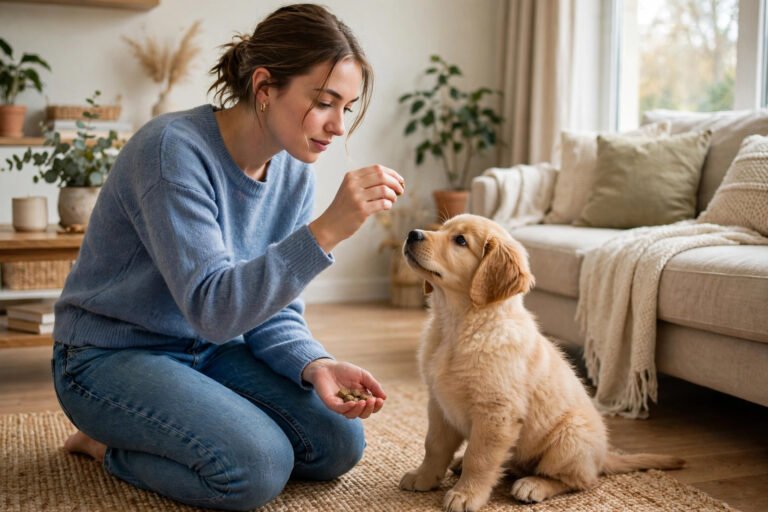
Puppy training for beginners starts with five cues, taught in short sessions with treats, and it starts the day the puppy comes home, usually around 8 weeks old. That is the whole method in one sentence. Everything else in this guide is how to run those sessions without turning them into a wrestling match.
The five cues are sit, down, come, stay, and loose leash walking. The American Kennel Club calls them the Basic 5, and says they set a puppy up for any training that comes later. Our guides on how to potty train a puppy and how to crate train a puppy cover the daily routines.
Puppy training for beginners starts with one rule
Reward the behavior you want, and do it the second it happens. That is positive reinforcement, and every source in this guide agrees on it. The American Kennel Club puts it plainly. The foundation of training should be based on positive reinforcement, which means giving a dog a reward to encourage the behavior you want.
VCA Animal Hospitals says the same thing from the other side. Puppies repeat behaviors that have a good result, and if an action leads to a treat, attention, a toy, or a chance to explore, the puppy will do it again.
Timing is the part most owners get wrong. A treat handed over five seconds late can pay for the wrong thing, because the puppy has already moved on. Say a short marker word, such as yes, the instant the puppy does the right thing, then give the treat. Pick one marker and use it every time, so the puppy never has to guess what earned the reward.
Punishment has the opposite effect. The AKC says to avoid leash corrections and yelling, because punishment can leave a dog confused about what you asked for. VCA warns that waiting until the puppy does something you do not want, then punishing it, can lead to fear and avoidance.
Keep sessions short. The AKC says five to 10 minutes, and always end on a positive note. VCA says individual sessions should be no more than a few minutes at first, done a few times a day. When the puppy starts sniffing the floor, yawning, or walking off, the session is over. End with something the puppy already knows, give a big reward, and stop.
Train in a quiet room first, and add new places one at a time, because a puppy that sits perfectly in the kitchen and ignores you in the yard has not failed. Each new place is a new lesson.
The five cues worth teaching first
Teach one cue at a time, and teach it with a lure before you add the word. VCA calls luring the use of a treat the puppy will follow, like a magnet for its nose, and says the lure fades away within 5 to 10 repetitions once the puppy understands. The cue word comes last, only when you can predict the behavior.
Sit
Hold a treat at the puppy nose, then lift it slowly up and back over its head. The bottom drops as the head rises. The moment it touches the floor, say yes and give the treat. The AKC also describes capturing, where you wait for the puppy to sit on its own and pay it.
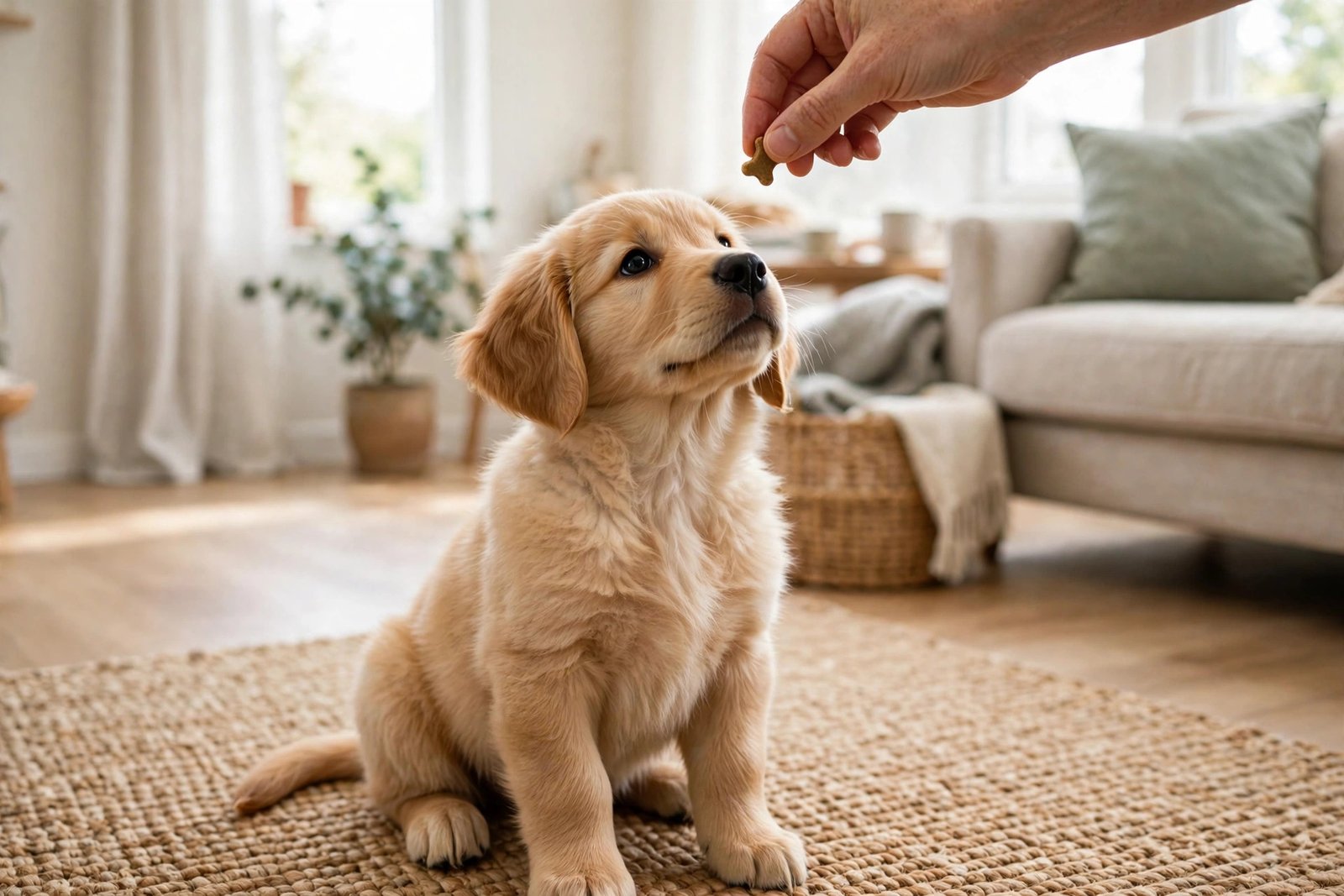
Never push the puppy bottom down. The AKC says that can confuse or upset some dogs, and it teaches nothing.
Down
Start from a sit. Move a treat from the puppy nose down to the floor between its paws, and pay it when the elbows touch. If the puppy pops back up, lure it again and pay faster.
Come
Begin indoors, in a quiet room, with the puppy a few feet away. Say its name or the word come, then pay it for turning toward you. Then toss a treat a short way off, call the name again when the puppy looks up, and pay it for coming back. Make coming to you fun, and never grab the puppy when it arrives. The AKC warns that reaching out to grab a puppy can confuse or frighten it, and a puppy that dreads the last step will stop coming.
Build distance slowly, and practice outside only in a safe enclosed area, on a long leash at first.
Stay
Stay is a duration behavior, not a position. Teach a release word first, such as OK or free, then put the puppy in a sit, pause, pay it for staying, and release it.
Add time before you add distance. If the puppy gets up early, that only means the time was too long. Go back to a shorter pause and try again.
Loose leash walking
Loose leash walking is the fifth cue, and the one owners rush most. The goal is a puppy that walks beside you without pulling, not a perfect heel. The AKC says to start by paying the puppy for standing next to your leg, then take one step and pay again as it catches up. When the puppy runs ahead, turn in the opposite direction, call it back, pay it in place, and carry on.
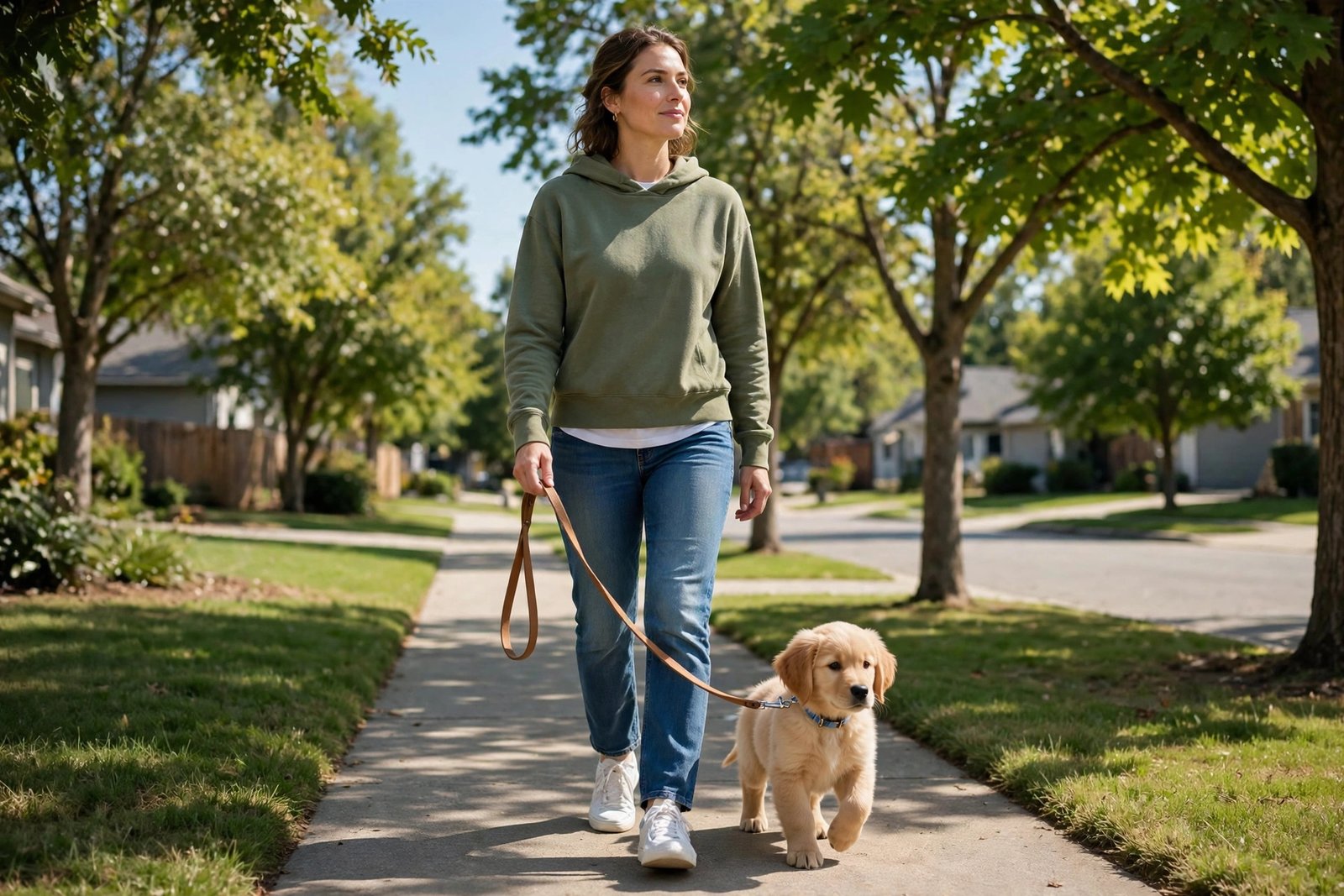
Give treats further apart over days, and let the puppy sniff along the way.
Proofing cues and fading the treats
A cue your puppy knows in the kitchen is not a cue he knows. It is a cue he knows in the kitchen. Real training starts when you take the same cue somewhere harder, and the step most owners skip is making that move gradually.
Start in a new room, then the garden, then the pavement outside the house. Each new place adds distractions, and each distraction makes the cue harder. Pay for the hard places. A sit in a quiet room earns a small treat. A sit on a busy pavement earns a better one, and a longer one. That is not bribery. It is paying the puppy for harder work, and it is how the cue survives outside the house.
Fading the treats is the second half of the same job. A puppy that only sits when he can see a treat has learned to watch your hand, not to listen to the word. Once he gets a cue right most of the time in one place, start rewarding every second or third success instead of every one, and mix in praise, a game, or a sniff of something interesting as the reward. Keep the best treats for the hardest places and the newest cues, and keep the easy wins cheap. The goal is a dog that works because the cue predicts good things, not a dog that works only when the treat bag is open. The AKC guide to basic commands covers the five cues themselves, and the routine around them is in our first-time dog owner guide.
What to do when teeth land on your hand
Every puppy mouths. The ASPCA says mouthing may seem cute at seven weeks, and far less endearing at three or four months, when the puppy is bigger and the teeth are sharper. The fix has two stages, in order.
First, teach bite inhibition, which means a soft mouth. Let the puppy mouth your hand during play. When it bites especially hard, give a high-pitched yelp, let your hand go limp, and praise it when it stops.
The ASPCA says to repeat this no more than three times within a 15-minute period. If yelping alone does not work, switch to a short time-out and ignore the puppy for 10 to 20 seconds.
Second, teach the puppy that teeth do not belong on human skin at all. Substitute a toy or chew bone whenever the puppy tries to gnaw on fingers or toes. The ASPCA says to keep tug toys in your pocket or close by, so you can redirect the puppy the instant it mouths you. If teeth touch your skin, yelp and walk away, and ignore the puppy for 30 to 60 seconds.
Jumping up works the same way. A puppy jumps because it works. Hands come down, voices rise, and the puppy gets attention. Ask for a sit when guests arrive, pay the sit before the jumping starts, and ask everyone in the house to do it the same way.
When a cue stalls: troubleshooting regressions
Every puppy stalls. A cue that was solid on Tuesday falls apart on Thursday, and the first instinct is to repeat the word louder. Louder does not help. Going back a step does.
A stall usually has one of three causes. The first is that the place got harder. A sit that worked in the kitchen fails at the park because the park is full of smells and other dogs. Move back to an easier place, get the cue right a few times, and build back up. The second is that the puppy is tired, overexcited, or in a fear period. Shorten the session to a minute or two, end on a win, and try again later. The third is that the reward stopped being worth it. If the treat is boring, the puppy’s attention goes elsewhere. Change the reward, not the cue.
What not to do matters as much as what to do. Do not punish a missed cue. A puppy that gets scolded for not sitting learns that training is stressful, and a stressed puppy learns nothing. Do not drill the same cue twenty times in a row. A puppy that fails ten times in a row has not learned stubbornness. He has learned that this session is not worth his attention. Stop, play for a minute, and come back to it tomorrow with a smaller step.
Socialization has a deadline, and it is short
Training a puppy is only half the job. The other half is socialization, which means calm, positive exposure to people, sounds, surfaces, and other animals while the puppy is young. The sources disagree on the exact window, so treat it as a range.
VCA puts the sensitive socialization period between 7 and 14 weeks of age. RSPCA Australia puts the critical period at about 2.5 to 14 weeks. The American Veterinary Society of Animal Behavior puts the most sensitive stage at roughly 3 to 16 weeks. The first three or four months matter most, and they pass fast.
Keep socialization sessions short and positive, and introduce only one or two new things at a time. That is the RSPCA Australia rule. Pair every new sight, sound, or person with something good, a treat or a game, so the puppy forms a positive association. A puppy that meets a vacuum cleaner once, from a safe distance, while eating treats, files it under safe.
Play dates help, but only with the right dogs. RSPCA Australia suggests puppy preschool classes and play dates with sociable dogs that are fully vaccinated. Until the puppy has finished its vaccines, avoid unfamiliar dogs and unclean places.
If the puppy freezes, growls, or snaps when handled, or its biting gets harder instead of softer over weeks, get a certified professional dog trainer or a veterinary behaviorist involved while the puppy is still small. The ASPCA says biting out of fear or frustration can signal problems with future aggression. A good class is also where the puppy practices its cues with distractions, so choose a trainer who uses reward-based methods, never fear or physical punishment.
Choosing a class or trainer
A good class is worth the money, and a bad one can set a puppy back. The difference is usually visible in the first ten minutes. A good trainer uses food, play, and praise, explains what to do and why, and keeps the class small enough that every puppy gets attention. Puppies work one at a time or in short turns, and the rest of the time they rest and watch, which is itself a lesson in settling.
Ask three questions before you sign up. What methods do you use, and what do you do when a puppy gets it wrong. How many puppies are in a class, and how old are they. And what should we practice at home between classes. A trainer who answers clearly, and whose answers match reward-based training, is a good sign. A trainer who talks about dominance, who uses choke chains or spray bottles, or who cannot explain what happens when a puppy fails, is a reason to leave.
Red flags are worth naming plainly. Any method that relies on fear, pain, or intimidation. Any class where puppies are flooded with stress and called socialized. Any trainer who guarantees results in a fixed number of sessions. Training is a process, not a product, and a trainer who promises otherwise is selling certainty they cannot deliver. VCA puppy behavior and training basics is a useful check for the methods in this section, and our guide to how to potty train a puppy covers the routine that supports everything in class.
Questions new owners ask about puppy training
How old should a puppy be to start training?
Puppies can begin very simple training as soon as they come home, usually around 8 weeks old, according to the AKC. Formal classes wait until the vet says the puppy has enough vaccine protection to mix with other dogs. Our new puppy checklist covers the gear and the first vet visit.
How long should a training session last?
Five to 10 minutes, says the AKC. VCA says a few minutes at first, a few times a day. Use the shorter number for a young puppy, and end while it is still winning.
My puppy knows sit at home but not outside. Why?
Context matters. VCA says a puppy that learns a skill in one place may not perform it in a new location, because the new place is a new lesson. Practice in each room, then the yard, then the sidewalk, and pay more for the harder places.
Teach sit tonight, in the kitchen, with five treats in your pocket. Say yes the instant the bottom touches the floor, and stop after five minutes while the puppy still wants more. Do that three times tomorrow, and the puppy will start offering sits without being asked.
Sources
- American Kennel Club: Teach Your Puppy These 5 Basic Commands
- VCA Animal Hospitals: Puppy Behavior and Training, Training Basics
- ASPCA: Mouthing, Nipping and Biting in Puppies
- RSPCA Australia: How Can I Socialise My Puppy
- How to Train a Puppy, citing the American Veterinary Society of Animal Behavior
5 thoughts on “Puppy Training for Beginners: The First Five Cues”