
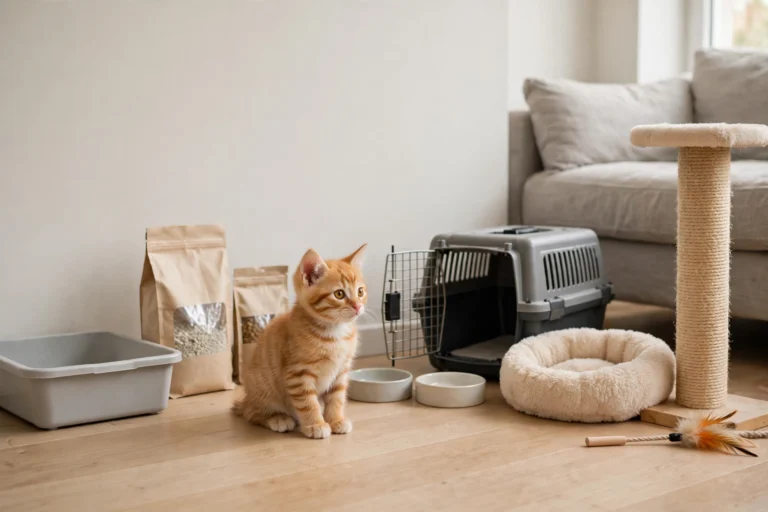
The kitten comes home on Saturday and the pet store aisle has forty kinds of food, twelve litter boxes, and a wall of toys that all look urgent. A new kitten checklist cuts that noise down to what matters in the first week.
Buy the supplies before pickup day. Set up one small room. Book the vet visit. Feed the food the kitten already eats.
Cornell Feline Health Center says the same thing in plainer terms: before bringing your new cat home, make sure you already have the basic provisions it will need, including a litter box, food, and ideally a scratching post.
The new kitten checklist, item by item
Start with a low sided, uncovered litter box a small kitten can climb into, filled with fine, unscented litter. Cornell Feline Health Center says kittens need sides low enough to enter easily, and most cats prefer unscented, fine textured litter. Add a scoop. One kitten gets two boxes once it has the run of the house.
Food comes next, and the brand matters less than the continuity. Ask the shelter or breeder what the kitten eats now and buy that exact food. Cornell Feline Health Center says to find out what your new cat has been eating and keep feeding some of the old food as you gradually switch to a new diet.
Check the bag for an AAFCO statement, since Cornell Feline Health Center says to check the packaging for AAFCO standards, and buy food labeled for kittens or growth.
Buy two shallow, sturdy bowls, one for food and one for water, and put them far from the litter box. Cornell Feline Health Center says to keep food and water dishes far away from the litter box to avoid contamination.
A carrier belongs on the list before the kitten, not after the first vet trip. Buy a hard sided carrier and leave it open in the safe room with a soft blanket inside. The ASPCA says to set the carrier up where your cat likes to hang out.
A soft bed, a hiding spot, and a tall scratching post cover rest and scratching. Cornell Feline Health Center says scratching is a normal marking behavior, and most cats can learn to use a post.
Two wand toys, a soft brush, nail clippers, and a bottle of enzymatic cleaner round out the shopping trip for kitten care for beginners. Ask the shelter for the kitten’s records and put them in the carrier pocket.

Grooming basics from week one
The brush and the nail clippers are on the shopping list already. Here is how to use them, because a kitten that learns grooming as a normal part of the week will let you do it for the next fifteen years, and a kitten that first meets a brush at six months will not.
Start with brushing. Two or three short sessions a week, a few minutes each, is enough. Use a soft brush, work in the direction the fur grows, and stop while the kitten is still enjoying it. Talk quietly, offer a treat at the end, and never hold the kitten down to finish a spot. A short session that ends well beats a long session that ends in a struggle, and the habit matters more than the amount of fur you remove.
Nail trims come next, and the rule is little and often. Trim just the sharp tip, never the pink quick inside the nail, and do one or two nails per session if that is all the kitten will allow. If you cut the quick, the nail will bleed and the kitten will remember it, so stop, press a clean cloth to the nail, and try again another day. Ask your vet to show you the first trim in person if you are unsure. One demonstration is worth more than a dozen videos.
Tooth brushing is the habit most owners skip, and it is the one that saves the most vet bills later. A finger brush or a small pet toothbrush with pet toothpaste, a few strokes on the outer teeth a few times a week, is a start. Human toothpaste is not safe for cats, so keep it out of the bathroom routine entirely. If the kitten will not tolerate it yet, a dental wipe or a vet approved dental treat is a bridge, not a replacement.
Set up one room and leave the rest of the house alone
A new kitten does not need your whole house on day one. It needs one small, quiet room with a door that closes, and that room needs everything in it before the kitten walks in.
The ASPCA gives this exact setup. Set the cat up in a small quiet room with the door closed, and give it bedding, hiding spots, toys, food, water, a scratcher, and a litter box. Some cats settle within a few hours, the ASPCA says, but most need a few days or more.
Let the kitten come to you. Sit a few feet away, talk quietly, and wait for it to approach for petting or attention. The ASPCA says to interact with the cat on its terms. When the kitten moves around confidently, open the door and let it explore the next room on its own schedule.
Keep the litter box in the quiet corner, away from the food bowls and the bed, and put the second box somewhere else entirely.
First meetings: children and other pets
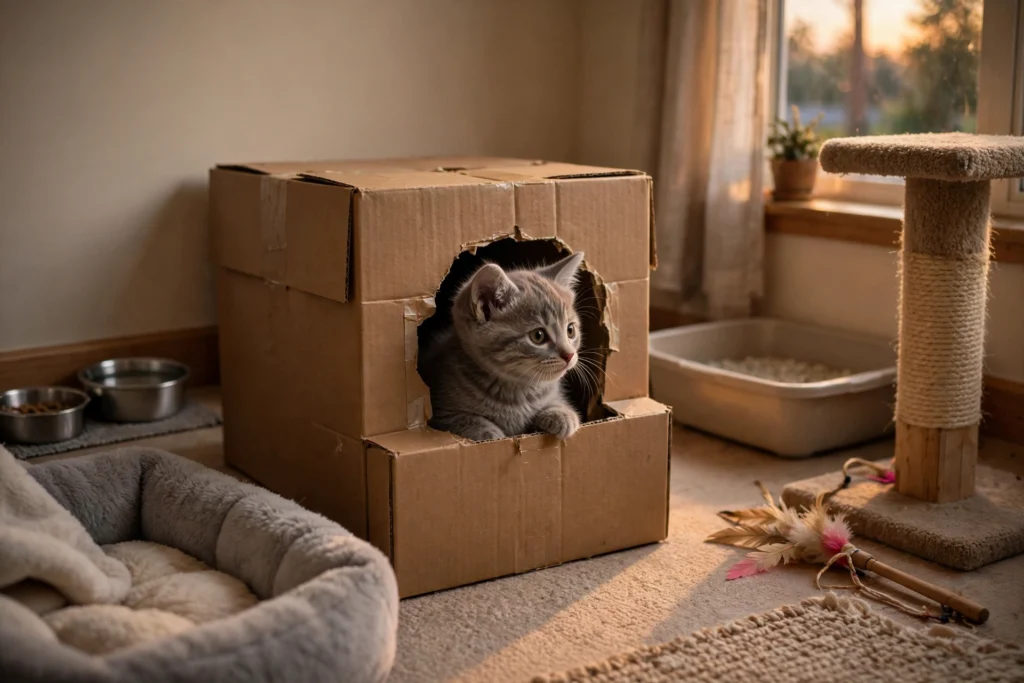
A kitten meets the house one room at a time, and it should meet the people and animals in it the same way. Start with scent before sight. Swap bedding between the kitten’s room and the other pet’s sleeping spot for a few days, so each animal learns the other’s smell before they ever see each other. Feed them on opposite sides of the closed door, so the smell of the other animal starts to mean food, not threat.
Children meet the kitten sitting down, on the floor, with an adult beside them. Show them how to hold the kitten: one hand under the chest, one hand under the back legs, close to the body, never by the scruff and never dangling. A kitten that is grabbed from above learns that small hands mean danger, and a scared kitten scratches. Short meetings are better than long ones. Five calm minutes, then the kitten goes back to its room for a rest, beats an hour of excited chasing.
The first face to face meeting with another pet should be short, supervised, and easy to end. Keep the dog on a lead or the other cat behind a baby gate. Watch the body language. A relaxed kitten explores. A frightened kitten freezes, flattens its ears, or bolts for cover, and that is your signal to end the meeting and try again tomorrow. The Cornell guide to choosing and caring for your new cat covers introductions in more detail.
Feed the food it already knows
Feed kitten food in small meals through the day, and keep fresh water down at all times. The right amount depends on the kitten’s age, size, and food, so this new kitten checklist gives no number. Our guide on how much to feed a kitten covers amounts and meal timing in full.
Switch foods slowly if you switch at all. Mix a little new food into the old food and raise the share over a week or so.
Keep people food out of the bowl. The ASPCA lists chocolate, coffee and caffeine, grapes and raisins, onions, garlic and chives, xylitol, alcohol, raw yeast dough, and milk and dairy among the people foods to avoid feeding pets.
Watch the eating itself in the first days. A kitten that skips meals, vomits repeatedly, or has diarrhea needs a vet call, not a new brand of food.
Litter takes one paragraph, not a second guide
The litter setup is one line of this checklist, not a chapter, because the detail lives in our litter guides. Use a low sided, uncovered box with fine, unscented litter, keep it clean, and put it somewhere quiet and far from the food. Our guide on how to litter train a kitten covers the full first week routine.
If the kitten goes outside the box, the setup is the first suspect, not the kitten. Our guide on kitten won’t use the litter box walks through the causes in order, spot, box, litter, cleanliness, stress, and health, so you change one thing at a time instead of buying a new box every day.
Walk the house at kitten height
Kitten proofing starts on the floor, not at eye level. Get down on your hands and knees and look for what a small animal can chew, swallow, or squeeze behind.
Cords come first. VCA Animal Hospitals says to unplug loose electrical cords or tuck them out of sight, since kittens are notorious for chewing on cords and a chewed cord can shock them. Tie up blind cords too, since VCA says they can strangle a playful kitten.
String is the quiet danger, the one that looks harmless. VCA says to put threads, rubber bands, yarns, and similar items safely away, because they are dangerous and potentially life threatening if swallowed.
Lilies outrank every other plant. Lilies from the Lilium or Hemerocallis species can be lethal to cats, and the ASPCA says even small exposures to pollen from these flowers can cause kidney failure or death in cats. Remove lilies from the house entirely, lock away medicines and cleaning products, and save the ASPCA Animal Poison Control number, (888) 426-4435, in your phone.
The first night
The first night sets the tone, and the tone you want is boring. Keep the kitten in its safe room with the door closed, the lights low, and the house quiet. Leave a night light on so it can find the litter box in the dark.
Expect crying. A kitten that just left its mother and littermates will call for them, and the sound is hard to sleep through. Sit with it for a while if that helps, then leave it to settle.
Play before bed, not after. The ASPCA says a good play session can last from 10 to 15 minutes, and to use toys during play, never your hands or feet.
Book the vet visit before the kitten arrives
Book the first vet visit for the first week, ideally within a few days of bringing the kitten home. Cornell Feline Health Center says any new cat should be checked by a veterinarian as soon as possible after coming home, and that matters most when the health history is incomplete.
At that visit, the vet will do a physical exam and check for internal and external parasites. If no health history is available, the vet will likely test for feline leukemia virus and feline immunodeficiency virus.
Vaccines follow a schedule, not a single appointment. Cornell Feline Health Center says the first FVRCP vaccination generally happens at 6 to 8 weeks old, then repeats at 3 to 4 week intervals until the kitten is 16 to 20 weeks old. Rabies vaccination follows at 8 to 12 weeks, and local law often requires it. Cornell also says cats are usually spayed or neutered at 6 months or older, though some vets recommend it earlier.
What the first month costs
Nobody likes talking about money before the kitten arrives, and everyone wishes they had. The first month has three kinds of cost, and naming them in advance stops the surprises.
The first is supplies: the box, litter, food, bowls, carrier, bed, scratcher, toys, brush, and clippers from the checklist. These are mostly one off purchases, and buying them before the kitten arrives means you are not shopping with a kitten crying in the car.
The second is the vet. The first visit, the vaccine series, and parasite prevention are the biggest single cost of the month, and the total depends on your area and on what the shelter or breeder already covered. Ask your vet for an estimate at the first visit, and ask what is included in it, so the second visit does not surprise you.
The third is the running cost: food and litter every month, plus a small reserve for the unexpected. A kitten that swallows string or eats a lily needs a vet the same day, and the ASPCA tips for a new cat are a useful reminder of what to keep out of reach. Set the reserve aside before you need it, even if it is small. Our guide to how to litter train a kitten covers the routine that sits underneath all of this spending.
A first week that fits on the fridge door
Day one is the safe room, the litter box, the food bowls, and quiet. Show the kitten each spot once, then leave it alone to explore. Day two adds short play sessions and a first gentle brush.
Day three is the vet visit if it is not already booked. Day four opens the next room, one room at a time, with the safe room door left open so the kitten can retreat. Day five introduces the carrier as a bed, door open, treat inside.
By day seven, the routine should look boring, same food, same times, same spot. Boring is the goal in week one.
Questions new kitten owners keep asking
What do I need for a new kitten on day one?
A low sided litter box with unscented litter, the food the kitten already eats, two shallow bowls, a carrier, a bed, a hiding spot, a scratching post, and a few wand toys. Add a vet appointment in the first week.
How old should a kitten be before it comes home?
Cats Protection recommends that kittens stay with their mother until at least 8 weeks. A kitten that arrives younger needs extra care, so ask your vet what to adjust.
When should a new kitten see the vet?
As soon as possible after coming home, Cornell Feline Health Center says, and within the first week at the latest. The first FVRCP vaccine generally starts at 6 to 8 weeks, with boosters every 3 to 4 weeks until 16 to 20 weeks.
Can I give my kitten cow’s milk?
No. The ASPCA lists milk and dairy among the people foods to avoid feeding pets. Give fresh water and kitten food instead.
Buy the box, the food, and the carrier today, set up the safe room tonight, and book the vet visit before the kitten arrives. Everything else on this new kitten checklist can wait until you know the kitten.
8 thoughts on “New Kitten Checklist: What to Buy Before Your Kitten Comes Home”