
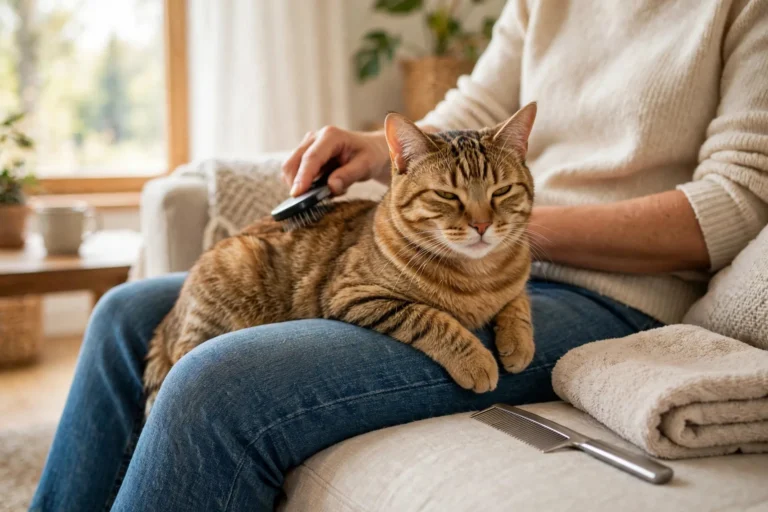
Cats groom themselves for hours a day, and they still need your help. Learning how to groom a cat at home means brushing out the loose fur your cat would otherwise swallow, trimming nails before they curl into the pads, and checking ears and teeth while your cat is still calm enough to let you. Most cats need a short session once or twice a week, and long-haired cats need a few minutes every day. A bath only enters the picture when the coat gets dirty or sticky.
Brush first, because a wet tangle turns into a mat.
The kit: five tools and a towel
You need less than the pet store shelf suggests. A slicker brush, a steel comb with wide and fine teeth, cat nail clippers, a cat toothbrush with cat toothpaste, and a cat shampoo cover almost every cat. Add a towel and a few treats, and you are set.
Pick tools for the coat in front of you. A rubber curry brush or a grooming glove suits a short coat. A long coat needs the steel comb more than any brush, because the comb is what finds the tangles hiding near the skin.
Scissor style clippers fit cat nails best, since the curved blades snip the tip without cracking the nail. Skip human and dog clippers. Cat nails are thin and split easily under the wrong tool.
Buy the shampoo before you need it, not during a crisis. Human shampoo, including baby shampoo, has the wrong pH for a cat’s skin and can irritate it. If you are still gathering first supplies for a new arrival, our new kitten checklist covers the grooming tools along with everything else a kitten needs in week one.
How to groom a cat at home starts with the brush
Learning how to brush a cat starts with timing. Pick a calm moment, when your cat is already settled and half asleep. Set the cat in your lap, and start with a few strokes on the back, where most cats like to be touched. Work in the direction the fur grows, in short sections, and let the cat walk away if it wants to.
A cat that leaves on its own terms comes back next time. A cat that gets pinned does not. Groomers who work with cats every day keep sessions under five minutes. Two minutes of brushing that ends with a treat teaches your cat more than ten minutes that ends with a struggle.
Short-haired cats: once a week is plenty
Short-haired cats shed less visibly, and that fools people into skipping the brush. The loose fur still has to go somewhere, and without a brush it ends up in your cat’s stomach. Cornell University’s College of Veterinary Medicine points out that loose fur removed during grooming will not wind up on the furniture, and your cat will swallow less hair and have fewer problems with hairballs.
Brush a short-haired cat once a week, and up to three times a week if the coat is thick or plush. A slicker brush, a rubber curry brush, or a grooming glove all work. Brush gently in the direction of hair growth, then run a steel comb through the same section. If the comb glides from skin to tip, that section is done.
Check the spots the tongue misses while you are there: behind the ears, under the front legs, around the neck, the belly, and the base of the tail.
Long-haired cats: daily, and the comb matters more than the brush
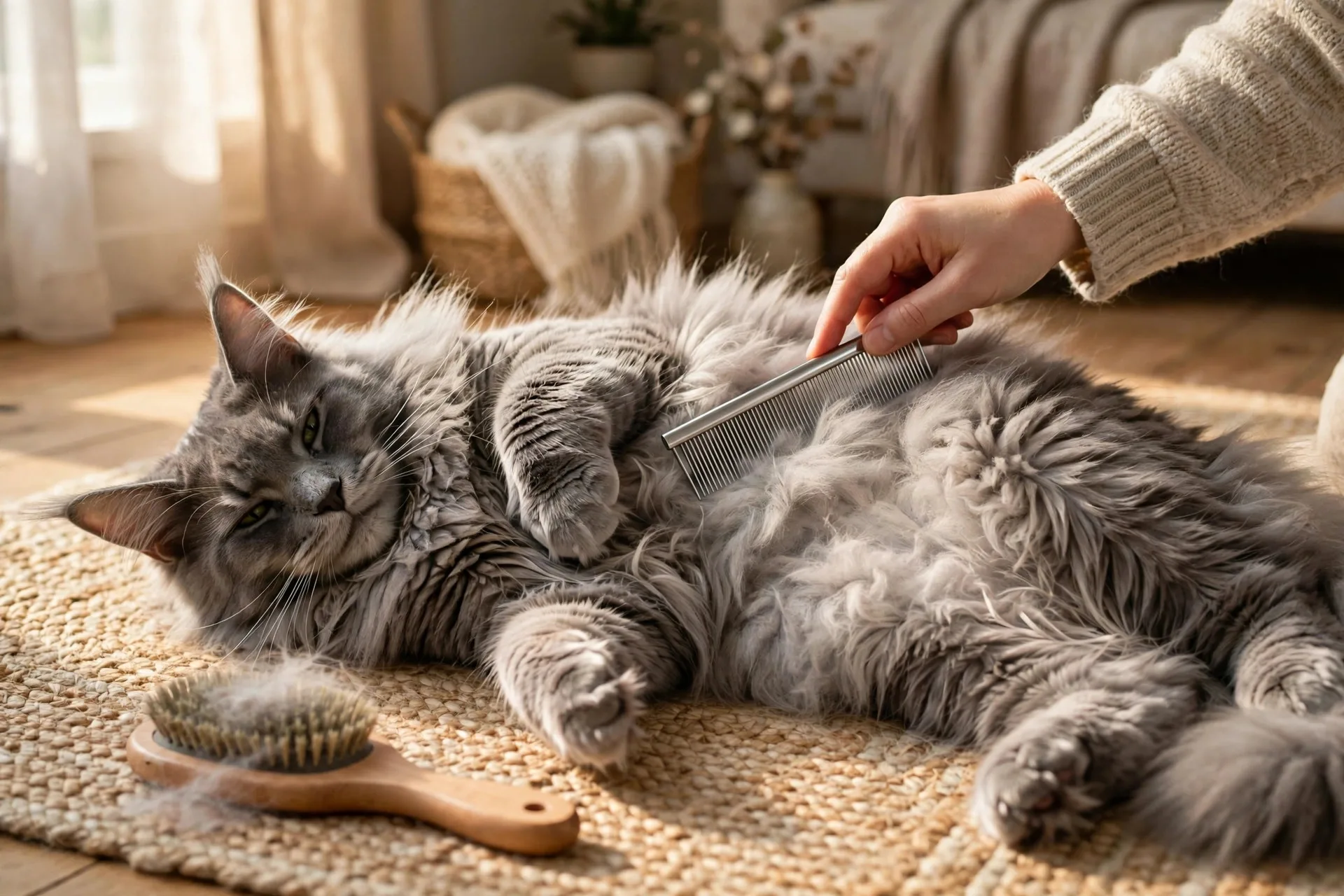
Learning how to groom a long-haired cat means learning to use the comb. A brush glides over the top of a long coat and leaves the undercoat untouched. The steel comb is what reaches the skin, and the skin is where mats start.
If you own a Ragdoll, a Maine Coon, or a Persian, plan on a few minutes every day. Our Ragdoll guide has more on the breed’s coat.
Start with the brush to take off loose surface hair. Then work the comb through one section at a time, from skin to tip. Focus on the high friction areas first: the belly, the armpits, and between the back legs.
That is where the coat rubs against itself all day and where mats form fastest. Hold the base of a tangle with your fingers so you do not pull on the skin, and work it apart from the tips inward.
Never cut a mat out with scissors. Skin folds into a mat, and scissors cut skin easily. A tight mat close to the skin belongs to a professional with a mat splitter or clippers.
Baths are the exception, not the routine
Most healthy cats rarely need a bath. They wash themselves, and bathing too often strips the oils that protect their skin. Groomers recommend a bath about once every three months for most cats, according to Rover’s guide, which interviewed two certified feline groomers. Long-haired and curly-haired cats may need one once a month, and hairless cats need weekly baths because their skin touches everything directly.
Bathe your cat when the coat is visibly dirty or greasy, when the cat has gotten into something sticky or smelly, or when your vet recommends a medicated bath for a skin condition. Older cats and overweight cats sometimes cannot reach their backs and hindquarters anymore, and they need a bath for the spots they can no longer wash. Kittens under two months old should not be bathed at all, since they cannot regulate their body temperature yet. A warm damp cloth does the job for a young kitten.
When a bath is due, prepare first. Trim the nails first, and brush thoroughly before the bath. A tangle that gets wet tightens into a mat.
Use a sink or a shallow tub with a few inches of lukewarm water, and a rubber mat on the bottom so the cat can stand steady. Wet the coat with a pitcher or a cup, work a cat shampoo through the fur from nose to tail, and keep water out of the ears and eyes. Rinse until the water runs clear, because shampoo left in the coat irritates the skin. Then towel dry the cat and keep it somewhere warm.
If the cat panics, stop, dry the cat off, and try another day or ask a groomer. For the small messes that do not deserve a full bath, a cat grooming wipe or a damp cloth handles it in a minute.
Nails: take a little, and stop before the quick
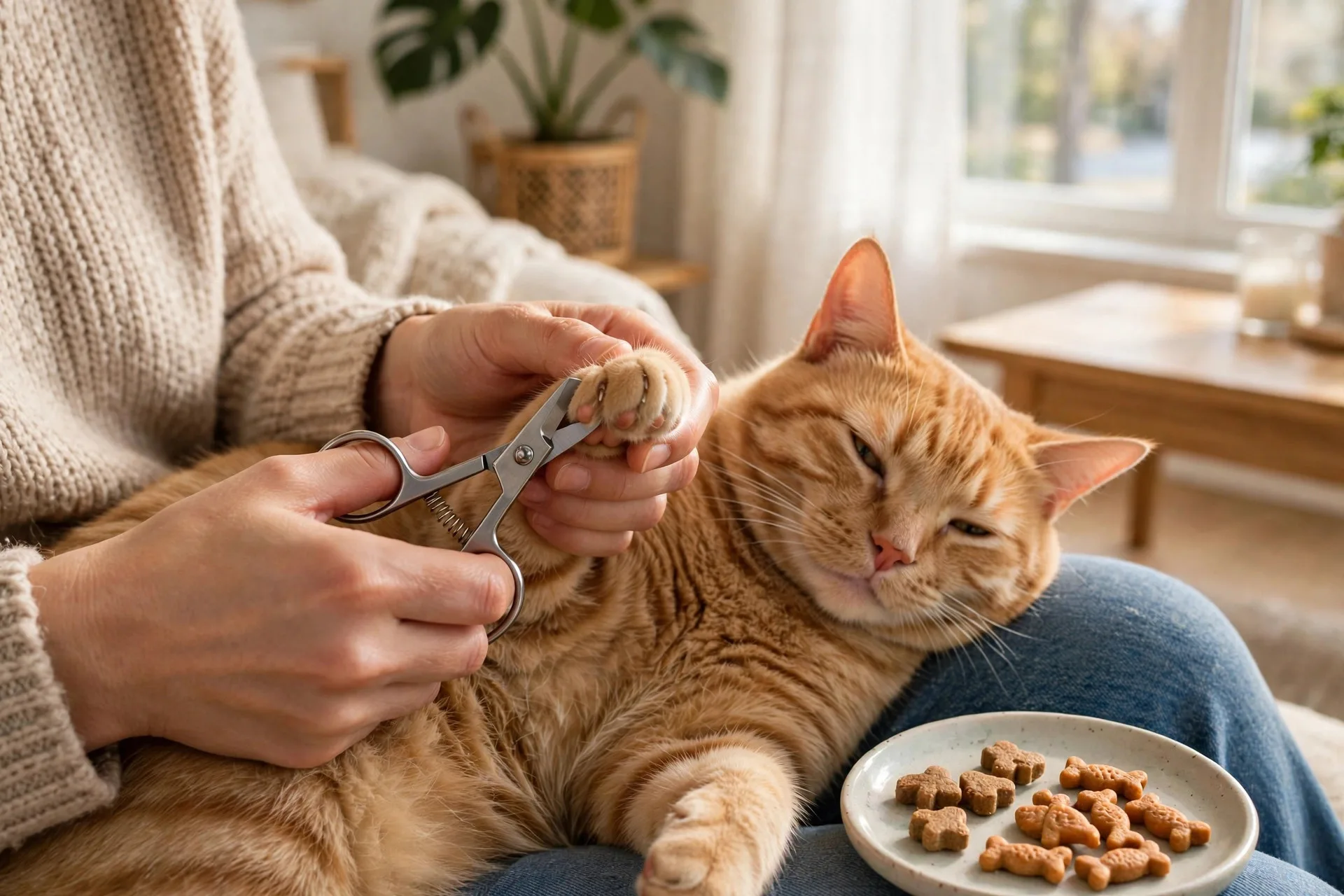
Indoor cats need regular nail trims because they do not wear their claws down on rough ground the way outdoor cats do. The ASPCA recommends trimming a cat’s nails every ten days to two weeks. Groomers who trim nails daily put the range at every two to four weeks, so treat the calendar as a starting point and check the nails themselves.
If the claws click on hard floors, or catch on fabric, they need a trim. Cornell warns that a nail left too long can grow into the foot pad and cause an infection, and older cats that scratch less are the ones most at risk.
Wait for a relaxed moment. Set the cat in your lap, hold one paw gently, and press the pad lightly so the claw extends. On a light colored nail you can see the pink quick inside. Cut only the clear sharp tip, and stay well away from the pink.
Hold the clippers at a 45 degree angle and snip. On dark nails you cannot see the quick, so take even smaller cuts and stop sooner.
Trim two or three nails and stop if the cat gets restless. Many owners trim a paw a day and finish the set across a week. That counts. The cat does not keep score.
If you do nick the quick, stay calm. Press styptic powder or corn starch onto the tip and hold it there until the bleeding stops. If it keeps bleeding for more than a few minutes, call your vet. Keep the powder within reach before you start.
Never declaw a cat as a substitute for trimming. The ASPCA, the AVMA, and nearly every major veterinary group oppose it.
Ears and teeth take five minutes a week
Ears mostly need a look, not a clean. Most cats have upright ears with good airflow, and they keep them clean themselves. Check the ears once a week when you brush. A healthy ear looks pale pink inside, with a little wax and no smell.
If you see redness, dark gunk, or a smell, or if your cat scratches at its ears or shakes its head, book a vet visit. Ear mites and infections hide behind those signs, and cleaning will not fix them.
Do not clean the ears with cotton swabs, baby wipes, or anything with alcohol. Swabs push debris deeper, and alcohol stings and irritates sensitive ear skin. If your vet says the ears need cleaning, they will recommend a cat ear cleaner and show you how to use it.
Teeth need more of your time than ears do. Between 50 and 90 percent of cats over the age of four have some form of dental disease, according to Cornell, cited in Rover’s grooming guide. Brushing is the one thing at home that lowers that risk. Aim for every other day, and accept two or three times a week if that is what your cat tolerates.
Start slow. Let your cat sniff the toothpaste on your finger, then sniff the brush, then feel the brush touch the mouth. Reward each step with a treat.
Once the cat accepts it, lift the lip, put a pea sized amount of cat toothpaste on a cat toothbrush, and brush the outside of the teeth and the gum line in small circles. Use toothpaste made for cats only. Human toothpaste can upset a cat’s stomach, and cats do not spit.
While you brush, look at the gums. They should be pink, not red or white, with no swelling.
Reading the cat: when to stop
Grooming works when the cat cooperates, and the cat cooperates when it feels in control. A cat that can leave will stay longer next time. A cat that gets held down learns that grooming means a fight.
Watch for the signs that the session is over. The tail starts lashing instead of resting. The ears flatten. The skin along the back ripples.
The cat turns its head toward your hand and stares, or it tries to walk away.
Any one of those means stop. You do not need to wait for a hiss or a bite. The early signs are the polite version of the same message, and a cat that has to escalate to be heard will escalate faster next time.
Stop while the cat is still relaxed, and end with a treat. The last thirty seconds of a session are what the cat remembers. If the session ends calmly, the next one starts easier. If it ends in a struggle, the next one starts with a cat that hides under the bed when it sees the brush.
When to hand the cat to a professional
Home grooming covers most cats most of the time, and it still has limits. A groomer or a vet should handle a mat that sits tight against the skin, a sanitary trim under the tail and down the back legs, and any cat that panics at nail trims after weeks of slow work.
See your vet sooner if the coat changes. A dull coat, bald patches, a smell that stays after a bath, or a cat that suddenly grooms one spot raw can point to something under the skin. You are the person who sees the skin every week, and that regular look is how small problems get caught early.
Our guide on how to groom a dog at home runs the same routine for dogs: brush first, stop while the animal is still calm, and let a professional handle the rest. Cats and dogs disagree on most things. They agree on that one.
Questions owners ask about grooming a cat at home
How often should I brush my cat?
Short-haired cats need brushing once a week, and long-haired cats need it daily. Thick coated short-haired cats do better with two or three sessions a week, and shedding season adds a session for every coat type.
Do cats need baths?
Most healthy cats rarely need a bath, about once every three months. Bathe your cat when the coat gets dirty, greasy, or sticky, when your vet prescribes a medicated bath, or when an older or overweight cat cannot groom itself properly. Use a shampoo made for cats.
How do I groom a long-haired cat without mats?
Comb to the skin every day, and brush first to clear loose surface hair. Focus on the belly, armpits, and between the back legs, where the coat rubs and mats form. Hold the base of any tangle so you do not pull the skin, and never cut a mat out with scissors.
My cat hates being brushed. What do I do?
Shorten the session to a minute or two, use a grooming glove instead of a brush, and pay the cat with a treat after every few strokes. Let the cat walk away. If the cat still panics after weeks of slow work, ask your vet or a groomer for help rather than forcing it.
Sources
- Rover: How to Groom a Cat, from Brushing to Baths and Nail Trims
- Cornell University College of Veterinary Medicine: Choosing and Caring for Your New Cat
- Aristo Pets: How to Groom Your Cat at Home, a Vet-Backed Guide
- WebVet: How to Groom a Cat at Home, Even One That Hates It
- NYC Animal Care Centers: Feline Grooming Tips