
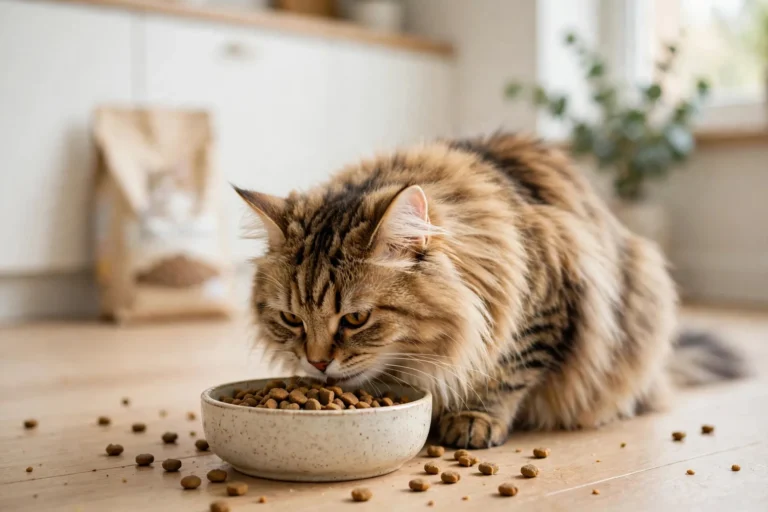
The best cat food for hairballs is a complete food with named fibre and enough moisture, fed to a cat that gets brushed. No bag on the shelf does the job alone, and no bag needs to cost a fortune to work.
Hairballs start with grooming, so food is one lever out of three. The other two are the brush and the water bowl. Get all three right and most cats bring up far fewer hairballs, while getting only the food right still leaves one on the rug at 3am.
That 3am sound is familiar to most cat owners. The retching, the pause, then the small damp tube on the floor. It looks nothing like a ball.
Cornell University College of Veterinary Medicine describes hairballs as slender and cylindrical, more like a small cigar, because the narrow food pipe squeezes them on the way out. They are usually about an inch long, though Cornell notes some reach five inches long and an inch thick. The medical name is trichobezoar.
Why your cat keeps making them
A cat’s tongue is covered in tiny backward slanted hooks called papillae. They catch loose dead hair and push it down the throat. Cornell explains that most swallowed hair passes through the digestive tract and leaves in the stool.
Some of it stays in the stomach and slowly clumps into a wet mass. When that mass gets big enough, the cat retches it back up.
Kittens rarely produce hairballs because they spend less time grooming. Older cats groom with long practice, so they swallow more fur.
Long haired breeds sit at the top of the list. Cornell names Persians and Maine Coons as significantly more at risk than short haired breeds, and a long haired Ragdoll sheds just as much loose fur. Shedding season makes it worse for every coat type.
The question is how to keep swallowed hair moving through the gut instead of sitting in the stomach long enough to clump. That is where food earns its place, and also where its limits show. Nothing dissolves a hairball once it has formed.
The best cat food for hairballs is the one that fits your cat
There is no single winner here. What matters is what the food does inside your cat: fibre and moisture, plus digestibility.
Fibre is the main mechanism. Most hairball control foods are high fibre products, and Cats.com notes that fibre additives help food and hair move through the digestive tract. Insoluble fibre adds bulk that carries hair along with the stool, while soluble fibre holds water and keeps stools soft.
Look for named sources on the label, such as powdered cellulose, beet pulp or psyllium, rather than a vague promise of “natural fibre.” If the bag will not tell you where its fibre comes from, that tells you something too.
Moisture is the second mechanism, and it is the one dry food cannot give you. WebMD points out that a cat eating only dry food may not take in enough water for its digestive system to work as it should. Wet food carries water inside every bite.
Dry hairball formulas still have value. A dry formula plus a cat that barely drinks is simply a weaker combination than most owners realise.
Digestibility is the quiet third factor. Cats.com makes the point that a cat with chronic hairballs should first eat an optimally digestible diet, and only then try extra fibre. A food built mostly from meat leaves less residue in the gut. Extra fibre on top of a poor diet is a patch on a leak.
One more thing the label will not tell you: hairballs can point to a food problem that has nothing to do with fibre. Cats.com notes that food allergies causing itchy skin make cats groom more, and more grooming means more swallowed hair. If your cat scratches a lot and brings up hairballs often, ask your vet about a limited ingredient or hypoallergenic food. A diet change is also a diagnostic tool, and guessing wastes months.
Reading a hairball label without getting fooled
Walk down the cat food aisle and every second bag claims hairball control. Most of the claims rest on the same trick: added fibre. That is fine as far as it goes, but fibre alone does not make a complete diet. A bag can be high fibre and still poor food.
Start with the adequacy statement: the food should say it is complete and balanced for your cat’s life stage, following AAFCO profiles or feeding trials. If that statement is missing, put the bag back.
Then look at the fibre sources and the first few ingredients. Named animal protein should lead the list. A hairball formula that starts with corn and byproducts and ends with a sprinkle of cellulose is selling the word hairball, not the result.
Price tells you almost nothing here. Grocery store formulas and clinic sold formulas use the same basic mechanism. The expensive bag may add omega 3s or a more digestible protein, and those are real benefits, but they do not make the fibre work harder.
Buy the bag your cat will eat, that fits your budget, and that your vet agrees with, then judge it over four to six weeks. One week is not a trial.
Brushing beats the bag
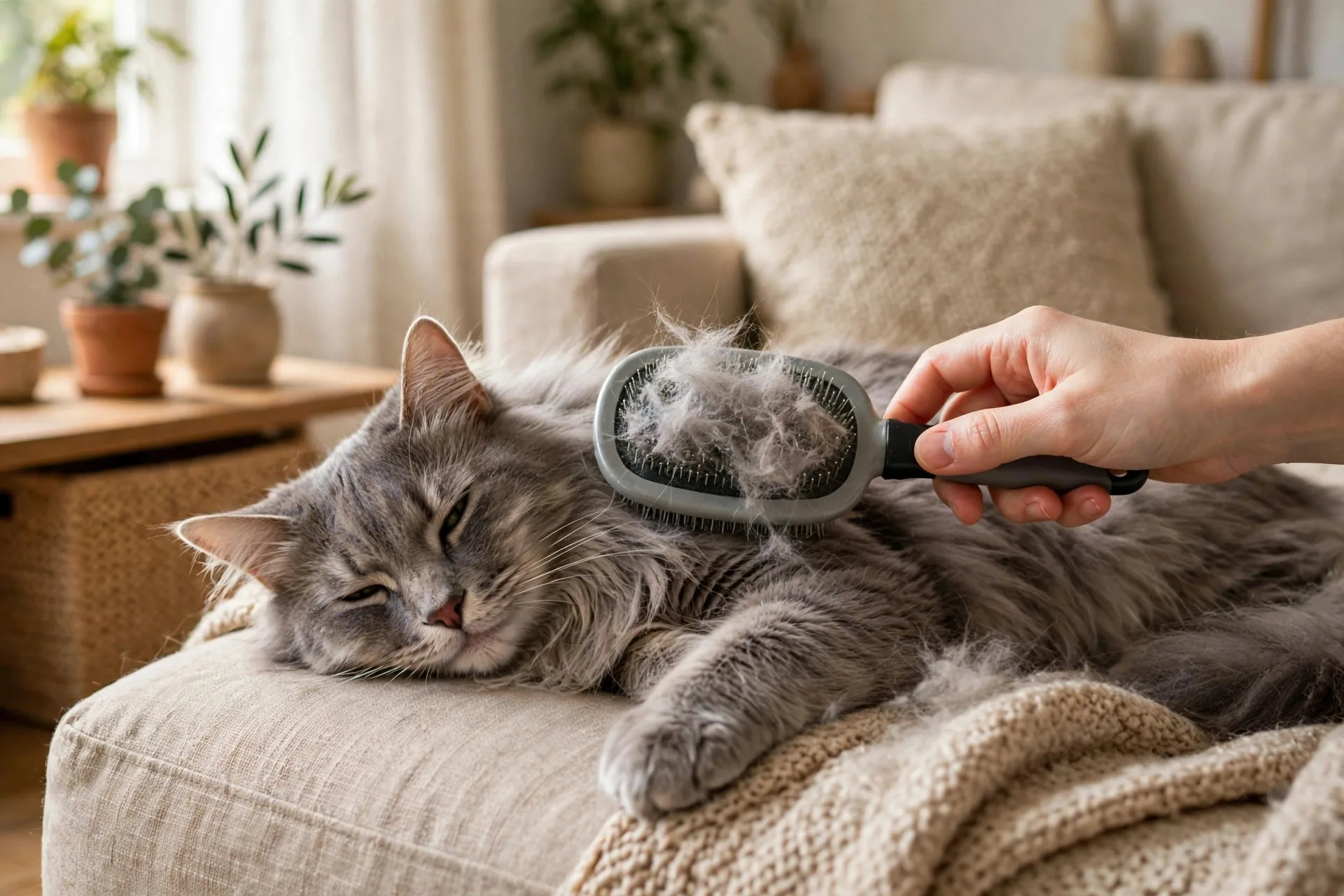
Here is the awkward truth for a food article: the brush does more than the food. Every hair you brush off your cat is a hair your cat does not swallow. WebMD recommends combing or brushing daily, and says it can also be a way to bond with your cat.
Long haired cats need daily brushing. Short haired cats do well with a few sessions a week, more during shedding season.
If your cat hates the brush, start short and end before the cat objects. A grooming glove or a de shedding tool works for cats that will not tolerate a slicker brush.
After brushing, a wipe with a damp cloth or a fragrance free baby wipe picks up the loose fur the brush missed. WebMD suggests exactly that. It takes thirty seconds and it catches the fur that would otherwise end up in the stomach.
Professional grooming helps too, especially for long haired cats that will not sit still for you. A trim once or twice a year, done by a vet or a reputable groomer, cuts the loose hair load dramatically.
Water is the quiet lever
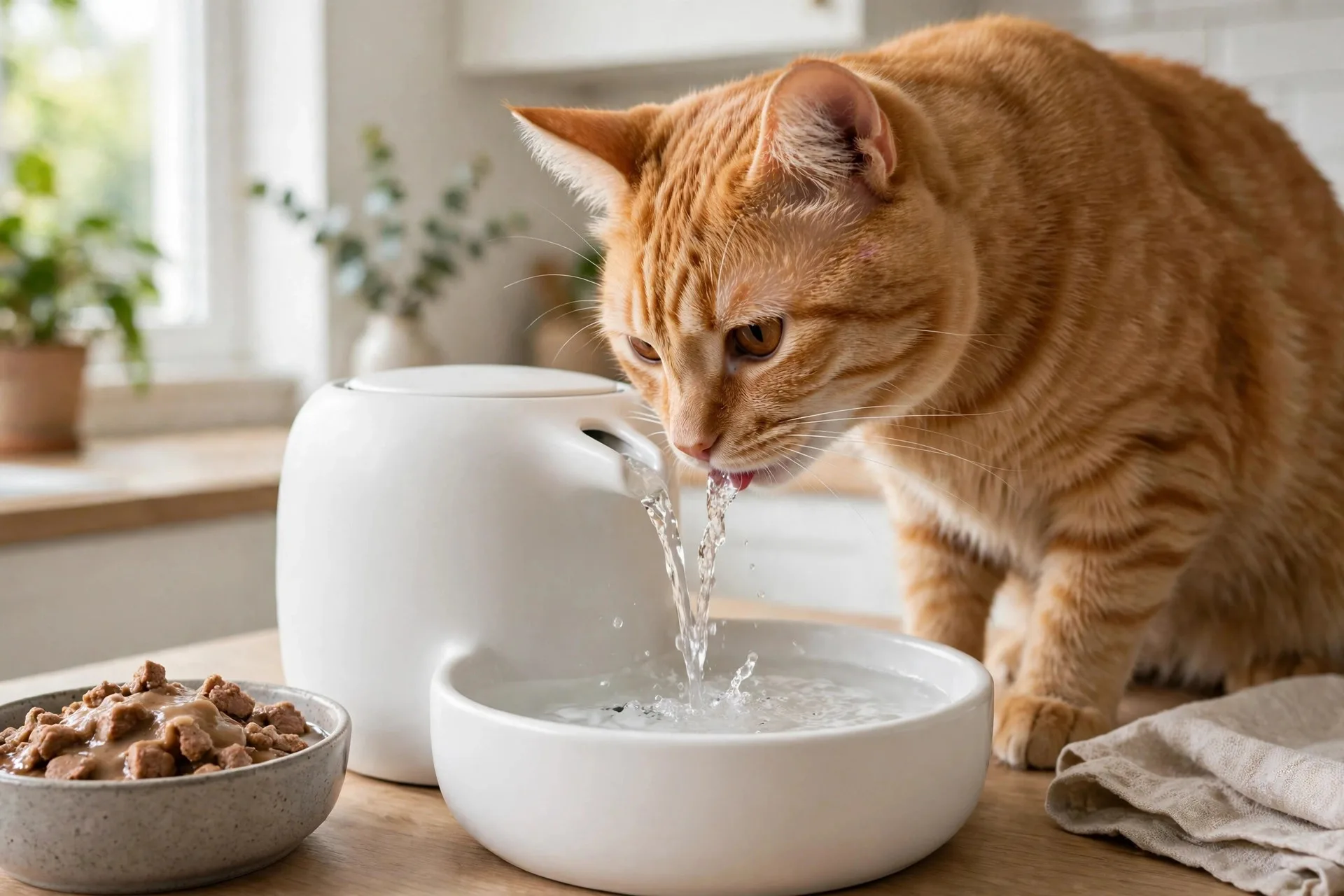
Cats descend from desert animals and their thirst drive is famously low. A cat on dry food alone is often mildly dehydrated, just enough for the gut to move more slowly. Slow gut movement gives swallowed hair more time to clump.
Wet food is the simplest fix: a cat eating wet food takes in a large share of its daily water with its meals.
A water fountain often gets more use than a still bowl because cats prefer moving water. Several bowls in different rooms help too. Fresh water, changed daily, matters more than any gadget.
Some owners add a spoonful of water or low sodium broth to dry kibble. That works for cats that accept it, and others walk away in disgust.
Try it once. If the cat refuses, do not fight about it. The fountain or the wet food will do the job instead.
Cat hairball remedies that help, and ones that do not
Food and brushing cover prevention. Remedies cover the hair that is already inside. A few have real support.
Plain canned pumpkin is the most useful home remedy. It adds soluble fibre and moisture at the same time. Use plain pure pumpkin, not pumpkin pie filling, which has added sugar and spices.
A teaspoon a day mixed into food is the amount most vets suggest. Catster calls it a reliable fibre source that most cats accept without a fuss.
If your cat is already eating a high fibre hairball formula, ask your vet before adding more fibre. Too much fibre can block nutrient absorption and cause loose stools.
Petroleum based hairball gels are the standard over the counter option. They coat hair so it slides through instead of clumping, and Cornell recommends a mild petroleum based laxative once or twice a week as part of prevention. Put a dab on the cat’s paw and the cat licks it off.
Check with your vet first, especially if your cat has other health conditions, because a laxative can be the wrong choice for some cats.
Egg yolk lecithin is worth knowing about. Egg yolks contain lecithin, which emulsifies the fat that binds hairballs together. They also contain choline, which supports the gut contractions that move food along.
Cats.com explains both mechanisms and notes that a small amount of egg yolk in food can help. It adds calories, so adjust portions to match. Our guide to how much to feed a kitten covers portions by age, and the same principle applies to adults.
What does not help? Butter and oil. Cats.com is blunt about this: butter and oil are digested and absorbed before they can lubricate anything, and too much fat can cause digestive problems of its own.
Mineral oil is worse, because a cat can inhale it into the lungs and develop pneumonia. Skip both. Never give a human laxative without a vet saying so. The dose and the ingredients are wrong for cats.
Some cats overgroom because they are stressed or in pain. Catster notes that compulsive licking dramatically increases fur intake. If your cat licks the same patch bare, no food will fix it until the cause is treated.
When hairballs stop being normal
An occasional hairball in a cat that eats and plays normally is nothing to worry about. Cornell says bringing up a hairball every week or two is nothing to worry about in a cat that is otherwise well. The line between normal and worth a vet visit is still thinner than most owners think.
Veterinarian Gary Norsworthy, quoted by Cats.com, argues that vomiting hairballs twice a month or more signals chronic small bowel disease, with an even lower threshold for short haired cats.
That is a stricter view than Cornell’s, and the disagreement itself is useful. It means frequency is a signal worth tracking. Two hairballs a month in a long haired cat that is otherwise well is one thing. Two a month in a short haired cat that is also losing weight is another.
Call your vet promptly if your cat retches repeatedly without producing anything, cannot keep food or water down, stops eating for more than a day, or becomes lethargic. WebMD warns that a lodged hairball can block the intestine, which can be fatal without treatment. A blockage sometimes needs surgery.
Also watch for coughing that gets blamed on hairballs. Cornell warns that repeated hacking may have nothing to do with hair at all. It can be a sign of asthma or another breathing problem that needs emergency care.
If your cat hacks often and never produces a hairball, get it checked.
Frequently asked questions
What is the best cat food for hairballs?
The best cat food for hairballs is a complete and balanced food with named fibre sources and enough moisture, built around protein your cat will actually eat. No single brand wins for every cat. Judge a food by fewer hairballs over four to six weeks, not by the claims on the bag.
Does wet or dry food help more with hairballs?
Wet food helps through moisture, which keeps the gut moving. Dry hairball formulas help through extra fibre. A mix of both, plus regular brushing, usually beats either one alone.
How do I help a cat with hairballs at home?
Brush daily for long haired cats and several times a week for short haired cats, add wet food or a water fountain, and consider a teaspoon of plain canned pumpkin a day. Ask your vet before using a hairball gel or laxative. Our guide to what cats can safely eat lists safe foods and ones to avoid.
Can hairballs be dangerous?
Yes, though it is rare. A hairball can grow too large to pass or lodge in the intestine and cause a blockage. Signs include repeated unproductive retching, loss of appetite and constipation, along with a bloated abdomen or lethargy. Those signs need a vet promptly.
Sources
- Cornell Feline Health Center: A Hairy Dilemma
- WebMD: Hairballs in Cats: Causes, Symptoms, and Remedies
- Cats.com: Best Cat Food for Hairball Control
- Catster: The Surprisingly Simple Ways to Help a Cat With Hairballs
- Catster: How to Help Your Cat Pass a Hairball