
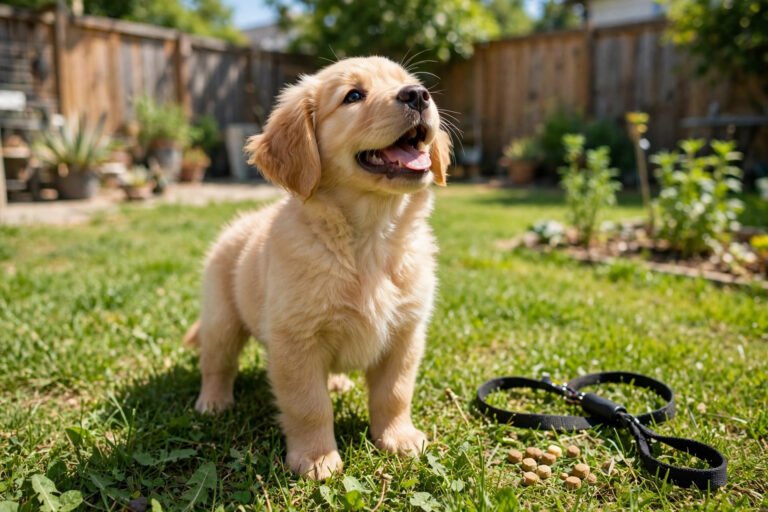
You brought the puppy home yesterday, and it has already peed on the rug twice. That is normal, and it is also the whole job for the next few weeks. Learning how to potty train a puppy means taking it out before it needs to go, rewarding it the second it goes in the right spot, and cleaning up accidents without making a scene.
Start on day one. The American Kennel Club says potty training should begin the day your puppy comes home, and VCA Animal Hospitals says the same. Puppies start learning household routines at once, so the first week sets the pattern. If you have not bought the basics yet, our new puppy checklist covers the crate, the collar, and the rest of the first week gear.
The puppy potty training schedule that actually works
A puppy potty training schedule runs on triggers. The clock helps, but the triggers are what save the rug. Take the puppy out first thing in the morning, last thing at night, after every nap, after every meal, after drinking water, after play, after chewing a toy, and after time in the crate. The American Kennel Club lists all of those, and says a very young puppy may need a dozen trips outside or more each day.
Between triggers, go out every one to two hours while the puppy is awake. VCA Animal Hospitals gives that exact range, and adds two more rules. Take the puppy out every half hour during high energy play, and every four hours even if it has been resting.
PetMD puts a number on the youngest puppies. An 8 to 12 week old puppy can only hold its bladder for two to three hours.
How long can a puppy hold it? The sources disagree, so treat every number as a rough guide. The American Kennel Club says a puppy can generally hold its bladder for about the same number of hours as its age in months, up to about 9 months to 1 year of age. A 6 month old puppy may hold it for around six hours by that rule. The same organization gives a different rule on another page, age in months plus one hour. Neither rule comes from a study. Use the shorter number as your ceiling, and shorten it again the moment you get an accident.
Nights follow the same logic. VCA Animal Hospitals says puppies may need overnight outings until they are 5 months of age. Pick up the water bowl a couple of hours before bed, take the puppy out last thing, and set an alarm for one middle of the night trip while it is still young. The night trip means the schedule is working.
Read the signs, then move fast
A puppy rarely goes without warning. The American Kennel Club lists the common signs. Sniffing the ground, circling, suddenly stopping play, whining or scratching at a door, and becoming restless. VCA Animal Hospitals adds that many puppies pause what they are doing and squat, and that some get restless when their bladder is full.
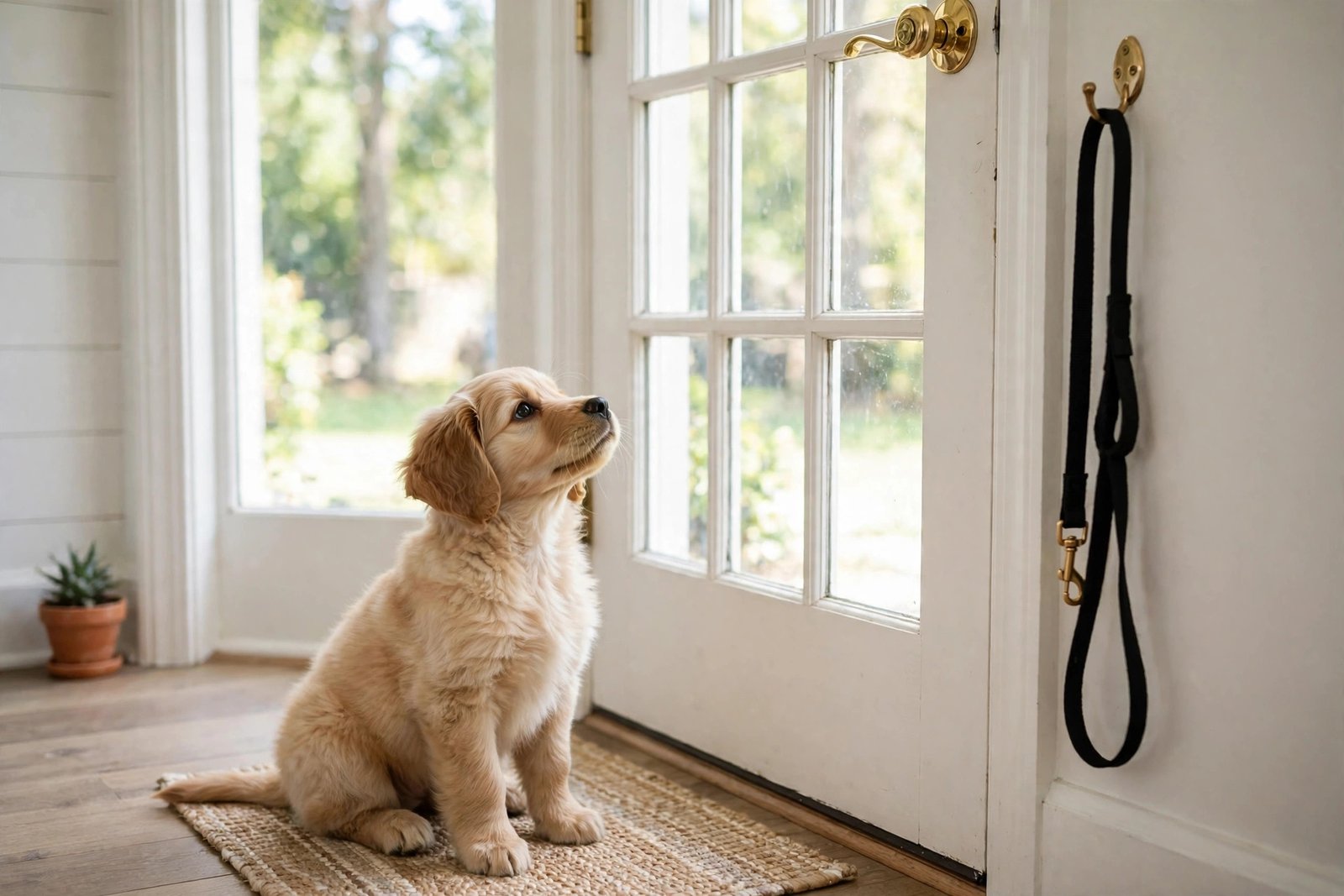
You have seconds, not minutes, once you see a sign. Pick the puppy up calmly and carry it to the spot. Do not wait to be sure. One wasted trip costs a few minutes. One missed trip costs a puddle and a step back in training.
Supervision is the other half of the schedule. VCA Animal Hospitals says a puppy should always be directly supervised, safely confined where it can eliminate if it must, or asleep in its crate. When you cannot watch the puppy, use the crate or a gated room. A crate works because most dogs prefer not to soil where they sleep. Our guide on how to crate train a puppy will cover the crate steps in full once it is live.
What to do outside, in the right order
Pick one spot and one door, and use them every time. VCA Animal Hospitals says to lead the puppy through the same exit door to the same elimination area, and to go along every time. Do not send a puppy outside alone. Most untrained puppies left outside alone get distracted and do not eliminate until they are back indoors.
Go out on a leash, stand in the spot, and wait. VCA Animal Hospitals says to be patient for a few minutes, and if the puppy does not eliminate after 5 minutes, take it back inside, supervise it closely, and try again at the first sign of restlessness. The ASPCA gives the same shape of advice. Give the puppy at least five minutes, and if nothing happens, confine it for 15 minutes and try again.
When the puppy starts to go, say your cue word calmly. Pick one short phrase, such as go potty, and use it every time. The American Kennel Club says to say it as the puppy begins to eliminate in the correct location, so the puppy links the word to the act.
Reward the puppy while you are still outside, right next to the spot. VCA Animal Hospitals says to praise quietly and offer a small treat there, not after you get back inside. The American Kennel Club is louder about it. Cheer, clap, and hand over a small high value treat the moment the puppy finishes. Small treats work best, because you will hand out a lot of them and you do not want to overfeed the puppy.
Hold the play until after the puppy goes. VCA Animal Hospitals says play time and freedom to run off leash should wait until the puppy has finished eliminating. That order teaches the puppy to go quickly when you bring it out, instead of treating every trip as recess.
What to do when puppy accidents happen
Puppy accidents will happen, more than once, and they are not spite. A puppy that pees on the floor did not plan it. It needed to go and nobody got it outside in time, or it did not know how to ask yet.
If you catch the puppy in the act, interrupt it calmly and take it outside. VCA Animal Hospitals says to make an odd noise or tap your hand on your leg, without scaring the puppy, then guide it quickly to the right spot and praise it if it finishes there. If you find the puddle after the fact, do not punish the puppy. The American Kennel Club says the same. Just clean it up.
Punishment backfires in a specific way. VCA Animal Hospitals warns never to rub a dog’s nose in an elimination and never to strike the puppy, because punishing a natural act can teach the puppy never to toilet near a person. That puppy does not stop peeing indoors. It starts peeing behind the sofa, where you cannot see it.
Clean the spot with an enzymatic cleaner, the kind made to break down pet urine, and follow the label. The American Kennel Club says lingering odor draws a puppy back to the same spot, and VCA Animal Hospitals says the smell of urine or feces is a cue to use that location again. Regular household cleaner leaves a scent a puppy can still smell. An enzymatic cleaner removes it.
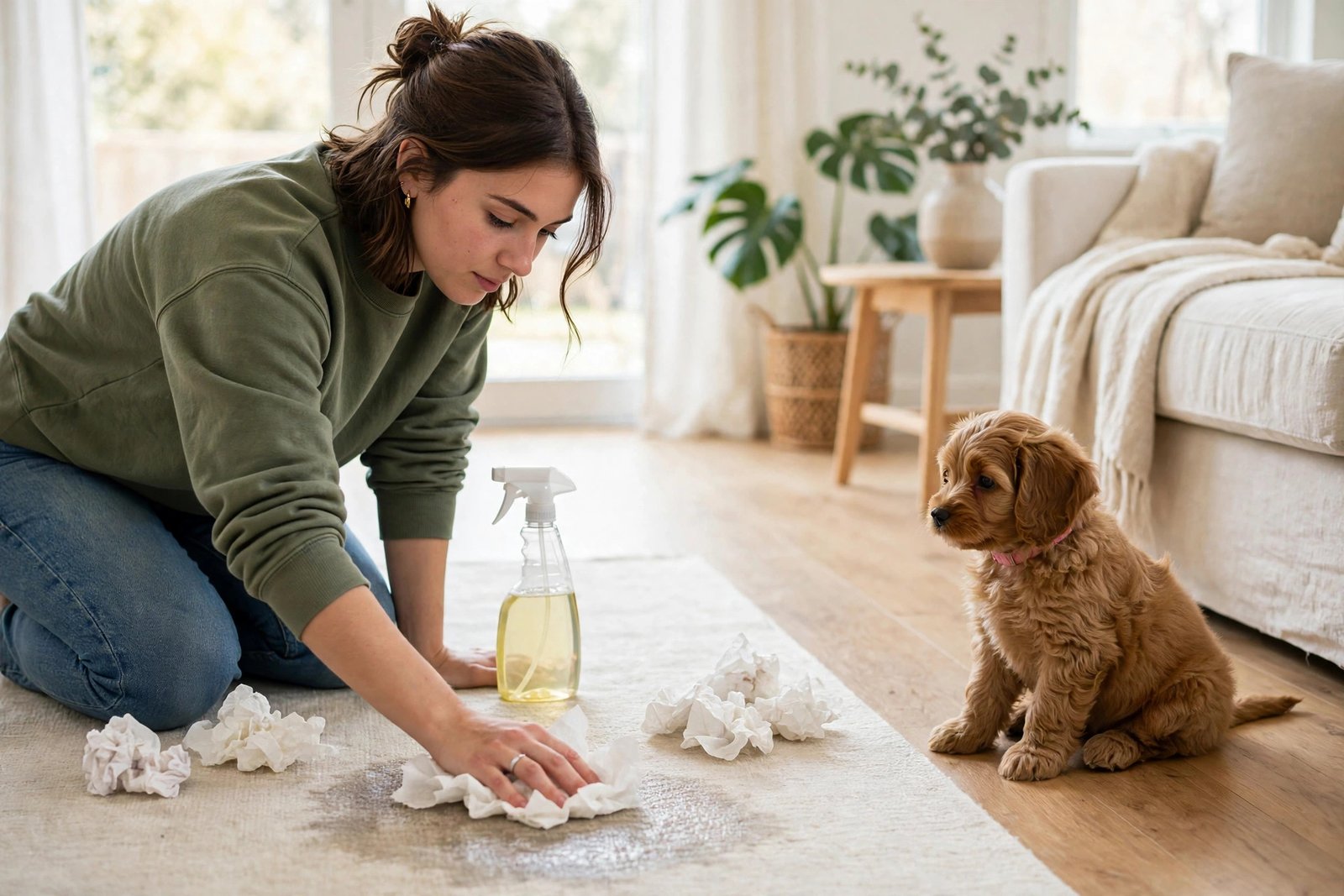
After an accident, ask what failed. Was the gap between trips too long? Did the puppy show a sign nobody noticed? Did it get too much freedom too soon? Fix that one thing.
Pads, and when to skip them
Puppy pads split trainers, and the split is worth knowing before you buy a pack. The American Kennel Club quotes Mary Burch, director of its Canine Good Citizen program, saying pads can be tricky because you are reinforcing two different options for the puppy. In an ideal setup, the puppy learns to hold it indoors and only eliminate outdoors.
Pads still help in real situations. They help when nobody can get home during the day, and they help very small dogs in severe winter weather. They also help while a puppy waits to finish its vaccine series, when heavily used outdoor areas carry more risk. If you use pads, put them in one fixed spot and take the puppy there on the same trigger schedule. Indoor spots work the same way for cats, by the way. Our new kitten checklist covers the litter box version for kitten owners.
Do not use pads as a shortcut for supervision. A pad on the floor does not teach a puppy to hold it, and a puppy that learns pads first takes longer to learn outdoors. If you can get home every couple of hours, skip the pads and go straight to the door.
When the puppy seems trained, and when it is not
A puppy that goes a week without an accident is having a good week. It is not trained yet.
VCA Animal Hospitals says a puppy should go 8 to 12 weeks without mistakes before it gets more freedom around the house. That sounds long, and it is. Open one room at a time, and close it again if accidents return.
The American Kennel Club says the same thing from the other side. Many owners expand access too quickly, and the puppy starts having accidents in rooms it rarely used before. Too much freedom too soon is the most common reason a puppy that seemed trained starts going indoors again.
How long does puppy house training take in total? The American Kennel Club says it varies significantly from puppy to puppy. Some learn within days, while others may need several months. That range is all anyone can promise, and it depends on the puppy, the schedule, and how consistent the people in the house are.
If a puppy is not making progress by four to six months, or a trained puppy suddenly starts soiling the house, talk to your vet. The American Kennel Club says dogs that stay difficult to housetrain despite consistent training should get a veterinary evaluation, because a medical problem can sit underneath the behavior.
Questions owners ask while potty training
How often should I take my puppy out?
Every one to two hours while awake, plus after waking, eating, drinking, and playing, and last thing at night. Very young puppies may need a dozen trips a day, and the American Kennel Club says that is normal.
My puppy pees right after coming back inside. Why?
It probably got distracted outside and never fully emptied its bladder. VCA Animal Hospitals says puppies can get distracted while eliminating and fail to fully empty their bladder. Go out on a leash, wait the full five minutes, and hold the play until after the puppy goes.
Should I punish my puppy for accidents?
Do not punish the puppy. VCA Animal Hospitals says never to punish a puppy for a natural act, and the American Kennel Club says to just clean it up and reward the next success outside.
When can my puppy sleep through the night?
Many puppies still need a night trip until about 5 months of age, according to VCA Animal Hospitals. Keep the last trip late, the first trip early, and the alarm set until the puppy starts sleeping through on its own.
Start tonight with the schedule, not the guilt. Take the puppy out after its next meal, say go potty as it starts, and hand over a treat while you are still standing on the grass. Do that a dozen times a day for a week, and the puppy will start telling you when it needs to go.
1 thought on “How to Potty Train a Puppy Without the Guesswork”