
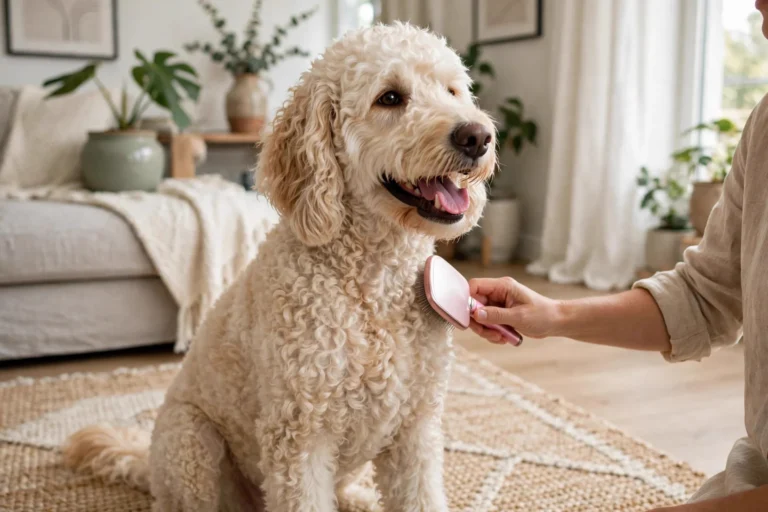
A slicker brush for doodles is the tool that keeps a curly coat from turning into a felted mat near the skin. It is a flat pad covered in fine bent wire pins, and those pins reach through wavy or curly hair to loosen shed hair and small tangles before they lock together. If you own a Labradoodle, a Goldendoodle, or a similar mix, this brush matters more than any other grooming tool in your drawer.
Most new doodle owners run a brush over the top of the coat and feel pleased. The coat looks fluffy, and the brush holds a little hair. Then a groomer parts the coat and finds mats pressed flat against the skin. That gap is the whole story of doodle grooming.
Why a doodle coat mats when it looks fine on top
A doodle coat mixes Poodle curl with the softer coat of a Golden Retriever, a Labrador, or another breed, and the mix varies from dog to dog. Shed hair often stays caught in the curl instead of falling onto your floor. Dead hair then wraps around live hair and knots near the skin, where friction from a collar and lying down twists it tighter. A guide to Goldendoodle matting from Bark Breeds (Golden Doodle Coat Matting) puts it plainly: brushing that only reaches the top layer leaves those knots underneath, where they tighten.
Mats start at the skin and work outward. The top can stay soft while the base turns into a dense patch that moves as one piece. Part the coat with your fingers until you can see skin.
If the hair separates into strands, the coat is healthy. If it resists and moves as a sheet, a mat is forming.
Coat type changes the risk. A wavy fleece coat usually responds well to regular brushing. A tight curly wool coat mats faster and can defeat even a careful routine. Happiest Doodles, who live with three doodles with different coats (Best Brushes For Doodles), found that their wavy fleece dog stayed mat free with brushing, while their two curly wool dogs did better with hand checks, a short clip, and a regular bath.
What a slicker brush actually does
A slicker brush has a flat or slightly curved pad covered in fine pins that bend at the tip. The pins slide through curls, catch loose hair, and pull small tangles apart. The pad flexes a little under pressure, which helps the pins give instead of digging into skin.
Pin length decides whether the tool works at all on this coat. Flying Pawfect (Best Slicker Brushes For Doodles) calls pin length the single specification that decides whether a brush works on a doodle, because a doodle mats at the skin and a short pinned brush never reaches that layer. Short pins skim the top third of the coat.
Long pins reach the base without forcing you to press hard, and pressing hard is what scratches skin. A slicker loosens and lifts, while a metal comb finishes the job by proving the section is clear.
How to use a slicker brush for doodles without scratching the skin
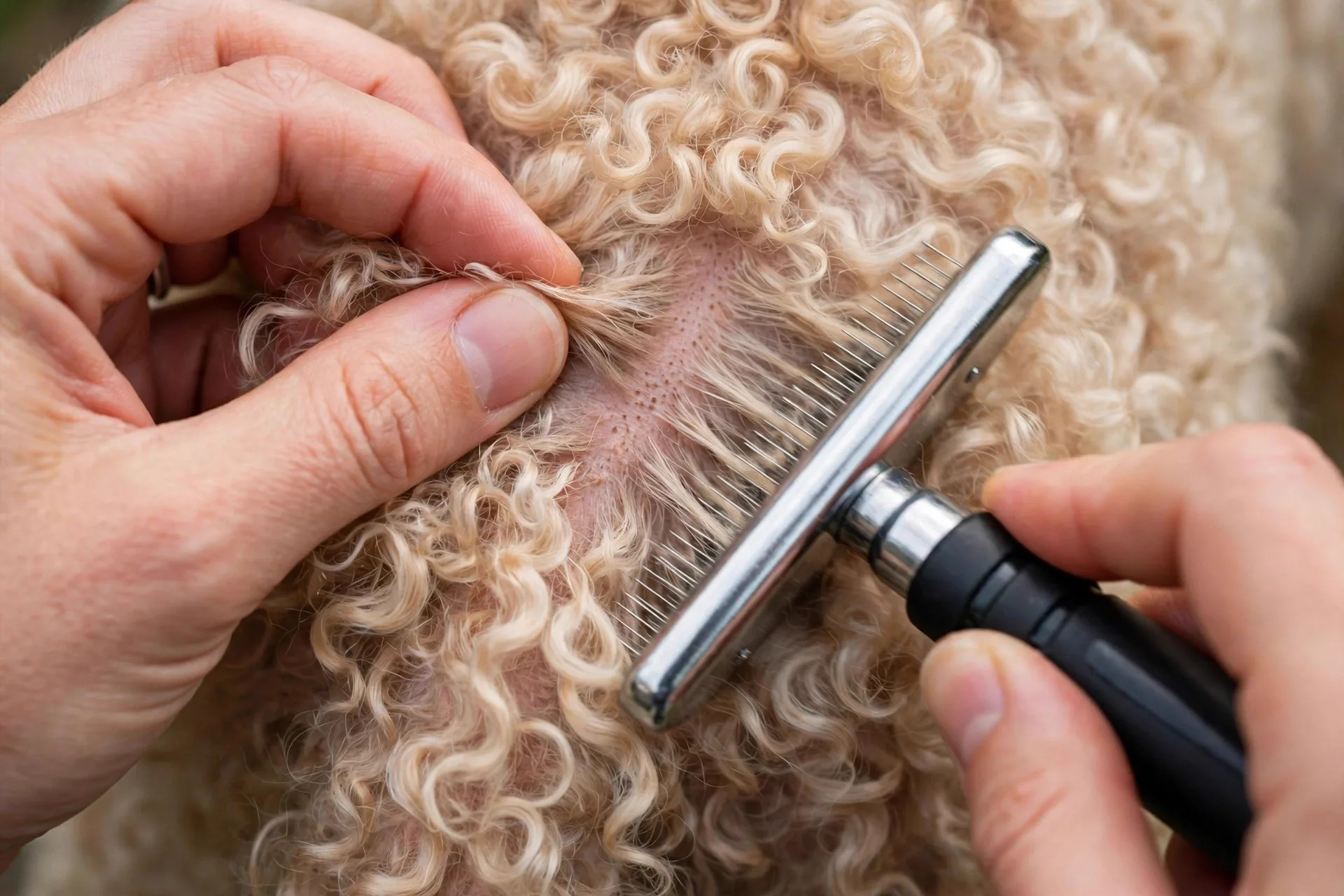
Line brushing is the technique groomers use. You work in thin layers, from the skin outward, instead of sweeping across the whole coat at once. The name comes from the line of skin you expose with each part.
Start with a dry coat or a lightly misted one. A light mist of detangling spray helps the pins slide and reduces pulling. Never brush a soaking wet coat, because wet hair breaks more easily. If your dog just had a bath, let the coat dry a little first.
Work from the lowest point upward. Doodle Doods (Line Brushing Doodle) advises starting near the rear and the feet, because starting at the bottom clears a path. Part a small section with your free hand or a comb until you can see a line of skin. Brush only the hair below that part, with short light strokes away from the skin.
Move your hand up about half an inch and release a new layer of hair over the brushed section. Brush that layer the same way, line by line, until the whole area is done. It feels slow at first, and it gets faster as the coat stays clear.
Use the flat of the pad, and keep the pressure light. Test it on your own forearm first. If it stings or leaves red lines, you are pressing too hard. Go lighter in the armpits, the belly, and behind the ears.
Stop and check your dog as you go. A dog that flinches or tries to move away is telling you something. Ease off, work a smaller section, add a little spray, and give a treat.
Keep sessions short. Five to ten minutes, three times a week, beats a long weekly battle, and you can split a full brush across two days.
The comb test that tells you when you are done
A slicker can make a coat look finished when it is not. A metal comb tells you the truth. After you brush a section, run a steel comb through it from the skin outward.
If it glides from skin to tip without catching, that section is done. If it stops, a tangle is still there. Go back with the slicker on that spot, then comb again.
Use the wide teeth first, then the fine teeth, which find the small tangles that later grow into mats. Bark Breeds (Golden Doodle Coat Matting) describes the same check: the comb should pass without catching, and where it stops, a tangle is forming. Keep the comb beside the slicker so you reach for it every time.
Where mats hide first
Mats form where friction, moisture, and pressure meet. Check those spots first, even on a day when you skip a full brush. Behind the ears is the first place to look.
The ear flap sits flat against the head, and the coat under it gets little air and constant friction. Skip The Groomer (Behind Ears And Armpits Solve Mat Hotspots With Demat Detangle Clean) notes that by week two without care, the spot at the base of the ear flap is already a tangle, and by week three or four on a curly coat it can be a mat. Lift the ear and check with your fingers.
Armpits come next. Every step compresses the coat there, and the spot is awkward to reach, so owners skip it. Lift the front leg gently, like a handshake, and brush in short strokes while holding the hair at the base.
If your dog will not stay still for both armpits in one session, do one today and the other tomorrow. Check the collar line, the base of the tail, and the back of the legs too.
How often should you brush a doodle
Most doodle coats need brushing at least three times a week. Long or very curly coats need daily brushing. Shorter trims need less, but the comb still needs to reach the skin. The Doodle Brush (How To Brush Your Doodle At Home A Complete Step By Step Guide) gives the same floor: three times a week at minimum for any doodle, daily for curlier and denser coats, and daily without exception during the coat change from puppy to adult coat, usually between six and twelve months, when mats form fastest.
Frequency matters more than session length. Five to ten minutes three times a week prevents more mats than thirty minutes once a week. Puppies need a gentler start, with a softer slicker, sessions of a few minutes, and treats throughout. The goal in the first months is trust.
A doodle that swims or plays in rain mats faster, because moisture and friction speed up tangling. Brush after a swim or a wet walk, once the coat has dried a little. For a wider routine, see our guide to how to groom a dog at home (How To Groom A Dog At Home).
What makes the best slicker brush for doodles
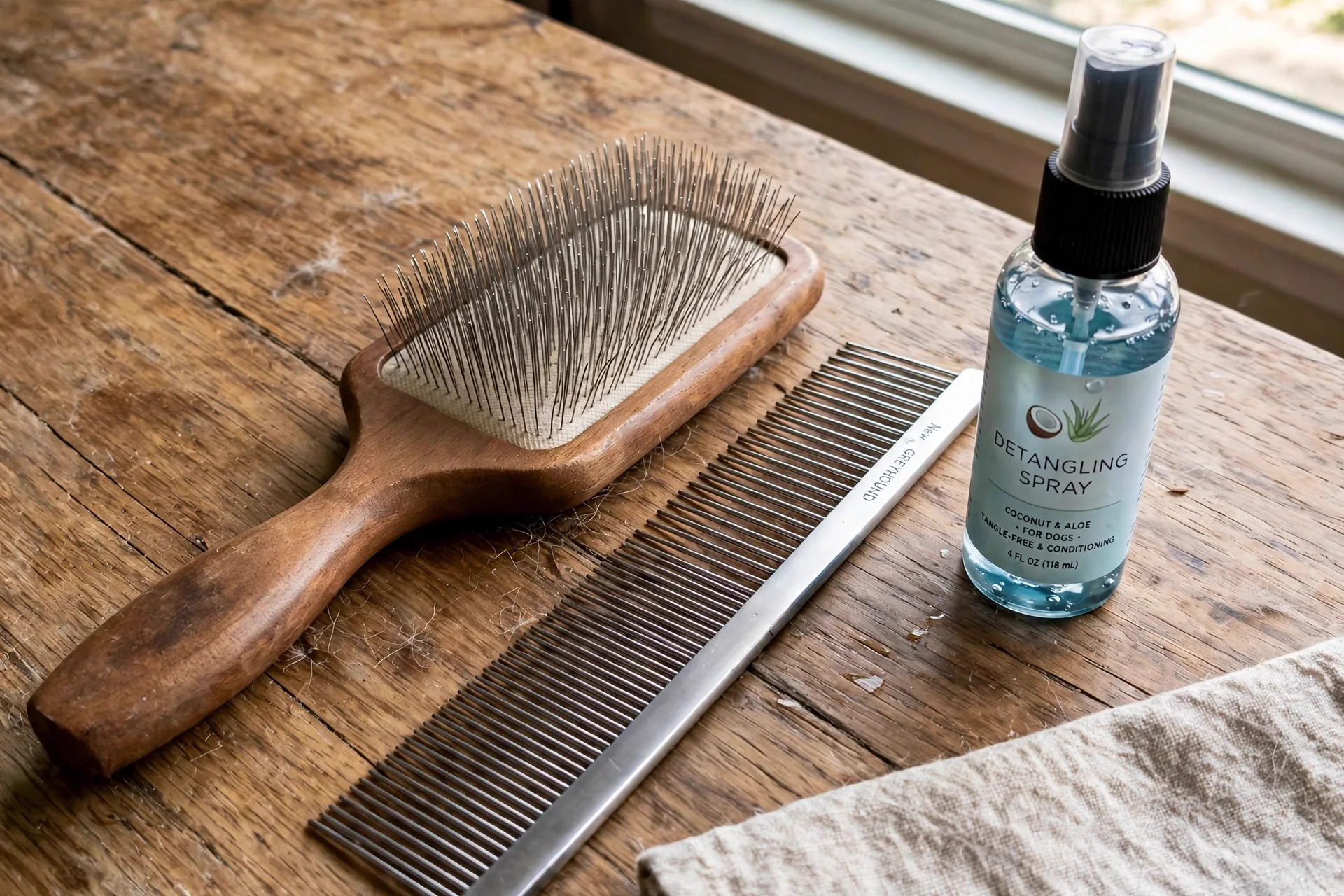
There is no single best slicker brush for doodles, because coat type, dog size, and your hand all change the answer. Pin length comes first. Look for long pins that reach through a dense curl to the skin without pressing hard. Happiest Doodles (Best Brushes For Doodles) makes the same point: extra long pins reach the skin without you pressing hard, and pressing hard is exactly what causes skin irritation.
Pin quality comes second. Look for fine stainless steel pins that bend at the tip and spring back. Cheap pins bend permanently, snap, or stay stiff and scratch. Run the brush across your forearm before you use it on your dog.
Handle comfort comes third. You will hold this brush for real minutes, and an ergonomic grip is the difference between a thorough session and a rushed one. Head size comes fourth. A large or medium curved head follows the shape of a shoulder or a thigh, and a small head is worth owning for the face, the ears, and the feet.
Price is a poor guide on its own. A cheap slicker with short stiff pins costs less at the till and more at the groomer, because it misses the mats that later need a shave. Doodle Doods (Line Brushing Doodle) warns against cheap slickers for daily use, because low quality brushes are ineffective, can cause brush burn, and make a dog hate being brushed.
Buy the comb at the same time. If you are still gathering puppy supplies, our new puppy checklist (New Puppy Checklist) lists the grooming tools to buy first.
When matting needs a groomer instead
Some mats are a home job, and some are not. Try a small mat at home if you can part the coat around it, see skin at the edges, and work it apart with your fingers and a slicker without pulling. Hold the hair at the base, use a little spray, and stop if the dog flinches.
Call a groomer when the mat sits tight against the skin and you cannot see skin through it, when a large area is matted, or when the coat has felted into a solid sheet. That sheet is called pelting, and brushing it out hurts. A groomer can clip it off safely and give the coat a fresh start. Doodle Doods (Line Brushing Doodle) draws a clear line here: if you spend more than fifteen minutes dematting with no end in sight, the dog should be shaved, and the hair will grow back sooner than you think.
Call a groomer or a vet sooner if you find red, sore, damp, or smelly skin under a mat. Never cut a mat out with scissors at home. Mats sit tight against the skin, and the skin tents up into the mat when you pull.
Many owners book a groomer every six to eight weeks. Bark Breeds (Golden Doodle Coat Matting) gives that range as a common pattern. A shave is a reset, and the next groomer visit will look very different if you start line brushing as the coat grows back.
FAQ
How often should I brush my doodle with a slicker brush?
Brush at least three times a week, and daily for long or very curly coats. Keep sessions to five to ten minutes.
Can a slicker brush hurt my dog?
It can hurt if you press hard or scrub at a tight mat. Use light strokes, test the pressure on your own forearm first, and stop if your dog flinches.
Do I need a comb as well as a slicker brush?
A comb is still needed. The slicker loosens tangles and the metal comb proves the section is clear to the skin. If the comb catches, a tangle is still there.
What should I do if I find a mat?
Work a small mat gently with your fingers, a little spray, and the slicker, holding the hair at the base. Leave a tight mat or any mat over sore skin to a groomer. Never cut a mat out with scissors at home.
Sources
- Doodle Doods line brushing guide: Line Brushing Doodle
- Bark Breeds Goldendoodle matting guide: Golden Doodle Coat Matting
- Happiest Doodles best brush for a Goldendoodle: Best Brushes For Doodles
- Flying Pawfect best slicker brushes for doodles: Best Slicker Brushes For Doodles
- Skip The Groomer behind the ears and armpits mat hotspots: Behind Ears And Armpits Solve Mat Hotspots With Demat Detangle Clean
- The Doodle Brush how to brush your doodle at home: How To Brush Your Doodle At Home A Complete Step By Step Guide