
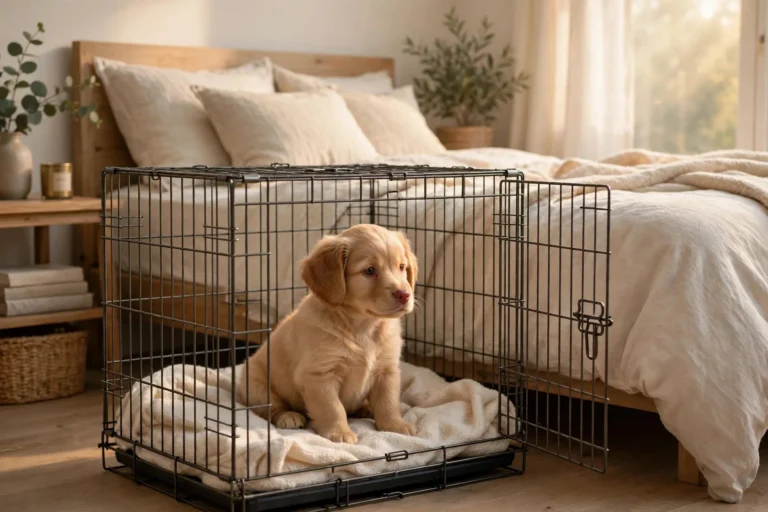
An 8-week-old puppy needs four small meals, a potty trip every one to two hours while awake, one or two trips overnight, and 18 to 20 hours of sleep a day. That is the whole puppy schedule at 8 weeks in one sentence.
The rest of this guide turns it into a day you can actually live. A puppy does not read schedules.
The loop that runs the whole day
Forget the idea of a timetable with a slot for everything. A puppy day is one loop, repeated until bedtime: potty, eat or play, potty, nap. A good puppy schedule repeats that loop all day (Puppy Schedule), and every clock time in this guide is just that loop wearing a watch.
The loop works because a puppy’s body runs it anyway. Food goes in, and a potty trip follows 5 to 30 minutes later, according to the American Kennel Club (Puppy Schedule). Play wakes a puppy up and fills the bladder, and waking from a nap means another trip outside.
The crate fits inside the loop as the nap spot, not as a separate project. A crate schedule for puppy life at this age is simple: the puppy sleeps in the crate, wakes, goes straight outside, and comes back in for the next round. Run them as one system and each one does half the work. Our step by step guide to how to crate train a puppy in small steps (How To Crate Train A Puppy) covers the slow build in detail.
One warning before the table. The first three days will feel like the loop never ends, because it barely does. An 8-week-old puppy has just lost its mother, its littermates and every smell it knew. A first week plan built around calm and predictability (Your Puppys First Week At Home) beats an ambitious one every time. Keep life dull this week.
Puppy schedule 8 weeks, hour by hour
This table starts at 6:30 a.m. because that is when most puppies wake up, not because the clock matters. Shift every time to match your own morning and keep the gaps the same.
| Time | Feeding | Potty | Crate and sleep | Training and play |
|---|---|---|---|---|
| 6:30 a.m. | None yet | Straight outside | Wake from overnight crate sleep | None, keep it boring |
| 7:00 a.m. | Meal 1 | Outside after eating | Crate door open during meal | Sit before the bowl goes down |
| 7:30 a.m. | None | Potty after play | Nap in the crate | Gentle play, about 15 minutes |
| 9:30 a.m. | None | Outside on waking | Wake from crate nap | Name game, two minutes |
| 11:00 a.m. | Meal 2 | Outside after eating | Nap in the crate | Short play, then settle |
| 1:00 p.m. | None | Outside on waking | Wake from crate nap | Handling paws and ears |
| 3:00 p.m. | Meal 3 | Outside after eating | Nap in the crate | Five minute training game |
| 5:00 p.m. | None | Outside on waking | Wake from crate nap | Family time, calm play |
| 7:00 p.m. | Meal 4, last meal | Outside after eating | Short crate rest | A chew toy, quiet settling |
| 9:30 p.m. | None | Last potty trip | Bed in crate beside your bed | None, lights low |
| About 2:30 a.m. | None | One quiet trip | Back to crate after | None, no play, no lights |
A dozen or more outings a day is normal at this age, and the AKC says so plainly (Puppy Schedule). A common guideline from the AKC is that a puppy can hold its bladder for about as many hours as its age in months. An 8-week-old is working with roughly two hours at best, and often less when it is awake and excited.
Sleep is the biggest block in the table. Puppies typically need 18 to 20 hours of sleep each day, according to the AKC (Puppy Schedule), in naps of 30 minutes to two hours. If your puppy turns into a tiny biting machine in the late afternoon, it usually needs a nap, not more play.
Days 1 to 7: what actually changes
Day 1 is arrival day, and the only job is calm. Carry your puppy straight to the toilet spot before it sees the inside of the house, then let it explore one puppy proofed room. Show it the crate with the door open, a soft blanket inside and a treat or two.
Day 2 is when the loop starts for real. Run the table above, and write down every wee, poo and meal on a sheet by the door. It feels fussy for a day, then patterns show up fast. Most puppies need to go soon after eating and again a little later.
Day 3 is vet day. Book a wellness check inside the first few days and bring every record the breeder or shelter gave you. Vaccine timing, deworming and feeding amounts all depend on your individual puppy, so an online chart cannot replace that visit.
Day 4 is crate day. Feed the meal in the crate with the door open, then close the door for a few seconds while the puppy eats and open it before the bowl is empty. If the puppy fusses, you moved too fast, so go back to door open meals for a day.
Day 5 is handling day. Touch a paw, look in an ear, stroke along the back, then a treat. Keep each touch to two seconds, then a treat, and stop while it is still easy.
Add the name game too: say the name, toss a treat, repeat five times, done. The AKC says training can start as soon as a puppy comes home (Puppy Schedule), provided you use positive reinforcement and keep sessions to five to ten minutes.
Day 6 is visitor day, singular. One or two calm adults, sitting on the floor, letting the puppy approach them. No party, no kids’ playdate, no trip to the dog park. The socialization window in a puppy’s first three months shapes its future personality, according to the AKC (Puppy Schedule).
Day 7 is review day. Sit with the sheet by the door and make one change, not five. Maybe the second nap needs to start earlier because the puppy gets bitey at 4 p.m. Track the schedule for seven days, then adjust it once a week (Weekly Crate Potty Plan End Puppy Accidents) instead of reacting to each accident as it happens.
Then carry the puppy outside to watch traffic for five minutes, and leave before the puppy looks tired.
Four meals, one bowl rule
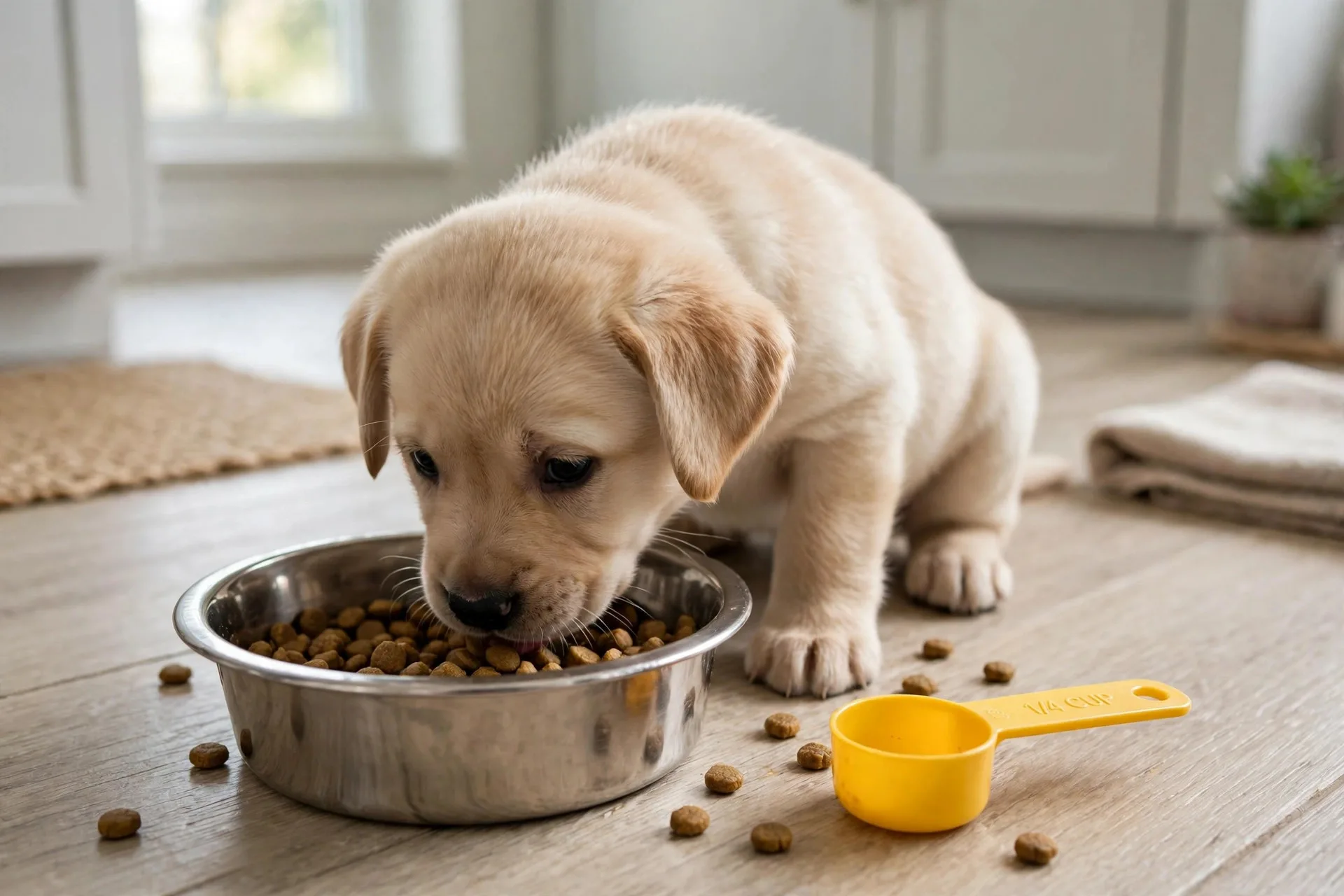
Four meals a day is the standard for a puppy schedule at 8 weeks. The AKC says four feedings a day are usually adequate at 6 to 12 weeks (Puppy Feeding Fundamentals), dropping to three sometime between 3 and 6 months and two from 6 to 12 months. The table spaces them at 7:00 a.m., 11:00 a.m., 3:00 p.m. and 7:00 p.m. The last meal should land at least two hours before bed.
Keep feeding exactly what the breeder used, in the same number of meals, for at least ten days. A stressed gut plus a new food is the classic recipe for loose stools, and a first week plan should say so up front (Your Puppys First Week At Home).
One rule makes the whole feeding schedule work: put the bowl down, and pick it up after fifteen minutes whether the puppy finished or not. The AKC gives the same fifteen minute limit (Puppy Feeding Fundamentals). A puppy that eats at set times potties at set times. Free feeding turns potty training into guesswork.
Before the puppy arrives, get the gear in place. Our new puppy checklist (New Puppy Checklist) covers everything to buy first, from the crate and divider to the bowls and the enzymatic cleaner you will be glad you bought before you needed it.
Nights: the 2 a.m. trip
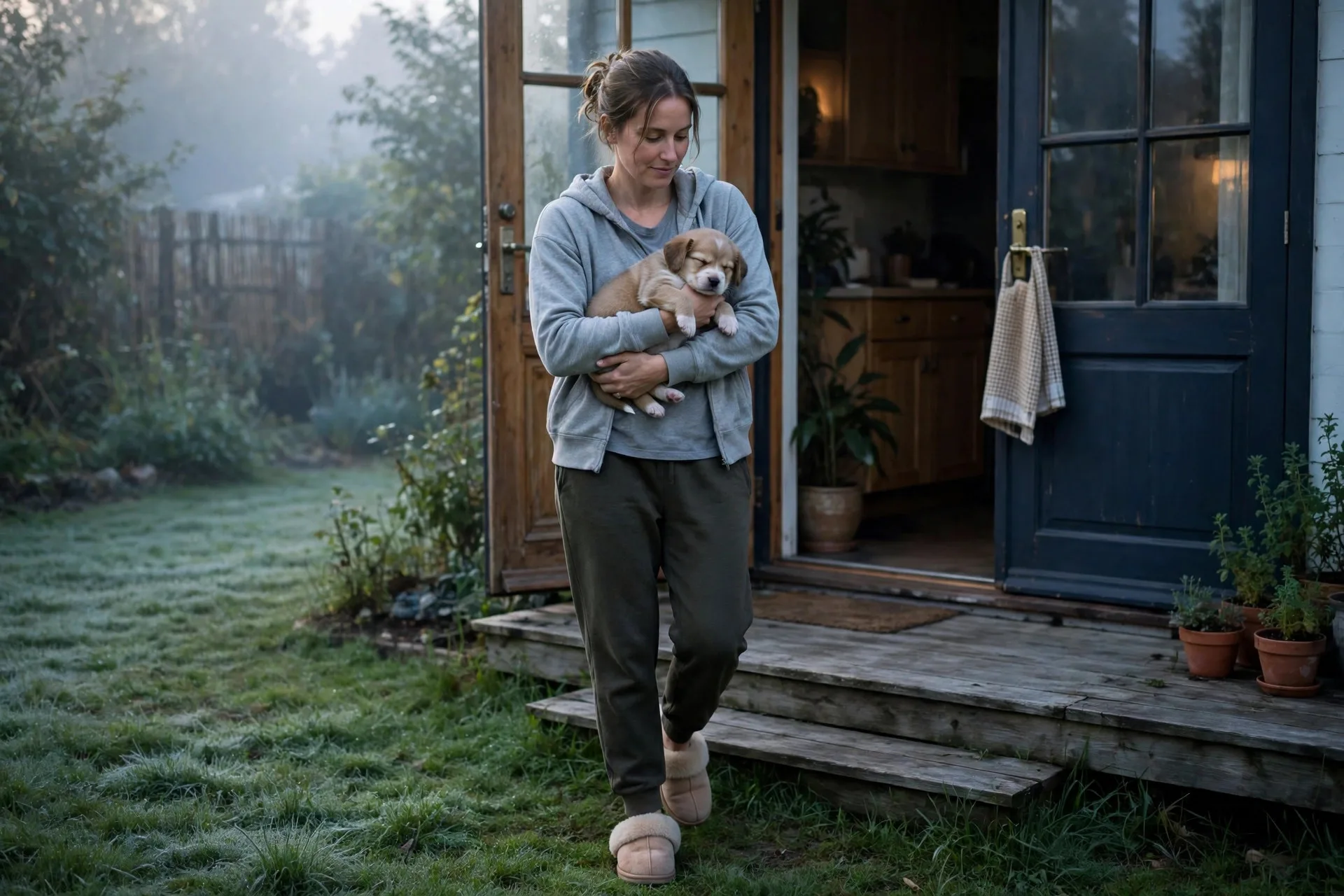
Nights one to three are the hardest part of the week, and no honest schedule hides that. Put the crate beside your bed so your puppy can hear you breathing. A warm water bottle wrapped in a towel and the bedding that smells of the litter both help. Most puppies cry for a few minutes and then sleep for two to four hours.
Set an alarm for the overnight trip instead of waiting for crying. The AKC suggests waking a little before you think your puppy will need to go, so you are not responding to whining and barking. Carry the puppy outside, stand still, wait, praise quietly when it goes, carry it back, crate, lights out. Make it boring: no play, no conversation, no kitchen light.
Two things that look like problems usually are not. A puppy that whines in the crate overnight most likely needs the bathroom, according to the AKC (8 Week Puppy Schedule). Take it out, then put it straight back.
A puppy that sleeps through one night and not the next has not gone backwards. If the puppy strains or cries when it potties, call your vet.
When the schedule bends, and it will
Here is the part the neat tables skip: the schedule bends around the puppy, not the other way round. A puppy that falls asleep mid play does not need waking for a training session. A puppy that had a loose stool after a new treat needs the treat retired, and a vet call if it happens twice.
A puppy that screams in the crate at 9 p.m. after two calm nights has not broken the routine, something changed. Your job is to find it.
Accidents are part of the schedule too, and they are information, not failure. Clean them with an enzymatic cleaner, note the time, and move on. Punishing a puppy after the fact teaches it to hide next time, and it teaches nothing about where to go. Rewarding correct behaviour works better than punishing accidents (Puppy Schedule), and the AKC has said so for years.
The bend goes the other way as well. Some puppies settle faster than the table suggests. If your puppy naps two hours in the crate without a sound and potties cleanly after every meal by day five, you do not need to keep waking it on a timer.
Stretch the gaps a little, watch what happens, and keep the notes. The table is scaffolding. You take it down as the puppy grows.
What week one is not for
Week one is not for obedience drills, long walks, the dog park, a bath, or meeting every dog in the neighbourhood. Teaching stay, heel or recall can wait, and any guide that packs those into the first seven days is selling a fantasy of a finished dog.
What week one is for is trust, a rhythm the puppy can predict, and the first layer of toilet habits. Slow this week is fast next month. If you want the training plan that follows this routine, our guide to puppy training for beginners (Puppy Training For Beginners) picks up where this schedule leaves off.
Questions owners ask in week one
How often should an 8-week-old puppy go out to potty?
Every one to two hours while awake, plus a trip after waking, after eating, after play and before bed.
How many hours a day should a puppy sleep?
Puppies typically need 18 to 20 hours of sleep each day, in naps of 30 minutes to two hours.
How long can an 8-week-old puppy stay in a crate?
About an hour at a stretch while you are away, according to the AKC’s alone time guidance (Puppy Schedule).
Can I leave my 8-week-old puppy alone while I work?
Not for a full workday. A puppy schedule at 8 weeks needs a potty break every one to two hours, so arrange a midday visit, a sitter, or time off for the first week or two if you can.
Sources
- American Kennel Club, Puppy Feeding Fundamentals: Puppy Feeding Fundamentals
- Petcro, Puppy Schedule by Age: Puppy Schedule
- Mambo, Your Puppy’s First Week at Home: Your Puppys First Week At Home
- The Paw Compass, How to Survive the Complete 8 Week Puppy Schedule: 8 Week Puppy Schedule
- Patient Leash, A Weekly Crate and Potty Plan to End Puppy Accidents: Weekly Crate Potty Plan End Puppy Accidents
- PetUpon, 8-Week-Old Puppy Care: First-Week Guide: How To Care For An 8 Week Old Puppy
- PawWise Daily, Surviving Your First Week With a Puppy: Surviving Your First Week With A Puppy Chaos Cuddles And Chewed Up Shoes