
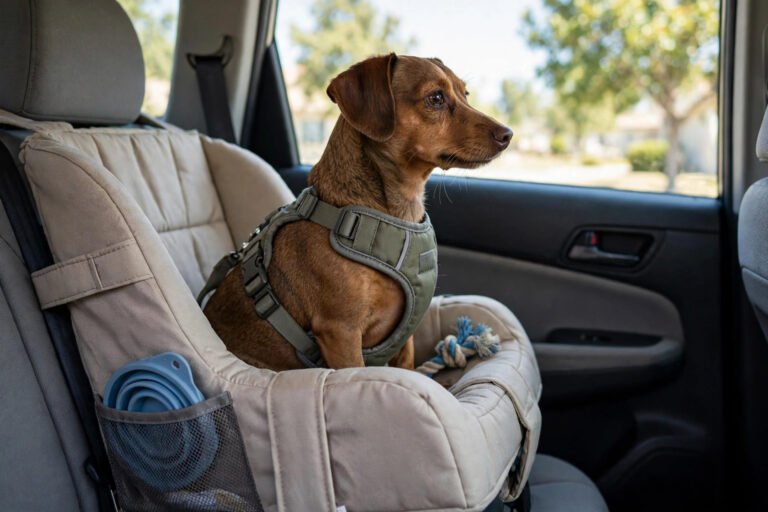
There is no federal safety standard for dog car seats in the United States. Child car seats must pass a federal crash test before they can be sold. Dog restraints face no such requirement, so a box can say crash tested without meaning much. That fact decides how to shop for the best dog car seat, because the label is the least reliable part of the product.
The seat matters less than the restraint. A booster seat keeps a small dog contained and gives it a window view. It does not hold a dog in a crash unless a crash tested harness does the holding. Buy the harness first, then pick a seat that works with it.
Most dog car seats are comfort products, not safety devices
The Center for Pet Safety, a nonprofit that runs the only independent certification program for pet restraints in the US, draws a line most shoppers never hear about. It separates distraction prevention tools from crash protection products. A booster seat, a hammock, and a seat cover all sit on the distraction side. They keep the dog out of the driver’s lap and off the upholstery, and they do not claim to hold a dog through a collision.
The Center for Pet Safety tests restraints at 30 mph using crash test dogs in three sizes. A product earns certification only if it keeps the test dog on the seat and its hardware intact across every size it sells.
Few products have passed. Rover notes the Sleepypod Clickit Sport harness underwent intensive crash testing at 30 mph for dogs up to 90 pounds and carries Center for Pet Safety certification. Its carrier seats carry the same certification, the Sleepypod Mobile Pet Bed up to 15 pounds and the Air up to 18 pounds.
The gap between marketing and testing showed up in a Center for Pet Safety pilot study of four popular travel seats, the PupSaver, Snoozer Lookout I, Top Paw, and Kurgo SkyBox. None of the four earned certification, and one rotated on impact when a plastic buckle failed.
Booster seats still have a place. If your dog rides loose on the back seat today, a booster seat plus a proper harness is a real improvement. The mistake is clipping the dog to the seat itself.
The Center for Pet Safety advises that a travel seat should connect to the LATCH anchors, the same anchors a child seat uses, and the dog should ride in a certified harness connected directly to the seat belt. Never connect your dog directly to the travel seat, because those connections are very weak.
The four types, and which dog each one fits
A booster seat is a raised box that straps to the back seat and lifts a small dog high enough to see out the window. It suits dogs up to about 30 pounds. The Kurgo Skybox, one of the better known boosters, carries a 30 pound limit.
Small breeds, like the ones in our guide to best dog breeds for first-time owners, usually fit a booster well. A booster helps dogs that get carsick, since seeing out the window helps. It fails a dog over its weight limit or a dog that tries to climb out.
A bucket seat is a deeper booster, with higher walls and a chin rest rim. The K and H Bucket Booster lifts a dog about 5 inches off the seat and suits puppies and small dogs that like a den.
A carrier seat is a hard or soft sided carrier that belts into the back seat. This is the only seat type with independently certified options, and only for small dogs. The Sleepypod Mobile Pet Bed carries certification for pets up to 15 pounds, and the Away carrier for pets up to 18 pounds.
A carrier seat suits a small dog that sleeps through rides and an owner who wants one product for bed, carrier, and car. No carrier made for a 60 pound dog has passed the same test.
A hammock or bench cover hangs between the headrests and protects the upholstery while giving a larger dog a flat surface to lie on. The K and H Buckle and Go is a containment seat of this kind, with no weight limit. It suits big dogs that curl up and sleep, and it serves nobody as a restraint without a crash tested harness.
| Type | Best for | Weight range | Crash protection |
|---|---|---|---|
| Booster seat | Small dogs that want a window view | Up to about 30 pounds | No, comfort only |
| Bucket seat | Puppies and small dogs that like a den | Up to about 30 pounds | No, comfort only |
| Carrier seat | Small dogs, one product for bed and car | Up to 15 to 18 pounds | Yes, if Center for Pet Safety certified |
| Hammock or bench cover | Large dogs that lie down and sleep | No weight limit | No, use a harness with it |
How to size one without guessing
Dog car seats fail most often on size, and the fix is a tape measure, not a guess. For a carrier, the Center for Pet Safety founder advises measuring the dog from the tip of the nose to the base of the tail and adding 6 inches. That total is the carrier length to look for.
A carrier that is too large lets the dog slide around inside it, and that sliding raises the risk of injury in a sudden stop, so bigger is a bad idea here.
For a booster or bucket seat, check the weight limit first and the interior dimensions second. For a harness, measure the chest behind the front legs, because sizes vary between brands.
Fit the harness the way you would fit a walking harness. The American Kennel Club recommends thick, padded straps, and says the dog should ride at the back, not at the neck, with room to sit or lie down. Two fingers should fit flat under each strap.
If you can pull the harness over the dog’s head without unclipping it, it is too loose. A growing puppy will outgrow a harness in weeks, so our new puppy checklist covers measuring again as the puppy grows.
One more check: sit in the car with the seat installed and the dog in it before you drive anywhere, and check that the belt anchors reach and the seat does not slide.
The harness does the holding, so buy it first
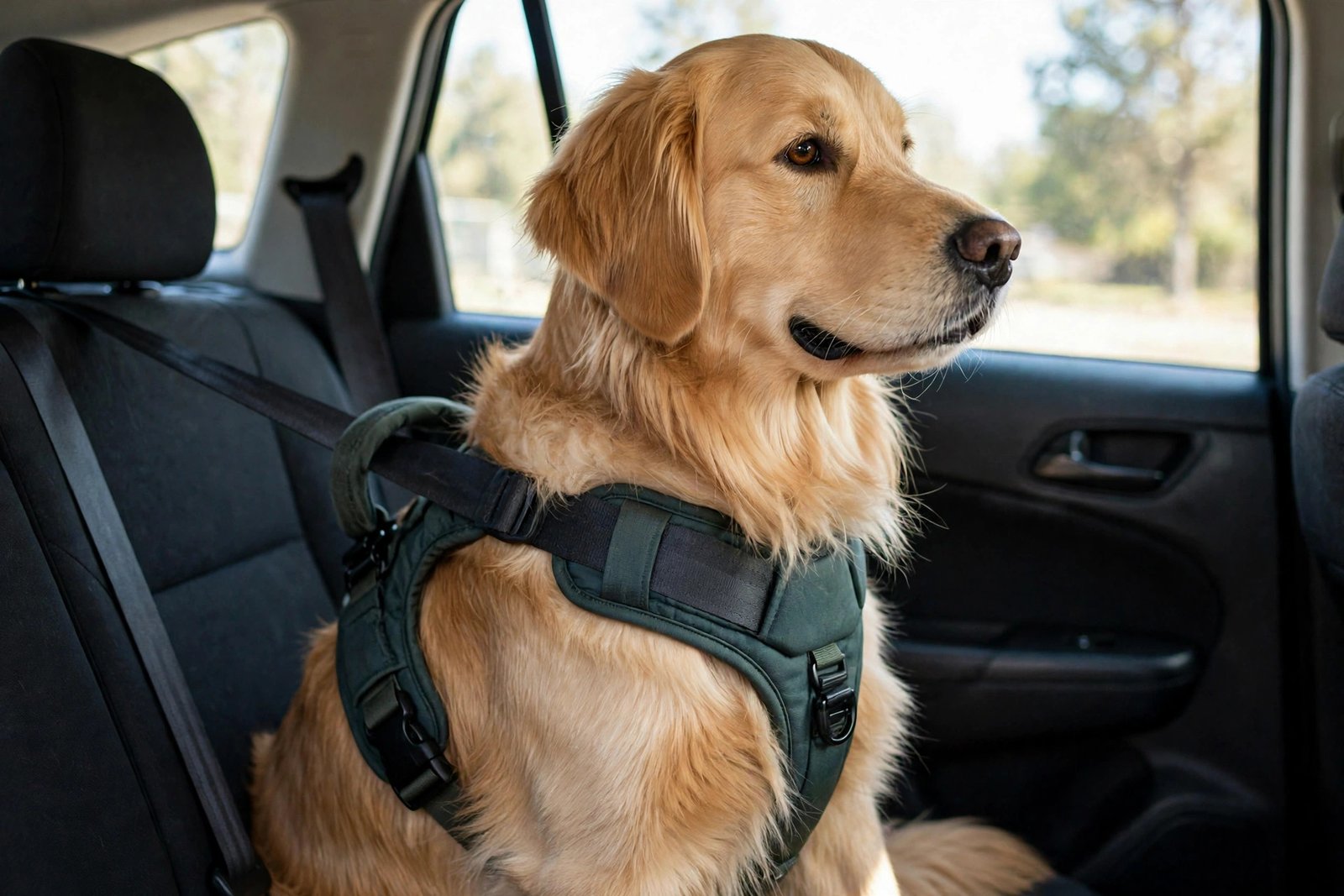
A car harness is not a walking harness with a carabiner clipped on. It uses thicker straps and more padding to spread the dog’s weight across the chest in a sudden stop, and it connects to the car’s seat belt rather than to a leash clip. A walking harness is built for pulling on walks, while a car harness has to withstand the force of stopping at high speed.
Never clip a car tether to a collar. A collar concentrates the force of a stop on the neck, and that is how dogs get hurt in crashes that the car itself survives. Clip to the harness, and keep the tether short enough that the dog can sit and lie down but cannot reach the front seat.
The seat belt should thread through the harness, not dangle from a long leash style tether. A long tether lets the dog build up speed before the strap catches, which is the opposite of what you want.
The Kurgo Tru-Fit carries a maker test for dogs up to 75 pounds, and the Kurgo Impact for dogs up to 108 pounds. Those are manufacturer tests, not Center for Pet Safety certification. A manufacturer test is a claim, and a Center for Pet Safety listing is a result you can look up.
For large and extra large dogs, a harness or a travel crate is usually the answer, since no carrier seats exist for big dogs and the Center for Pet Safety does not recommend dividers. If your dog is too big for any certified harness size, a crate secured to the vehicle is the safest choice, and the American Kennel Club says it should let the dog stand, turn, and lie down.
Getting a nervous dog to accept the car
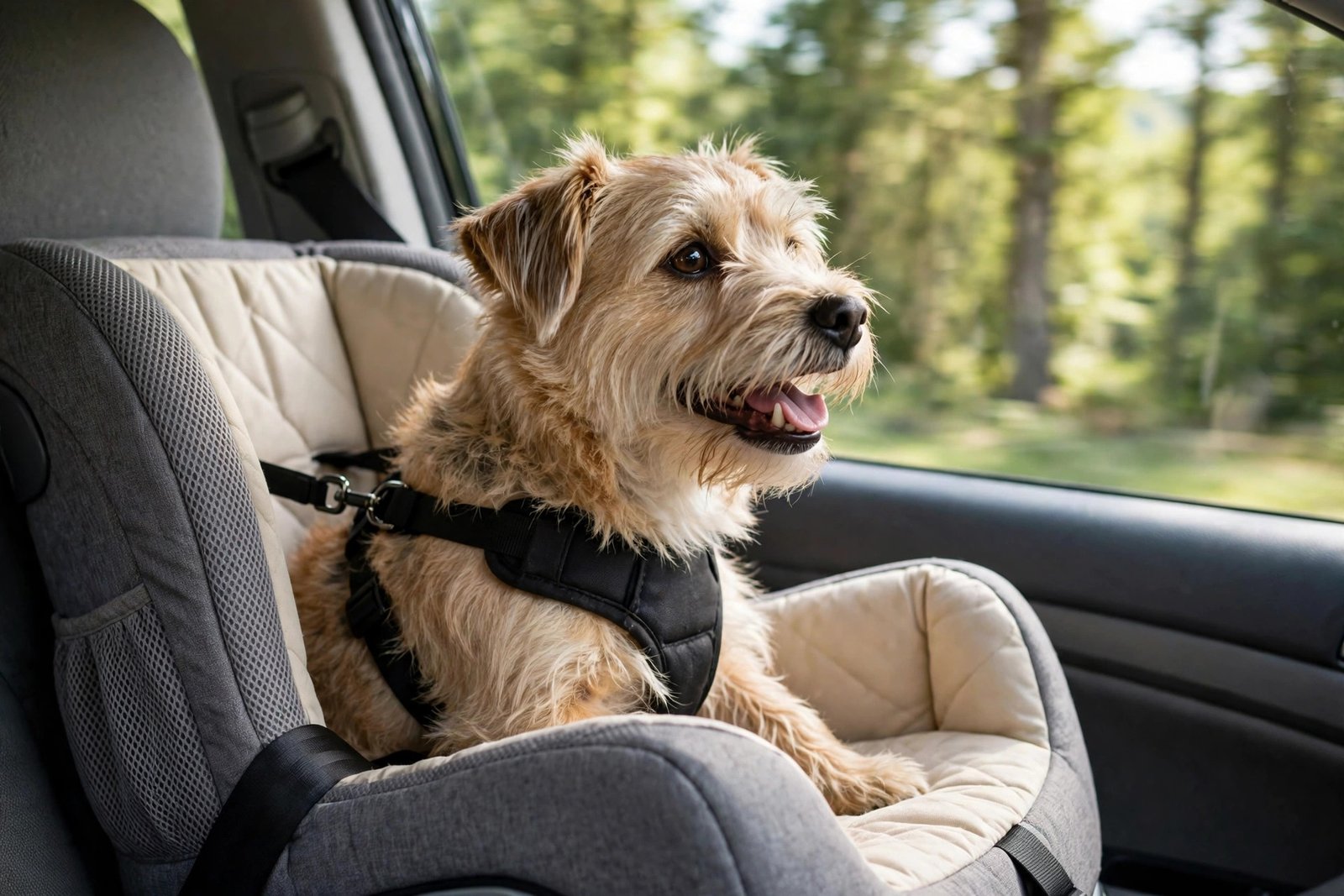
A dog that shakes in the car needs short, boring trips first, not a better seat. The American Kennel Club advises buying the carrier or harness ahead of the trip and letting the dog get used to it at home. Let the dog wear the harness around the house for a few minutes at a time. Leave the carrier door open so the dog can walk in and out, and reward every entry with a treat or a toy.
Then drive around the block, and build the length slowly, stopping before the dog gets sick or panics. The American Kennel Club also advises feeding the dog lightly before a trip, about one third the normal amount, and waiting at least an hour after a meal before driving again.
Keep the windows up enough that the dog cannot stick its head out. The American Kennel Club warns that a head out the window can lead to eye or ear injuries from debris and wind.
If the dog still drools, vomits, or pants heavily after a few weeks of short trips, talk to your vet. Carsickness has medical fixes, and anxiety has training fixes.
What the law says in your state
There is no federal law that requires a dog to be restrained in a car. The law is a patchwork, so check your own state’s current rules before a road trip.
Three states get named in almost every roundup: New Jersey, Hawaii, and Rhode Island. New Jersey’s rule is the strictest, with fines reported between $250 and $1,000. Hawaii prohibits a dog in the driver’s lap, with fines reported around $97 for the lap and $57 for a loose pet. Rhode Island’s rule covers open air vehicles.
The real picture is messier than the roundups. New Jersey has no dedicated pet restraint statute; its rule comes from an animal cruelty transport law that officials have read to cover loose pets. Hawaii’s rule is a distracted driving statute that happens to name animals. Fine figures vary between sources, so treat any number you read as approximate.
Everywhere else, the risk comes through broader laws. An officer in any state can cite a driver for distracted or careless driving if a loose dog blocks the view or climbs across the lap. Restrain the dog even where no law says you must, because the ticket is the smallest cost of a loose dog in a crash.
Questions owners ask about dog car seats
What is the best dog car seat for small dogs?
A Center for Pet Safety certified carrier seat, such as the Sleepypod Mobile Pet Bed for pets up to 15 pounds, is the safest small dog choice. A booster seat is fine for comfort, but pair it with a certified harness.
Can my dog ride in the front seat?
No, not if the car has airbags. Keep the dog in the back on every trip.
Do I need a car seat if my dog wears a harness?
A harness is the safety device. A seat is comfort and containment. A large dog in a good harness on the back seat is safer than a small dog in a fancy booster clipped to the seat itself.
How do I stop my dog getting carsick?
Take short trips first, feed lightly before driving, and wait at least an hour after a meal. If sickness keeps happening, ask your vet, because medication can help.
Measure your dog tonight and check the weight limit on the seat you already own. If the dog is over the limit or the tether clips to a collar, buy the harness first.