
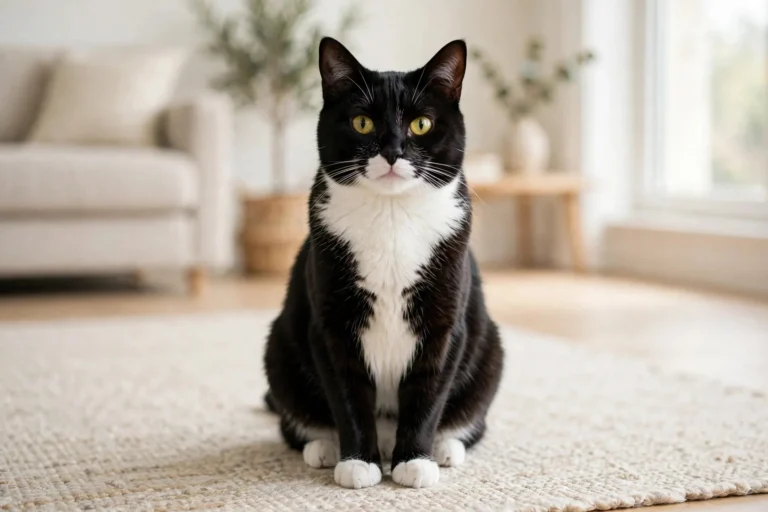
A tuxedo cat is a black and white cat with white on the chest, belly, paws, and often the chin. The pattern looks like formal evening wear, which explains the name. It is a coat pattern, not a breed. That single fact shapes everything else in this guide, from which cats wear the pattern to why no one can promise you a set personality with it.
Here is the short version. A tuxedo cat can be almost any breed or no breed at all. Owners often describe these cats as outgoing, talkative, clever, and affectionate.
Science has not confirmed any of that as a trait tied to coat color. The one peer reviewed study on coat color and behavior found something different.
What a tuxedo cat actually is
A tuxedo cat is a bicolor cat. One color in the coat is white and the other is usually black. Some people also count gray and white cats with the same layout as tuxedos. The classic version stays black and white, with most of the color on the back and head and white on the underside.
The white markings tend to show up in familiar places: a white chest patch, white paws that look like socks, a white belly, and a white chin. Some tuxedos have a black spot on the chin that looks like a small mustache. No two patterns match exactly.
Genetics explains the look. The white spotting gene controls where pigment cells settle while a kitten develops. Where pigment cells reach, the coat gets color.
Where they never reach, the coat stays white. A tuxedo sits at the low to mid end of that scale, with white limited to the chest, belly, paws, and face.
Research from the University of Bath and the University of Edinburgh, summarized by Petful, found that pigment cells move and multiply at random during early development rather than following a fixed plan. A faulty KIT gene slows that multiplication, so the cells cannot cover the whole embryo before the skin forms. The white patches are the gaps the pigment cells never reached.
Bicolor coats are among the most common patterns in domestic cats, so tuxedos turn up in shelters, in barns, in apartments, and in pedigree litters. A black and white cat is easy to find. Finding one with the exact temperament you want takes more work.
Which breeds wear the tuxedo pattern
Because the white spotting gene appears so widely, the pattern shows up in random bred domestic shorthairs and longhairs and in many pedigreed breeds. Cats.com lists the Maine Coon, British Shorthair, Scottish Fold, American Shorthair, and Turkish Angora among the breeds that commonly carry it.
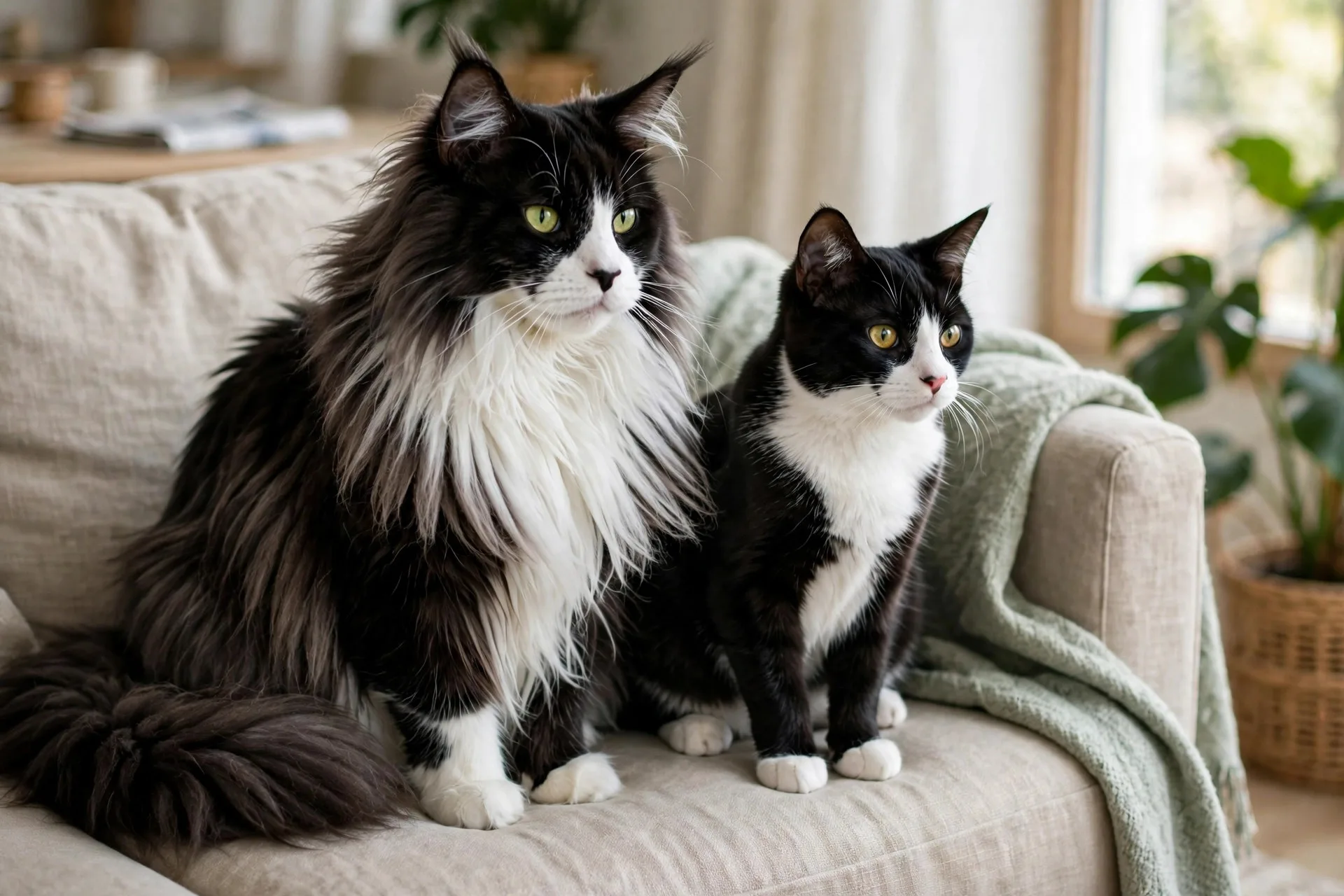
A tuxedo Maine Coon is a bicolor Maine Coon. Its size, voice, and sociable nature come from being a Maine Coon, not from the markings. A British Shorthair in a tuxedo coat still acts like a British Shorthair, which usually means calm and reserved.
An American Shorthair in the same coat tends to be steady and adaptable. A Turkish Angora in tuxedo markings tends to be active and athletic. The coat stays the same across those cats. The cats do not.
Most tuxedos you meet will not be pedigreed at all. They will be domestic shorthairs or domestic longhairs, which is the polite term for a mixed breed cat with no papers. Shelter tuxedos cost less than a pedigree, they are easy to find, and you can meet the actual cat before you decide.
If you want a predictable temperament, pick the breed first and treat the coat as a bonus. Our guide to the best cat breeds for first time owners compares breeds on the traits that actually shape daily life. Grooming follows hair length, not color.
What the tuxedo cat personality stories get right
Ask a room full of tuxedo owners to describe their cats and you will hear the same words again and again. Bold, chatty, smart, busy, and bonded. Owners call it tuxitude.
Those reports are worth taking seriously as lived experience. They are also not measured science, and this guide keeps the two apart.
The most common report is friendliness. Owners describe cats that greet visitors at the door and follow people from room to room. Sociability still tracks far more closely with early handling and the individual cat than with coat color.
Talkativeness comes next. Tuxedo owners often describe a cat that comments on the empty bowl and the closed door. Vocalness tracks more closely with breed and with learned habits than with a black and white coat.
Siamese and Oriental lines are famously chatty, and a cat that gets fed when it meows learns to meow. If you want a reliably talkative cat, a chatty breed is a surer bet than a pattern.
Cleverness is the most flattering claim. Owners report cats that open cabinets and solve puzzle feeders fast. There is no evidence that the white spotting gene affects cognition. Engaged cats that get a lot of interaction look smart, and tuxedo owners who adore their cats tend to interact with them a lot.
Playfulness and affection round out the usual list. Many tuxedo households describe high energy cats, with zoomies at dawn and a real appetite for fetch. Others describe lap cats that sleep on chests. Both can be true, in different cats, because energy follows age and breed and attachment follows early handling.
What the one real study found
Here is where this guide has to disagree with most of the internet. The tuxitude reputation sells a friendly, mellow, dog like cat. The only peer reviewed data on coat color and behavior points the other way.
In 2016, Elizabeth Stelow, Melissa Bain, and Philip Kass at the University of California, Davis published The Relationship Between Coat Color and Aggressive Behaviors in the Domestic Cat in the Journal of Applied Animal Welfare Science. They surveyed cat guardians, and 1,274 responses were analyzed after exclusions. Guardians rated their cats’ aggression toward humans during everyday interactions, handling, and veterinary visits.
Owners reported black and white cats, along with sex linked orange females such as tortoiseshells and calicos, and gray and white cats, as slightly more aggressive toward people in those settings than cats of other colors. There is no measured finding anywhere that black and white cats are friendlier, calmer, or more dog like.
Read the limits before you worry. This was an owner survey, not a study where researchers watched the cats. It relied on people’s perceptions, it did not control for breed, and the effect was small. The average aggression score was very low, so even small differences counted as significant.
As Vet Times notes, the owners selected themselves, the cats were never observed directly, and small variations could come from owner perception. It does not mean your tuxedo will be aggressive. It means the cheerful claim that tuxedos are extra friendly has no scientific support.
Owner perception is powerful and self reinforcing. A person who expects a feisty cat may read normal behavior as feisty. A person who expects a sweetheart may forgive the same behavior. The fair takeaway is that coat color is a poor predictor of personality.
Why breed and early weeks matter more than the coat
If the pattern does not set the personality, what does? Breed, individual temperament, and early socialization, in roughly that order.
Breed sets the baseline. Selective breeding gave us the talkative Siamese, the placid Ragdoll, and the gentle giant Maine Coon. When a tuxedo cat happens to be one of these breeds, its temperament follows the breed, not the markings.
A Ragdoll cat in tuxedo markings would still be a better bet for an owner who wants a calm lap cat than a random bred tuxedo with no known background. The breed does the predicting.
Individual temperament is the wild card. Cats are born with a range of boldness and sensitivity. Within a single litter you can find an explorer and a wallflower wearing the same coat.
Meet the kitten, watch how it reacts to a new person, and ask the shelter what it does all day. Those observations beat any color chart.
Socialization is the lever you can actually pull. International Cat Care puts the key socialization period for kittens between two and seven weeks of age. During that window, gentle handling by different people helps a kitten learn that humans are safe. Kittens handled by four or five different handlers before seven weeks tend to be more sociable as adults, while kittens handled by only one person tend to bond to that person and stay suspicious of strangers.
Living with a black and white cat
Care for a tuxedo cat is care for any cat, with the breed and the individual setting the details. That stops you from buying special products for a pattern that needs none.
Food and weight come first. Feed a complete diet suited to the cat’s age and activity, measure it rather than free feeding all day, and watch the waistline. If you are unsure what belongs in the bowl, our guide on what cats can eat covers safe foods and the ones to keep away.
Grooming follows hair length. Shorthaired tuxedos need a weekly brush to cut shedding and hairballs. Longhaired tuxedos need brushing several times a week, with extra attention behind the ears and under the legs where mats form first.
Play is not optional for a bright, busy cat. Ten to fifteen minutes of active play twice a day, with a wand toy or a puzzle feeder, burns off the energy that otherwise turns into knocked glasses and 3 a.m. zoomies, and a bored clever cat left without that outlet will invent its own entertainment in ways you will not enjoy.

Health and lifespan follow the breed, not the coat. Cats.com puts the average lifespan for tuxedo cats at 13 to 17 years, with many indoor cats living to 20 or more. Common concerns are obesity, dental disease, and urinary tract problems, which a balanced diet, fresh water, and regular vet checkups help to manage.
Is a tuxedo cat right for a first time owner
Yes, for most first time owners, with one condition. Judge the cat, not the coat. A tuxedo that greets you and settles on your lap is a fine first cat. A tuxedo that hides and swats is a harder first cat, whatever its markings promise online.
Shelter staff can help you sort that out. Tell them your home, your hours, and your experience, then meet two or three tuxedos and compare them. One may be a chatterbox and one may be a lap cat.
That spread is the whole point. The pattern tells you what the cat looks like. The cat tells you who it is.
FAQ
Are tuxedo cats a breed?
Tuxedo is a black and white bicolor coat pattern caused by the white spotting gene. It appears in many breeds and in mixed breed cats.
Are tuxedo cats friendly?
Many owners report friendly, social tuxedos, but no study links the pattern to friendliness. Breed, individual temperament, and early socialization shape friendliness far more than coat color.
Are tuxedo cats smart?
Owners often describe clever tuxedos that learn routines and solve puzzle feeders. No evidence ties intelligence to the white spotting gene. Engaged cats that get play and training look smart in any coat.
Do tuxedo cats live longer than other cats?
Lifespan follows breed, health, and whether the cat lives indoors. Cats.com gives an average of 13 to 17 years for tuxedo cats, with many indoor cats living to 20 or more.
Are male and female tuxedo cats different?
Unlike calico cats, which are almost always female, tuxedos are roughly half male and half female because white spotting is not sex linked. Sex alone does not predict a tuxedo’s personality.
Sources
- Petful: Tuxedo Cat Personality, Traits and Facts: Tuxedo Cat Personality
- Cats.com: Tuxedo Cats Personality, Lifespan and Facts: Tuxedo Cat
- Stelow, Bain and Kass (2016): The Relationship Between Coat Color and Aggressive Behaviors in the Domestic Cat, Journal of Applied Animal Welfare Science: 26467020
- Vet Times: The link between coat colour, disease and behaviour in cats: The Link Between Coat Colour Disease And Behaviour In Cats
- International Cat Care: Bringing up a litter of kittens, behavioural considerations: Kitten Socialisation