
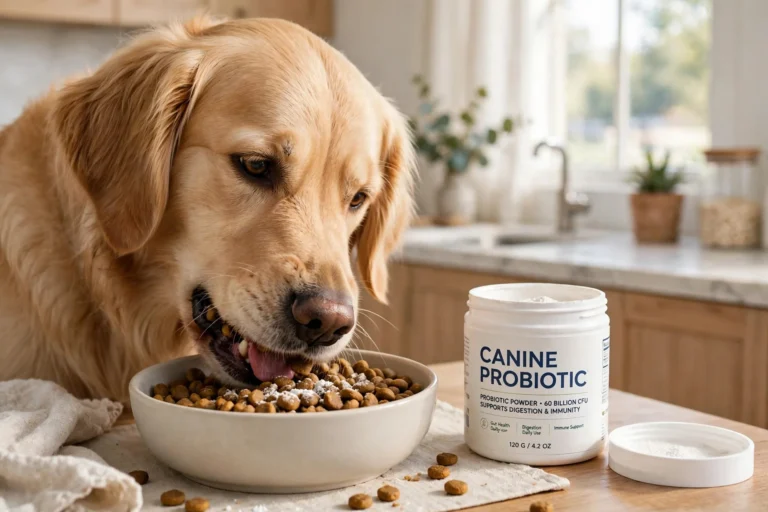
Walk down any pet store aisle and the supplement shelf looks like a pharmacy that lost its nerve. Powders promise calmer guts and chews promise shinier coats, with a smiling Labrador on the front of every bottle. Probiotics for dogs sit right in the middle of that shelf.
The short version is that probiotics for dogs can help in a few specific situations, the benefit is usually modest, and the product matters far more than the promise on the front. Fish oil for dogs is a different case, with stronger evidence behind it for stiff joints, and it still needs a vet to set the amount. Neither one replaces a vet visit when a dog is properly unwell.
What probiotics actually are
A probiotic is a live microorganism that, when given in an adequate amount, gives the host a health benefit. That definition comes from the World Health Organization and the Food and Agriculture Organization, and every word in it does work. The microbes must be alive when your dog eats them, the amount must be enough to matter, and the benefit must be real for that strain and that problem.
Your dog already carries huge populations of bacteria in the gut. Those bacteria help digest food, crowd out harmful organisms, and talk to the immune system. Antibiotics, a sudden food change, illness, and stress can knock that population around.
Cornell University College of Veterinary Medicine describes probiotics as a way to support and replenish those normal populations. It lists diarrhea and gastrointestinal upset as the best known use.
Prebiotics are different. They are fibers that feed beneficial gut bacteria, and some products combine both under the name synbiotic.
Strain matters more than the brand name on the tub. Two products can both list Lactobacillus and contain different strains with different evidence behind them. Cornell names a few strains with published work in dogs, including Enterococcus faecium strain SF68 and Bifidobacterium animalis strain AHC7 for acute diarrhea.
Most products come as powders, capsules, or chews, given by mouth with food.
What the evidence shows for probiotics for dogs
Probiotics have the best support for acute diarrhea, the sudden loose stool that follows a stressful event, a food change, or a course of antibiotics. Several trials found that specific strains shortened the illness by roughly a day or two compared with a placebo. That is a real effect, and it is also a small one. A dog that would have had four rough days might have two or three instead.
The evidence gets thinner from there. A 2019 systematic review by Jensen and Bjornvad looked at probiotics in dogs with gastrointestinal disease and found the effect very limited for acute gut disease. For chronic gut disease, the same review found no clear added benefit over diet, and diet remained the main treatment.
A veterinary summary of that review puts it plainly, saying the benefit is often modest and depends on the specific strain. That finding should change how you shop. If your dog has ongoing digestive trouble, a probiotic is a side note, not the plan. Our guide to dog food for sensitive stomachs explains why the food itself usually matters more than anything sprinkled on top of it.
Behavior is the most interesting new area, and also the easiest to overstate. Cornell describes research on Bifidobacterium longum, known as BL999, in which dogs that took the strain were less likely to bark, jump, spin, or pace in situations that normally caused them distress. That is one strain, in one line of research, funded by a pet food company. It does not mean a probiotic chew will calm a dog with separation anxiety. Behavior work and training do that job, with medication in some cases.
Side effects are usually mild. Veterinary guidance summarized by Dial A Vet lists wind and stomach discomfort as the common ones, and advises caution in pets that are very sick or have weak immune systems. Stop the supplement and call your vet if you see signs of an allergic reaction, such as breathing changes, a rash, or facial swelling.
Product quality varies a lot. The 2019 review cited a Canadian study in which only 4 of 15 products with a stated live count actually contained what the label claimed. Four out of fifteen is not a rounding error. It is the reason the label checks later in this article matter more than the flavor of the chew.
Fish oil for dogs is a different story
Fish oil for dogs earns its place here because owners often buy it alongside probiotics, and its evidence looks different. Fish oil supplies two long chain omega 3 fatty acids, EPA and DHA.
The strongest evidence for fish oil is arthritis. A 2012 systematic review in the Journal of Veterinary Internal Medicine found the strength of evidence low for all joint nutraceuticals except omega 3 fatty acids in dogs. A 2022 systematic review and meta analysis of 72 trials found clear pain relief from omega 3 enriched diets and omega 3 supplements in dogs and cats with osteoarthritis.
The evidence for itchy skin is weaker. One small trial found that dogs with atopic dermatitis improved on an EPA and DHA supplement, but international guidelines describe any benefit for allergic skin disease as likely small. Fish oil can help as an add on. It rarely carries the treatment on its own.
Fish oil also has real downsides. VCA Animal Hospitals lists mild stomach upset, a fishy odor, and an oily coat among the possible side effects, and advises caution with anticoagulants and NSAIDs. Fish oil is pure fat, so it adds calories, and it can go rancid if stored badly.
This article will not give you a number for fish oil. The right amount depends on your dog’s weight, diet, health, and medicines, and many foods already contain fish oil. Your vet should set the amount, and should know the EPA and DHA content of the product you bought. Bring the bottle to the appointment.
Probiotics for puppies need a narrower answer
Probiotics for puppies raise a different question, because a puppy with diarrhea can go downhill fast. A bright puppy with one or two soft stools after a food change is a different situation from a quiet puppy that is vomiting, refusing food, or passing blood. The second needs a vet promptly, and no supplement should delay that call.
A vet may suggest a puppy appropriate probiotic during a gradual food transition, after a course of antibiotics, or as part of care for a mild digestive upset. Our new puppy checklist covers what to buy before that first week home, when new food, new people, and a first vet visit can all loosen a puppy’s stool. Vetstreet’s veterinary guide to probiotics for puppies stresses checking hydration, energy, appetite, and vaccination status first, and notes that a probiotic cannot treat parvovirus, parasites, or a swallowed object.

Blood in the stool, repeated vomiting, lethargy, a painful or swollen belly, pale gums, or diarrhea in an unvaccinated puppy all mean call the vet now. Choose a product made for dogs, and ask your vet whether it suits a puppy of your dog’s age and size. Human probiotics are not formulated for pets, and some contain xylitol, which is toxic to dogs.
How to read a label without getting fooled
Pet supplements are not regulated like drugs. The FDA has no dietary supplement category for animal products, so most pet supplements reach the shelf without pre market approval for safety or efficacy. A peer reviewed review of veterinary supplements states that companion animal supplements do not fall under the Dietary Supplement Health and Education Act of 1994 and undergo less regulatory oversight than human dietary supplements.
Look for the NASC Quality Seal. The National Animal Supplement Council gives its seal to companies that pass a quality audit, follow labeling rules, and accept random testing against label claims. The seal shows the company passed a quality audit. It does not show the product works.
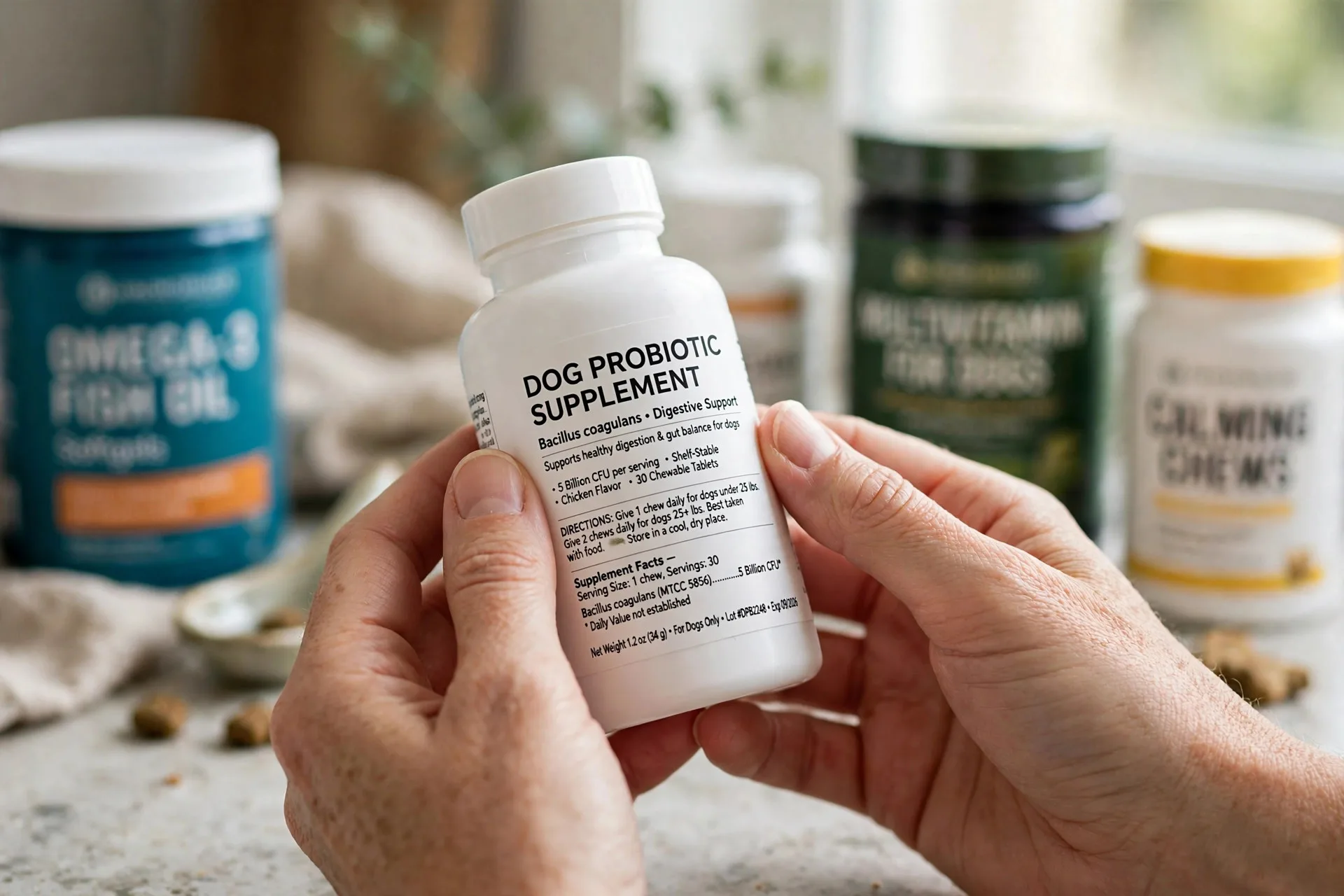
Read the small print with four checks in mind. The label should name the exact species and strain of each microorganism, not just the genus. It should state the number of live organisms, measured as colony forming units, with a guarantee that the count holds until the expiry date. It should carry an expiry date and a lot number. The company should be able to show evidence for the product, preferably a study by an independent researcher.
Skip products that promise disease cures, that hide behind a proprietary blend with no amounts, or that list no contact details for the manufacturer. The best probiotics for dogs are not the most expensive ones, and they are not the ones with the longest list of strains. Pick the one with a named strain, published evidence, a live count guaranteed to expiry, and your vet’s agreement.
Storage matters more than most owners expect. Live microbes die in heat and damp, and oil oxidizes, so keep both as the label directs and throw out anything past its expiry date.
When to call your vet instead
Supplements invite a particular kind of delay, the kind where an owner tries one more bottle while a real problem grows. Call your vet promptly if your dog has blood or black stool, vomiting with diarrhea, lethargy, a painful or swollen belly, pale gums, or diarrhea that keeps coming back. The same applies if your dog may have eaten something toxic or swallowed an object.
Probiotics may support recovery once your vet has assessed your dog, and fish oil may help a stiff older dog once arthritis is diagnosed and pain is managed. The order matters. Diagnosis first, supplement second.
Bring a short list to the appointment. What is the problem, and how long has it lasted? What food does your dog eat, including treats? What medicines and supplements does your dog already take?
What product are you considering, and why? If your vet says a supplement is not worth it for your dog, believe them. A vet who talks you out of a purchase is giving you better advice than a label that talks you into one.
FAQ
Can I give my dog probiotics every day?
Some vets suggest daily use for certain dogs, and Cornell notes that probiotics can be given daily as part of long term health care. Ask your vet first, because daily use makes sense only when there is a reason for it, such as recurring digestive upset.
Can probiotics replace my dog’s medicine?
No. Probiotics support the gut, and they do not replace prescription diets, antibiotics, or other veterinary treatment. For chronic gut disease, diet and veterinary treatment remain the mainstay.
How long do probiotics take to work?
Veterinary guidance says it may take several days to see full effects. If nothing has changed after a reasonable trial, and your vet agrees on the length of that trial, stop spending money on it and revisit the plan.
Is fish oil safe to give with other medicines?
Fish oil can interact with anticoagulants, NSAIDs, and some cancer drugs, and it needs caution in dogs with clotting disorders or diabetes. Tell your vet about every medicine and supplement before you add fish oil.
Sources
- Cornell University College of Veterinary Medicine, Riney Canine Health Center. The power of probiotics: Power Probiotics
- Dial A Vet Veterinary Team. Probiotics for Dogs and Cats: What They Are, What the Evidence Says and When to Use Them: What Are Probiotics
- Jensen AP, Bjornvad CR. Clinical effect of probiotics in prevention or treatment of gastrointestinal disease in dogs: A systematic review. Journal of Veterinary Internal Medicine. 2019.
- Vetstreet. Probiotics for Puppies: A Vet Guide: Probiotics For Puppies
- Senior Pup Life. Fish Oil for Senior Dogs: What the Evidence Says: Fish Oil For Senior Dogs
- Vandeweerd JM et al. Systematic review of efficacy of nutraceuticals to alleviate osteoarthritis in horses, dogs and cats. Journal of Veterinary Internal Medicine. 2012.
- Barbeau-Gregoire M et al. Systematic review and meta analysis of omega 3 fatty acids for osteoarthritis in dogs and cats. International Journal of Molecular Sciences. 2022.
- Burke K et al. Veterinary Pet Supplements and Nutraceuticals: Pmc7802882. Nutrition Today. 2020.
- Madison Locally Sourced, Dr Lori Scarlett DVM. How to Choose a Supplement: How To Choose A Supplement