
The best automatic cat feeder for a first-time owner is the one that matches the food your cat already eats, the number of cats in the house, and the number of meals your cat needs each day. Get those three answers right and the rest of the buying decision gets simple.
Most buyers skip them. They pick the feeder with the nicest app, then find out it cannot hold wet food or that their two cats treat it as a shared buffet.
Start with the food, not the feeder
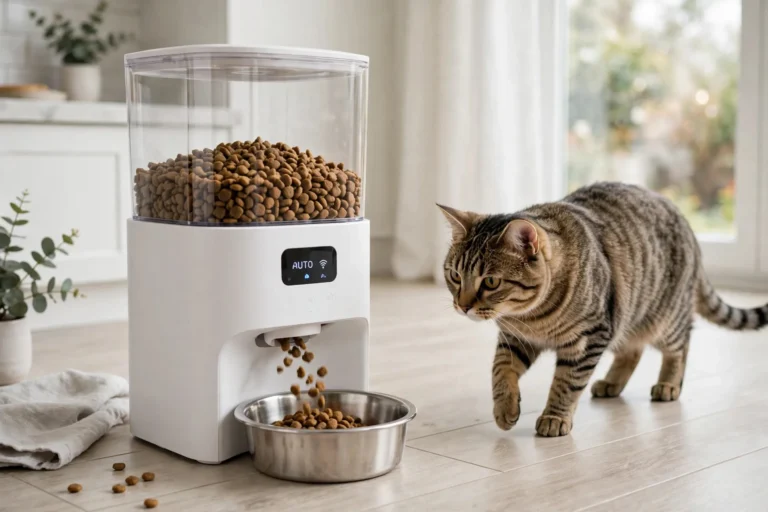
Every automatic feeder on the market is one of two machines. A hopper feeder stores dry kibble in a sealed container and drops measured portions into a bowl on a schedule. A tray feeder holds a few pre-filled compartments under a lid and rotates one open at each mealtime. The food your cat eats picks the machine.
Hopper feeders suit dry food only. They hold a lot, they run for days without a refill, and most of them connect to an app. The PetSafe Smart Feed schedules up to 12 meals a day, and the PETLIBRO Granary holds 5 liters and schedules up to 10. Neither machine touches wet food.
Tray feeders take any food you put in them, wet or dry, because you fill each compartment by hand. The trade is capacity. The Cat Mate C500 has five compartments, and its timer programs four meals, so it covers a day or a short trip. A tray feeder schedules meals, and its capacity ends there.
If the answer is kibble, a hopper feeder is the right shape. If the answer is wet food, skip the hopper aisle entirely and read the wet food section below. If you feed a mix, you need a plan for both, because no single machine covers a half wet, half dry diet on its own.
How big is a meal, really?
Portion control is the feature that justifies the price, and it is also the feature buyers test least. A feeder that dispenses the wrong amount on schedule is worse than a bowl, because it does it with confidence while you are at work.
Start with your vet’s daily amount, then split it across the meals your cat needs. The Cornell Feline Health Center says kittens under six months usually do best with three meals a day, cats between six months and a year do best with two, and most adult cats do well with one or two meals a day.
A feeder that only offers two meals a day cannot serve a young kitten, and one that tops out at four cannot split an adult’s ration into small frequent portions. Check the meal count before the hopper size. If you are still working out portions for a young cat, our guide on how much to feed a kitten walks through portions by age.
Then check how the machine measures. Hopper feeders measure by volume, and volume shifts with kibble shape. A rotor that drops a neat portion of small round kibble can drop a different amount of large flat pieces, and oddly shaped pieces can bridge inside the mechanism and jam it.
The PETLIBRO Granary lists kibble from 2mm to 15mm. The Feeder-Robot takes kibble 5/8 inch or smaller.
Tray feeders dodge this problem completely. You weigh each compartment yourself, so the portion is exactly what your kitchen scale says. That makes them the honest choice for a cat on a vet-set calorie plan, where a portion that drifts by a tablespoon a day adds up over a month.
The best automatic cat feeder for two cats is not one feeder
This is the part most roundups rush past, and it decides whether a feeder works in a real home. A scheduled feeder does not know which cat is eating. It opens on time, drops food, and any cat in the room can eat it. In a house with one confident eater and one shy one, the confident cat gets two dinners and the shy cat gets an empty bowl.
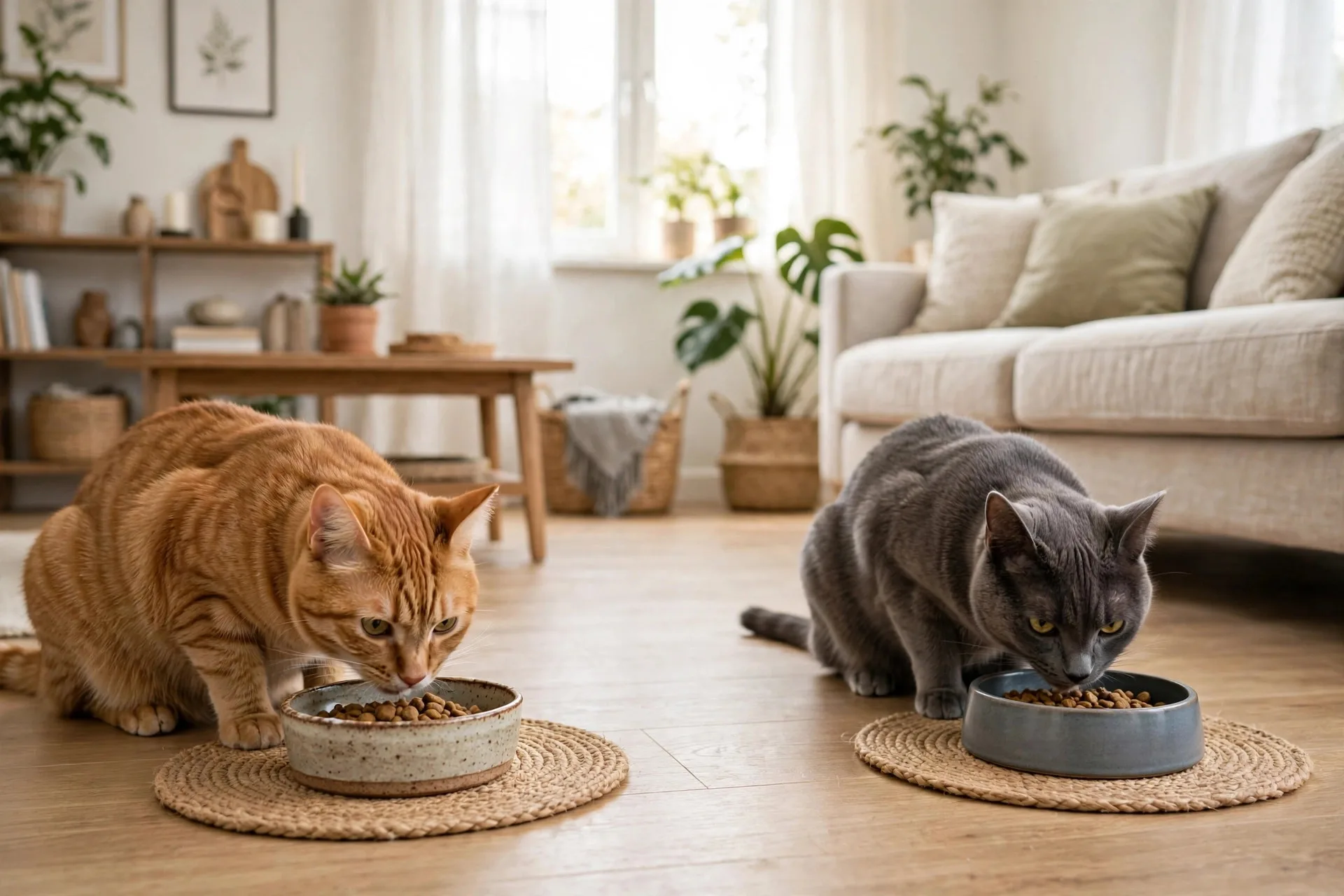
Cornell makes the same point about ordinary feeding. In a multi-cat household, not all cats come when called for dinner, and some cats eat too much when food is always available. Feeding cats separately, or in different parts of the house, can help. An automatic feeder does not change that.
The first honest option is two feeders in separate rooms, one per cat. It costs more, but it is the only scheduled setup that gives each cat its own meals without a fight.
The second option is a microchip feeder, and it is a different kind of machine. The SureFeed Microchip Pet Feeder reads your cat’s microchip and opens only for that cat. It suits weight management and prescription food in multi-pet homes, because the wrong cat physically cannot get in.
But its job is guarding food. Timed meals need a second machine, so it solves the thief problem and leaves scheduling untouched. A household with a food thief and a 5 a.m. wake-up call may need both a microchip feeder and a scheduled one, and that is a fair thing to admit before you spend the money.
Feed your cats in separate spots for a week with ordinary bowls and watch who finishes first, who walks away, and who circles back for seconds. That week tells you more about the right feeder than any spec sheet.
The best automatic cat feeder for wet food is a different machine
Wet food breaks every assumption a hopper feeder is built on. It cannot flow through a rotor, it dries out in an open bowl, and it turns risky if it sits warm for hours. So the best automatic cat feeder for wet food is a tray feeder, built around compartments you fill yourself.
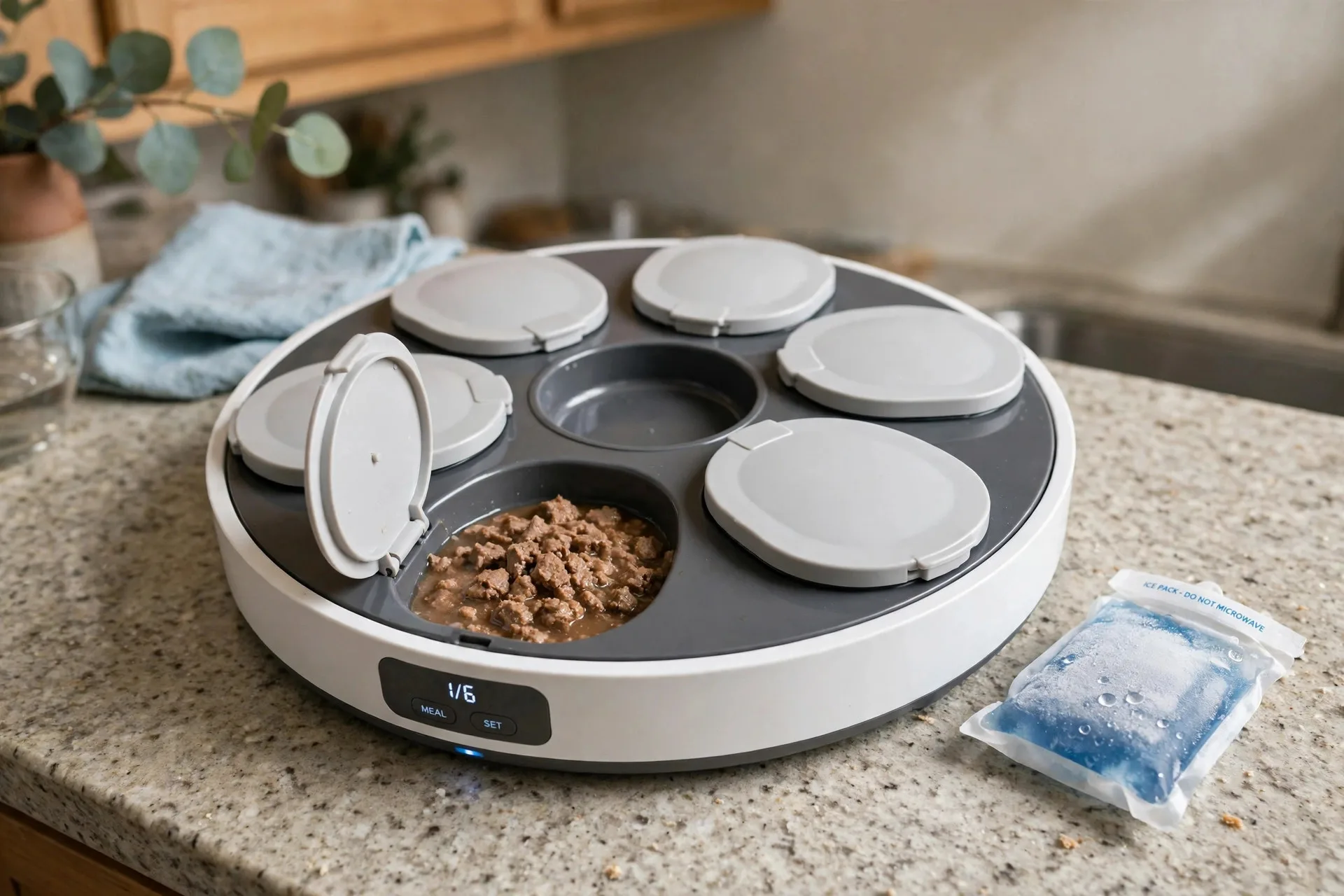
The Cat Mate C500 is the usual starting point, and its limits explain the whole category. Five compartments hold 330g of wet food each, twin ice packs come in the box, and the timer programs four meals. That covers a workday or an overnight trip, with no Wi-Fi, apps, or power outlet, running about twelve months on three AA batteries.
The ice packs are the weak point. Once they thaw, later compartments warm up, so the last meal of the day is the one to watch. Newer wet food feeders add active cooling instead of ice. The Petlibro Polar has built-in cooling and schedules up to three meals.
A few rules apply to every wet food feeder. Fill compartments with food straight from the fridge, not food that has sat on the counter. Keep the feeder out of direct sun and away from radiators. Clean the compartments after every use, because dried wet food in a seam is the fastest route to a smell your cat will notice before you do.
Cornell notes that wet food is typically about 70 to 80 percent water, which is why it spoils faster than kibble once it is exposed to air. If you are home for one of your cat’s two daily wet meals, you may not need a wet food feeder at all. A machine that covers one missed meal well beats a machine that covers three badly.
What happens when the power goes out
A feeder that only works while the power is on is a gamble. A plug-only feeder skips meals during a power cut, and a Wi-Fi feeder that keeps its schedule in the cloud can miss meals when the internet drops, even if the power stays on. This failure matters most because it strikes exactly when you are away and cannot fix it.
Look for dual power first. The PetSafe Smart Feed takes four D-cell batteries as backup. The PETLIBRO Granary takes three D batteries, sold separately. A feeder that runs on batteries alone, like the Cat Mate C500, sidesteps the question entirely.
Then check where the schedule lives. The Feeder-Robot keeps its programmed schedule on the unit and keeps feeding even when it goes offline. That detail is worth more than a camera or a voice recording feature, because a feeder that forgets its schedule during an outage has failed at its one job.
Jams, kibble size, and the test run that saves you
Every hopper feeder can jam. The question is how often, how it tells you, and whether it clears itself. Anti-jam design is a real feature, and it is worth paying for if you travel.
The Feeder-Robot lists anti-jam technology with food backup detection, which means it notices when food is not moving and tries to fix it. Cheaper hoppers rely on a rotor that turns until it does not, and the first sign of trouble is a cat staring at an empty bowl.
Kibble size is the jam you can prevent. Measure the longest piece in the bag and compare it with the feeder’s limit before you buy. The Granary takes kibble from 2mm to 15mm, the Feeder-Robot takes pieces 5/8 inch or smaller, and anything outside those ranges is a jam waiting for a weekend trip.
Run the feeder for a full week while you are home before any trip. Watch at least three meals from start to finish. Check that the portion in the bowl matches the portion you set, that the bowl is empty before the next meal drops, and that your cat actually eats from it. A cat that will not eat from a feeder is a problem you want to find on a Tuesday, not discover on a Sunday night from another city.
A short checklist before you buy
Answer these in order and the right feeder mostly picks itself. What food does your cat eat, wet or dry. How many cats, and does one steal from the other. How many meals a day, and how small does the smallest one need to be.
What happens during a power cut, and where does the schedule live. How will you clean it, and which parts come apart.
Skip the camera unless you actually need to watch meals from your phone. Skip voice recording unless your cat responds to it, because most cats ignore a speaker and eat anyway. Spend the money on backup power, honest portion sizes, and a design that fits your cat’s food.
Buy from a seller with a return window that covers a full week of testing, and keep the box until the test week is done. A feeder that passes a week at home is a feeder you can trust on a trip.
Frequently asked questions
Can an automatic feeder handle wet food?
Some can. Tray feeders like the Cat Mate C500 hold wet food in covered compartments with ice packs, and cooled models like the Petlibro Polar keep it chilled. Hopper feeders cannot handle wet food at all, so check the food type before anything else.
How many meals a day should a feeder serve?
Match the feeder to your cat’s age and needs. Cornell says kittens under six months usually do best with three meals a day, cats from six months to a year do best with two, and most adults do well with one or two meals a day.
Do I need Wi-Fi for an automatic cat feeder?
Wi-Fi is optional. Button-programmed feeders and tray feeders like the Cat Mate C500 work without Wi-Fi or an app. Wi-Fi adds remote scheduling and alerts, but it also adds a failure point, so a feeder that keeps its schedule on the unit is safer for trips.
Can one feeder work for two cats?
One scheduled feeder cannot tell cats apart, so the bolder cat may eat both portions. Two feeders in separate rooms work, or a microchip feeder like the SureFeed can guard one cat’s food. For a deeper look at what each cat should actually be eating, see our guide to foods that are safe for cats.
Sources
- Cornell Feline Health Center: How often should you feed your cat?: How Often Should You Feed Your Cat
- MyPetExperts: The Best Automatic Cat Feeders: Best Automatic Cat Feeders
- PawSifted: Best Automatic Cat Feeders (2026): Best Automatic Cat Feeders
- MeowTested: Best Automatic Cat Feeders (2026): Best Automatic Cat Feeders